ANTALYA – Prime Minister Shehbaz Sharif reached the COP31 leaders’ summit in Turkiye on Wednesday, where he plans to present Pakistan’s climate priorities alongside other heads of state and government.
Representatives of nearly 200 countries have gathered in the Mediterranean resort city while global emissions show few signs of declining and wars, inflation and other crises pull political attention elsewhere.
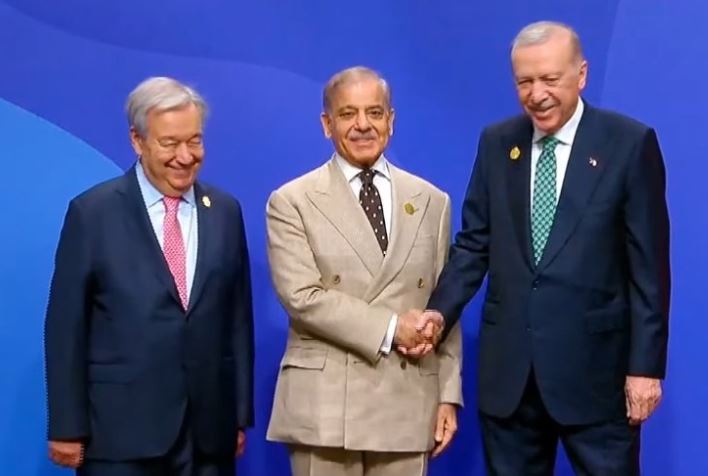
According to Pakistan TV, Turkish President Recep Tayyip Erdogan and UN Secretary-General Antonio Guterres welcomed the prime minister at the venue, and he later joined other leaders for the summit’s group photograph.
Pakistan’s message
The Prime Minister’s Office said Shehbaz would stress the need for stronger global climate action and closer international cooperation to limit the damage from climate change. The Foreign Office added that he would point to Pakistan’s rapid move toward solar power, its growing renewable capacity, and its work on disaster preparedness and early-warning systems. He will also call for climate finance that is predictable, adequate and accessible to developing countries.
The premier is due to speak at a high-level dialogue on clean energy and electrification, titled “35 by 35: Powering the Future,” at 3pm local time (5pm in Pakistan). He is also expected to meet Erdogan and other leaders on the sidelines. A Pakistan Pavilion at the venue will host 54 events on a range of themes.
Guterres sounds the alarm
Opening the third day, Guterres told leaders that the slow pace of action had put the world on a dangerous trajectory. He said the climate crisis was outpacing efforts to address it, but that science urged a stronger fight rather than surrender. He also argued that reliance on fossil fuels hurts economies, noting that three-quarters of humanity lives in countries that import them and are exposed to price shocks. He linked this to the oil price surge since the US-Israeli war on Iran disrupted Middle East exports.
Brazil’s President Luiz Inacio Lula da Silva, European Commission President Ursula von der Leyen, Chinese Vice President Han Zheng and Marshall Islands President Hilda Heine are among Wednesday’s expected speakers.
#BREAKING
Prime Minister Shehbaz Sharif arrives in Turkiye to attend the COP31 Leaders’ Summit, where he is received by President Recep Tayyip Erdogan and UN Secretary-General Antonio Guterres. World leaders, including PM Sharif, gather for a group photograph at the summit.
@PakPMO
@CMShehbaz
@RTErdogan
@antonioguterres#PMShehbazSharif #COP31 #Turkiye #ClimateSummit #PakistanTV
— Pakistan TV (@PakTVGlobal) November 11, 2026
Absences and a troubled year
The United States, the largest historical emitter, is missing the talks for a second year after President Donald Trump withdrew from climate cooperation. France, Germany, Japan, Italy and Canada also did not send their top leaders. Mohamed Adow of Power Shift Africa said the biggest economies should lead rather than leave the task to others.
A UN report last month concluded that the world is on track to exceed the 1.5C warming limit set under the Paris Agreement. This year has also brought severe heatwaves in Western Europe and a glacier collapse in Nepal that caused a flood killing more than 1,450 people, with thousands still missing.
Electrification push and finance disputes
Host Turkiye wants a final deal built around raising electricity’s share of global energy use to 35 per cent by 2035, from a little over a fifth today. Critics say the plan could do little to slow warming because it does not require the new power to come from clean sources, and no broader roadmap for moving away from coal, oil and gas has been agreed.
The conference also began on a tense note. Negotiators worked late on Sunday over developing countries’ demands to put climate finance on the agenda. Greenpeace’s Jasper Inventor said wealthy nations were taking a hard line on a finance platform agreed at COP30 in Brazil, while African countries are pushing for talks on tripling adaptation finance. Observers expect few major breakthroughs given the oil price shock and tensions over the wars involving Iran and Ukraine.