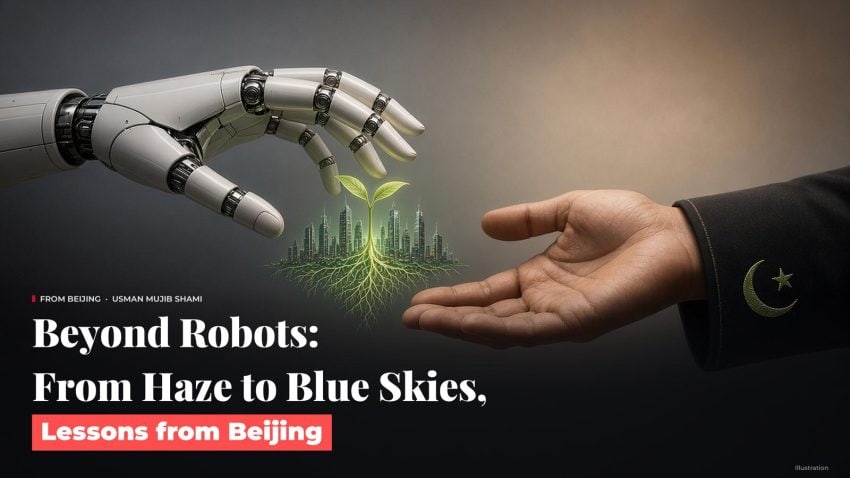
During my recent visit to Beijing for the seventh World Media Summit, I found myself thinking about two very different kinds of progress. One was spectacular: robots, artificial intelligence and technologies that seemed to pull tomorrow into the present. The other was quieter, but perhaps more important for ordinary people: the improvement in the air they breathe.
This was not my first time in China, which is why the change struck me so forcefully. About thirteen years ago, in 2013, I was a master’s student in Shanghai, living through the years when haze was simply part of winter. Now I was back, and I could measure the country against my own memories rather than against headlines.
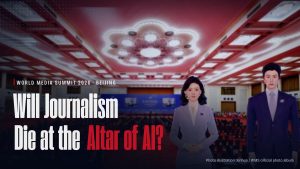
At Xinhuanet, we saw demonstrations of technology entering news gathering, production and presentation. Humanoid news presenters made the change particularly visible. During the world media summit, Xinhua and UBTECH had unveiled two such presenters, Xinyan and Xinyu. As a journalist, I could hardly watch these demonstrations without wondering how quickly our own working lives might change.
The technology displays extended well beyond journalism. There were self-driving autonomous electric vehicles/ taxis, manifold more efficient solar panels, medical innovations including a new miraculous liver treatment drug and a brain implant device. The robotic hands especially caught everyone’s attention. LinkerBot’s demonstrations involved music and remarkably delicate movements, including threading a needle.
An exhibition is not the same as everyday deployment, and a rehearsed demonstration cannot prove that a machine can perform every human task. Despite that, what I saw challenged the familiar notion that China merely copies other countries’ inventions and manufactures them cheaply. Vast investments are being made here in developing innovative technologies rather than simply reproducing products. This thesis is also supported by the fact that China entered the top ten of the World Intellectual Property Organization’s Global Innovation Index in 2025.
Yet the change that kept bringing my thoughts back to Pakistan was environmental. I remember what the air was like in 2013. That December, Shanghai itself was smothered by some of the worst smog in its recorded history, with schools and flights disrupted. Beijing’s condition was no different. This time, the skies told a different story. Locals told me that the smog had been largely fixed by around 2017–18. They spoke of leadership’s determination to get Chinese cities out of the list of world’s most polluted cities.
Their recollection captures a turning point, but the figures require a qualification: the problem was not eliminated in those years. Beijing’s annual average PM2.5 fell from 89.5 micrograms per cubic metre in 2013 to 58 in 2017, and then to 27 in 2025. That is almost a 70 per cent reduction since 2013, although still above the World Health Organization’s annual guideline of five.
What interests me is how this happened. China’s 2013 clean-air action plan combined measurable targets with cleaner household and industrial fuels, tighter vehicle controls, industrial restructuring and regional coordination. Officials’ performance was tied to results. Thousands of officials were punished for tampering the environment data, and for failing to implement policy measures. A peer-reviewed study estimated that emission controls accounted for roughly 80 per cent of Beijing’s improvement between 2013 and 2017, rather than favourable weather alone.
It reminded me of Henry Kissinger’s book ‘On China’. In an early chapter, he describes ‘Weiqi’, the board game known elsewhere as ‘Go’, which is still played on Chinese street corners. Unlike chess, it is won not through a single decisive blow but by patiently building position across the whole board. “If chess is about the decisive battle,” Kissinger writes, “wei qi is about the protracted campaign.” Rarely, he observes, did Chinese statesmen stake everything on a single all-or-nothing clash; their ideal was “the patient accumulation of relative advantage.” That is strategic thinking measured in decades, not news cycles. China’s clean-air effort looked to me like that same game: no single dramatic move, but steady pressure on coal, industry, transport and regional planning, sustained over a decade and extended into long-horizon climate targets. Local Chinese spoke of it the same way, as something won stone by stone.
While experiencing the Chinese success in this regard, my thoughts kept drifting to Lahore and the surrounding areas of Punjab, where winter smog has become an intolerable burden. Punjab has taken measures, and it would be unfair to pretend otherwise. But outcomes must be separated from publicity. Local media reported that an independent analysis found Lahore’s October PM2.5 had fallen 27 per cent year on year; after adjusting for weather, the estimated improvement was only about four per cent. Even that modest gain cannot be credited entirely to government action; it reflects every other factor in play as well, from economic activity to fuel use and crop-burning patterns.
My concern is that too much of our response still revolves around marketing, seasonal stopgaps and highly visible interventions. Anti-smog water guns are an obvious example. They may suppress dust locally, but there is little evidence that they can solve a citywide fine-particle pollution crisis. Spraying water for the cameras cannot substitute for preventing emissions from vehicles, factories, kilns and burning waste or crop residue.
Pakistan needs sustained political will: enforceable multi-year targets, reliable public data, cleaner transport and fuels, practical alternatives to agricultural burning, and officials held accountable beyond one winter. Cross-border pollution also demands cooperation, not an excuse for inaction at home.
I came away impressed by China’s machines. But the lesson I most want Pakistan to absorb is simpler: development should make daily life better. If cleaner air is possible after years of severe pollution in China, our question should not be whether change is possible. It should be whether we have the resolve to pursue it beyond the next publicity campaign.