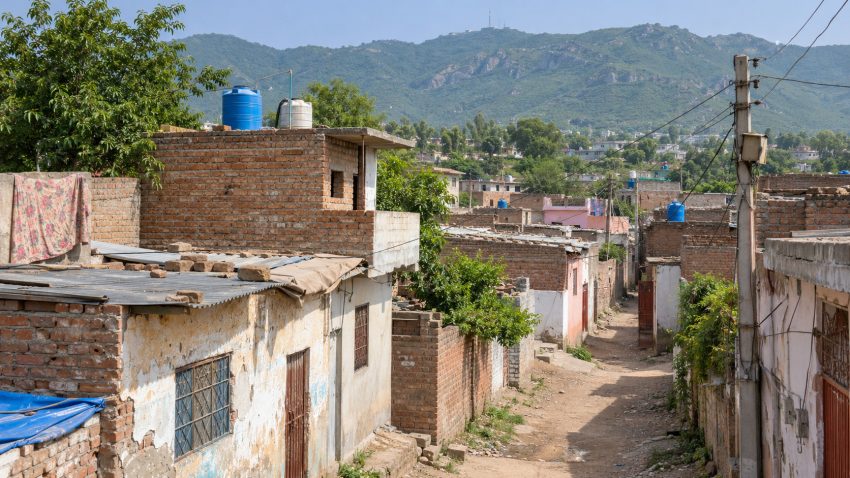
When Islamabad was planned in the early 1960s, the blueprint had no place for the people who built it. Labourers and domestic workers were housed in camps on the city’s edges, and many of those camps became today’s Katchi Abadis. The Capital Development Authority (CDA) operates under its 1960 Ordinance, which provides the legal framework for planning and development in Islamabad and has been cited as the basis for later regularisation efforts. The Additional Attorney General informed the Federal Constitutional Court that settlements established up to 1995 were recognised on humanitarian grounds. Yet regularisation has never kept pace with need: the CDA itself states that only ten settlements are formally recognised.
According to the Human Rights Commission of Pakistan (HRCP), about 55 katchi Abadis in Islamabad are now at risk, only 11 have been approved for regularisation, and even those cover only houses built before 2001. HRCP says thousands of families in the capital are affected, many of them sanitation workers, gardeners and other low-income labourers. Since March, the CDA, backed by police, has cleared homes in Islamabad’s Bari Imam, G-7 and other areas. An alliance of rights groups that includes HRCP told Dawn in June that some 50,000 working-class people in the city have been made homeless, an estimate I could not match against official data. The CDA says it is reclaiming state land. In September, its chief officer said the authority would not demolish Islamabad’s katchi abadis on its own while the matter is before the courts.
The exact scale is unclear because no comprehensive survey of informal settlements has been done in Islamabad since 2002, rights groups said at an April press conference in the capital. Over the same period, the city’s population has grown from about 800,000 to almost 2.4 million. The same groups cite the National Housing Policy 2025 as documenting more than 60 katchi abadis with up to 500,000 residents, which should be treated as a rough estimate. HRCP and allied groups also point to a 2015 Supreme Court stay order against summary evictions and to the 2001 National Housing Policy, which requires resettlement.
Residents of every faith are affected, and all deserve notice, compensation and an alternative home. But Pakistan’s Christians face this crisis with fewer defences. They are 1.37 per cent of the population in the 2023 census, a figure church leaders say is an undercount, and they have little political weight.
Another gap is representation. Christians hold reserved seats in parliament, but these are filled through party lists, so the members who sit there are chosen by party leadership and not by the communities they are meant to speak for. Many of them work hard within these limits, but a legislator who owes a seat to a party, not to the voters of a community, will always find it hard to put that community’s urgent concerns first. For families facing the loss of their homes, this means no one in the legislature is directly answerable to them.
The people who clean our streets and care for our gardens have no elected representative whose political survival depends on their votes. A system that gives a community a seat but not a voice serves neither the community nor the state. Giving Christians, and other minorities, a real say in choosing who speaks for them would make that voice stronger. It would also bring the concerns of the most vulnerable into debates about housing and development before the bulldozers arrive.
Without a voice in the legislature, the community’s economic weakness has gone largely unchallenged. Christians are concentrated in the lowest-paid work: the National Commission for Human Rights estimated in 2024 that about 80 per cent of sanitation workers are Christian, and the Islamabad High Court barred “Christians only” wording in sanitation job advertisements as recently as December 2025. That is how the community’s low income and its lack of political weight reinforce each other, and the effects are visible in where people live.
Rimsha Colony and neighbouring Akram Gill Colony in H-9 are home to roughly 25,000 people, mostly Christian, according to an estimate reported by Christian Daily. HRCP says the authorities themselves relocated these families after they fled their homes in 2012. People who clean the capital live near their work, have no savings or land to fall back on, and no elected representative accountable to them to raise their case. If their homes are cleared, they risk being pushed to the city’s edge with no security.
Rawalpindi shows both what is possible and what is missing. An official count in 2014 listed four katchi abadis there, and three received proprietary rights in 2007, according to Dawn. That year Punjab also decided to extend such rights to Christians living on provincial land. The fourth settlement, on railway land, was left without a decision, and Dawn found about 100 people living in caves after Pakistan Railways demolished their settlement in 2001. Regularisation works where it is tried and stalls where land belongs to a federal agency. Recent data for the city is scarce.
No one disputes that laws and regulations must be followed, and no city can function if every rule is set aside. But enforcing the law and caring for people are not opposing choices. A family that has lived for decades in a settlement the state itself tolerated, and in some cases even settled, deserves notice, a fair hearing and somewhere safe to go before it is asked to leave. Behind every demolished home is a child whose school year is broken, a worker who loses the walk to work, and an elderly person with nowhere to turn.
This is why political leaders, religious leaders, human rights bodies and social sector organisations must work in partnership with the government, and not stand against it, to be the voice of those who cannot be heard.
The Federal Constitutional Court has directed the CDA to finalise regulations for informal settlements. These should rest on a transparent settlement-by-settlement survey, notice before any removal, compensation, and resettlement near existing livelihoods and schools, as HRCP has urged. Affordable land and housing loans would finally give poor families secure tenure. Business training, start-up grants, education support and market-linked skills would build the incomes that make that housing affordable.
If we act together now, we can prevent a crisis that would cost the city far more than it saves. Development is judged by how a city treats those least able to protect themselves, and Islamabad still has time to get this right.