
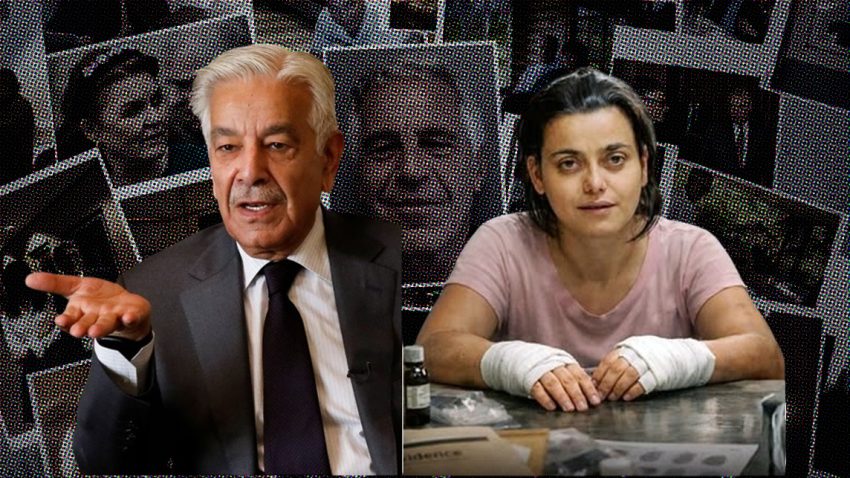
KARACHI – Pakistan’s Defence Minister Khawaja Asif made sensational comparison involving alleged drug dealer Anmol “Pinky,” referring to him as the “Pakistani version of Epstein Files.”
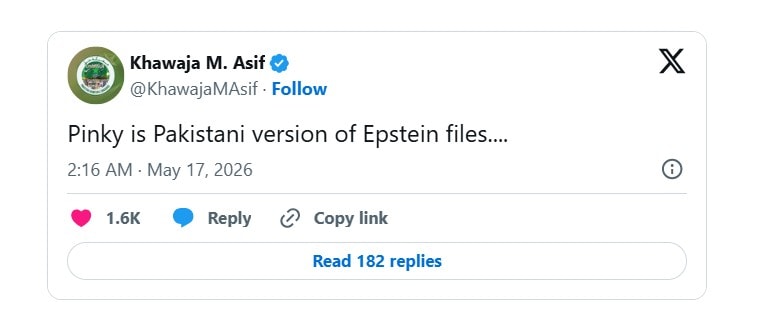
In a post shared on X, Khawaja said, “Pinky is the Pakistani version of the Epstein Files”, and his statement triggered widespread debate, drawing parallels with the infamous Epstein Files released by the US Department of Justice, which detailed Jeffrey Epstein’s crimes involving underage girls, drug use, and alleged links with influential figures across the world.
His remarks appear to be based on allegations surrounding Anmol “Pinky,” who is reportedly linked to a drug network with connections reaching influential circles. According to circulating claims, the network is not limited to street-level activity but allegedly extends into elite and political segments of society.
Sources further claim that around 30 politicians are among the alleged clients linked to the network, a revelation that has intensified political tension and speculation.
A highly confidential report related to the so-called “Pinky cocaine network” has already been submitted to the Chief Minister of Sindh. This report allegedly contains detailed information about the operation of the network, including its structure and distribution methods. According to these sources, the document outlines how the network functioned and describes the supply of expensive narcotics to various VIP circles in the city.
Who is Anmol Pinky?
Pakistani law enforcement agencies detained Anmol, widely known by the alias “Pinky” and also referred to in some reports as Anmol Bakhsh. Authorities allege she was the central figure behind a sprawling narcotics network dealing in cocaine and multiple synthetic drugs, earning her dramatic labels in media coverage such as the “Cocaine Queen” and alleged head of the so-called “Dabba Cartel.”
According to official accounts and media reports, Anmol was born around 1995 in Karachi’s Baloch Para area. She reportedly came from a modest household, with her father working as a taxi driver and her mother hailing from Punjab. Sources suggest she left home during her teenage years, ended her education after middle school, and later moved to Lahore with aspirations of entering the modeling and entertainment world. Over time, she is said to have drifted into elite social circles and high-profile nightlife scenes. Her family, according to reports, had already publicly disowned her years earlier.
Investigators allege that what followed was the rise of a highly sophisticated and deeply entrenched drug distribution network. The operation is said to have supplied cocaine and a range of synthetic narcotics including crystal meth, ecstasy, ketamine, and other party drugs, primarily targeting affluent buyers in upscale areas of Karachi such as DHA and Clifton, as well as clients in Lahore, Islamabad, and beyond.
Officials claim the network operated with surprising modern efficiency. Orders were allegedly placed through WhatsApp and social media platforms, while deliveries were carried out by couriers, including women riders, to avoid suspicion. Fake SIM cards, benami bank accounts, and coded communication methods were reportedly used to conceal transactions. Some reports even allege that branded packaging was used for narcotics, with labels such as “Queen Madam Pinky Don” and slogans like “Nam Hi Kafi Hai, Enjoy” circulating in seized materials.
Anmol was not just a distributor but also played a direct role in preparing and refining drug variants, including locally branded cocaine products allegedly sold under names like “White Coke” and “Golden Coke.” Prices reportedly reached tens of thousands of rupees per gram, with investigators claiming the operation generated monthly revenues exceeding Rs 20 million in Karachi alone.
During raids, authorities claim they recovered cocaine hydrochloride, chemical precursors such as acetone and ephedrine, laboratory-style equipment, and even a firearm. The network is believed to have extended across multiple cities and allegedly had connections reaching into elite social spaces and educational institutions.
Anmol had reportedly been under the radar of law enforcement since at least 2019, facing multiple narcotics-related cases and at times being declared a proclaimed offender. Authorities also allege that she operated with the help of associates, including family members, and may have benefited from protection networks involving bribery or corrupt officials.
Her arrest came on May 12, 2026, during a coordinated operation in Karachi’s Garden area, where officials claim they uncovered a drug-processing setup inside an apartment. The case exploded into public attention after videos surfaced online showing her being presented in court without handcuffs, sparking outrage and prompting internal inquiries into police conduct.
During interrogation and court proceedings, conflicting narratives have emerged. Law enforcement claims she has made confessional statements detailing the network’s operations and financial structure. However, she has also reportedly alleged illegal detention, torture, and forced statements, claiming she was held in secret custody for an extended period before her arrest was officially disclosed.
The fallout triggered political and institutional scrutiny, with authorities in Punjab and Sindh ordering reports and investigations into possible procedural lapses and alleged corruption links. Additional cases across Lahore and other cities are now being reopened or pursued in connection with the alleged network.
The scandal also ignited nationwide debate in Pakistan over elite drug consumption, organized narcotics syndicates, and suspected insider protection within law enforcement circles. Despite the explosive allegations and dramatic claims surrounding the case, Anmol remains legally presumed innocent until proven guilty as investigations and court proceedings continue.
Anmol Pinky accuses Police of Assault, Planting Drugs, and Threatening Her Family