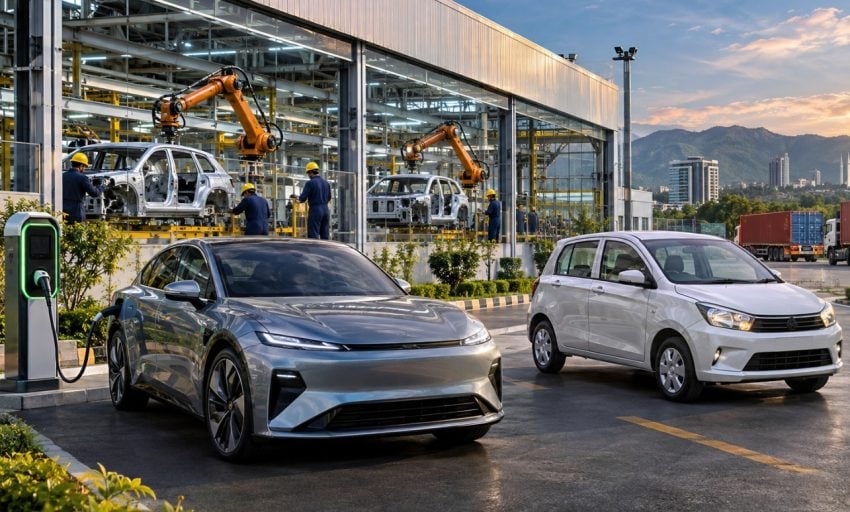
ISLAMABAD – Pakistan’s automobile industry is heading towards another transformation as the federal government approved Auto Policy 2026–2031, bringing new direction for Car pricing, EV mobility, local manufacturing and automobile exports.
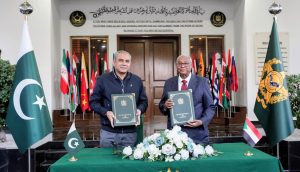
Information Minister Attaullah Tarar and Adviser to the Prime Minister on Industries and Production Haroon Akhtar Khan unveiled policy today with assurances to make vehicles more accessible to ordinary Pakistanis while encouraging investment, modern technology and greater competition in the automotive market.
One of key emerging from announcement is a new tax framework offering substantial concessions for electric and hybrid vehicles. According to details shared from the ministerial briefing, General Sales Tax (GST) on Battery Electric Vehicles (BEVs) has been set at 1%, while Range-Extended Electric Vehicles (REEVs) and Plug-in Hybrid Electric Vehicles (PHEVs) are assigned rates of 6% and 9%, respectively.
Fully electric vehicles are also expected to benefit from additional concessions, including 0% Federal Excise Duty (FED), 0% Advance Tax and 0% Capital Value Tax (CVT).
With automobile prices remaining beyond the reach of many households, the government has made affordability a central objective of its five-year strategy.
Haroon Akhtar said the new policy revolves around six major priorities: affordable vehicles, automobile exports, localization, improved safety, electric mobility and industry transparency. The initiative particularly targets middle- and lower-middle-income consumers who have struggled with rising car prices.
30% EV Sales by 2030
The announcement also strengthens Pakistan’s broader ambition to accelerate the adoption of environmentally friendly transportation. Under the existing National Electric Vehicle Policy 2025–2030, Pakistan aims for electric vehicles to account for 30% of new vehicle sales by 2030.
The latest automotive framework is expected to support that transition through manufacturing incentives, financing arrangements and policies encouraging local EV production. The proposed concessions could also attract investors interested in establishing electric vehicle manufacturing and assembly operations in Pakistan.
Local Car Production and Exports
The government is also seeking to reduce Pakistan’s dependence on imported automobile components while strengthening its capacity to export locally manufactured vehicles. Earlier policy drafts discussed mandatory export targets, greater localization requirements and incentives tied to manufacturers’ export performance.
These measures are intended to promote domestic production, encourage technology transfer and improve Pakistan’s competitiveness in international automotive markets.
Prime Minister Shehbaz Sharif has reportedly remained closely involved in developing the framework, which officials describe as an important step towards long-term automotive sector reforms. The complete policy document, detailed tax arrangements, financing provisions and implementation mechanisms are expected to be disclosed next week.
Pakistan’s Cheapest Electric Car is here! Check Price, Specs and Range