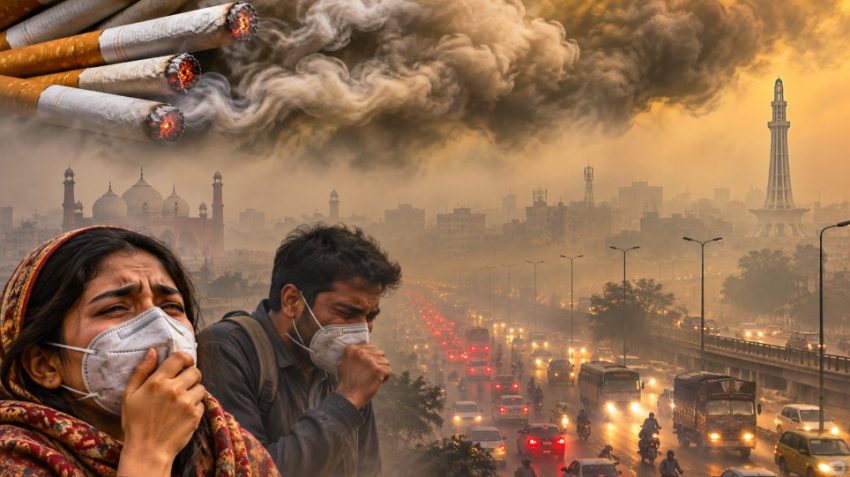
LAHORE – Breathing in Lahore becomes daily health hazard, as millions are exposed to pollution levels comparable to smoking nearly 10 cigarettes every day, as fresh air quality readings raisd concerns about public health safety in the metropolis.
The latest weekly Hawanama report by Pakistan Air Quality Initiative (PAQI), exposed the severity of Lahore’s worsening smog crisis, raising fresh questions about pollution control measures as winter approaches. Despite claims of improved environmental conditions during October, the latest findings show that Lahore’s air quality deteriorated sharply in early November, reaching hazardous levels and exposing millions of people to potentially dangerous concentrations of fine particulate matter.
The most alarming revelation came from PAQI’s assessment of the health burden associated with breathing Lahore’s polluted air. According to the report, the city’s average PM2.5 concentration reached 218.4 micrograms per cubic metre over seven days, equivalent to an approximate Air Quality Index (AQI) of 268.
This placed Lahore firmly in the Very Unhealthy category, with pollution concentrations approximately 14.6 times higher than the World Health Organization’s 24-hour guideline of 15 micrograms per cubic metre. Using a cigarette-equivalent pollution exposure calculation, researchers estimated that breathing Lahore’s air during the reporting period was roughly comparable to smoking 9.9 cigarettes per day.
Although comparison does not mean that air pollution and cigarette smoking have identical health effects, it shows concentration of harmful particles residents were exposed to. The situation was particularly concerning because Lahore failed to meet Pakistan’s own National Environmental Quality Standards (NEQS) limit of 35 micrograms per cubic metre on any of the seven days.
Lahore’s AQI surged to as high as 500, pushing the city’s atmosphere into the Hazardous category, and PM2.5 concentrations climbed to nearly 300 micrograms per cubic metre, nearly 20 times WHO’s 24-hour guideline.
Such concentrations pose serious health risks, particularly for children, elderly residents, outdoor workers and people suffering from respiratory or cardiovascular diseases.
Lahore becomes world’s most polluted city again as AQI soars to 355
Alongside the dangerous pollution readings, satellite observations revealed another troubling development: widespread agricultural burning across the region. Data obtained through NASA’s FIRMS system and VIIRS satellite instruments identified 4,215 fire detections within 300 kilometres of Lahore during the seven-day reporting period.
Of these, 2,763 were detected in Pakistan, compared with 1,446 in India. The figures shows that two-thirds of the recorded fire detections within the monitored area occurred on the Pakistani side of the border.
Interestingly, Pakistan recorded 17% fewer fires than during the corresponding period last year, when 3,325 detections were reported. India also recorded a decline from 1,688 fire detections in the comparable period of 2025, with this year’s total representing the lowest count since 2018 within the monitored radius.
Beyond the immediate discomfort caused by thick smog, environmental researchers have repeatedly warned about its long-term health consequences. PM2.5 particles are small enough to penetrate deep into the lungs and can enter the bloodstream, increasing the risk of respiratory illnesses, cardiovascular complications and other serious diseases.
The latest findings come as Punjab authorities continue highlighting enforcement campaigns against industrial emissions, agricultural burning and other sources of environmental pollution. Government officials have pointed toward October’s improved air quality as evidence of progress, but independent monitoring suggests that favourable weather played a major role in the temporary relief.