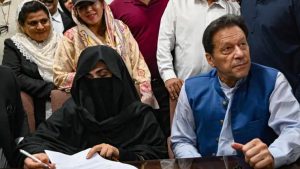
ISLAMABAD – Islamabad High Court (IHC) ordered Adiala Jail authorities to facilitate one-hour meeting between former prime minister Imran Khan, his wife Bushra Bibi and their legal representatives, as fresh concerns over Bushra Bibi’s health and a reportedly scheduled surgery brought a new dimension to the high-profile £190 million Al-Qadir Trust case.
The court’s intervention came during proceedings on appeals challenging the convictions of the former prime minister and his wife, with defence lawyers raising questions about access to their clients and the medical facilities available to Bushra Bibi behind bars.
A two-member bench headed by IHC Chief Justice Sarfraz Dogar directed the jail administration to arrange the meeting on Wednesday, November 11, allowing senior lawyer Salman Safdar to consult Imran Khan and Sardar Latif Khosa to meet Bushra Bibi.
The permission came with a clear warning from the bench that the arrangement must remain within the boundaries of the law and should not become grounds for demands to accommodate additional visitors.
During the hearing, Chief Justice Sarfraz Dogar questioned Salman Safdar over the need for another meeting, pointing out that the lawyer had already been granted access to Imran Khan and Bushra Bibi only days earlier. Safdar responded that although the previous meeting had taken place, the time available was insufficient for meaningful legal consultation, particularly with the appeals against their convictions still pending.
The chief justice made it clear that the latest permission was being granted under the relevant legal provisions. He cautioned Safdar against returning to court with a fresh request to add five more individuals to the list of people seeking access to Imran Khan.
After hearing the arguments, the bench initially allowed Sardar Latif Khosa to meet Bushra Bibi and Imran Khan. It subsequently accepted Salman Safdar’s request for another meeting with his client. The court restricted the meeting to one hour at Adiala Jail.
While the meeting order marked an important development in the case, the proceedings took a more serious turn when Salman Safdar disclosed details of Bushra Bibi’s medical condition. The lawyer informed the bench that Bushra Bibi had told him during their recent meeting that authorities had taken her for surgery approximately six months ago.
According to Safdar, she also revealed that arrangements were being made for another operation on November 15. The disclosure prompted the defence to question whether Bushra Bibi was receiving adequate medical attention while incarcerated. Safdar urged the court to order the formation of a medical board to independently assess her health and determine the treatment she required.
He reminded the bench that jail authorities had previously acknowledged before the Supreme Court that Bushra Bibi was suffering from an eye-related medical condition. The lawyer argued that her condition required proper medical supervision and insisted that the prison environment was unsuitable for the treatment she needed.
One of the most serious concerns raised during the proceedings involved Bushra Bibi’s reported return to her prison cell immediately after undergoing surgery. Safdar questioned how a female prisoner could be subjected to an emergency medical procedure and then sent back to jail on the same day. He maintained that doctors had performed the surgery under emergency circumstances, making the decision to return her immediately to detention particularly concerning.
The defence lawyer insisted that adequate post-operative care was essential and argued that Bushra Bibi’s medical requirements could not be properly addressed inside the jail. Safdar also highlighted that no application seeking bail on medical grounds had yet been submitted. He observed that courts had historically shown greater consideration in matters involving female prisoners, suggesting that Bushra Bibi’s medical circumstances deserved careful judicial attention.
The lawyer maintained that the defence was not attempting to avoid arguments in the pending appeals. Instead, he assured the bench that he would be ready to proceed with arguments once Bushra Bibi’s medical condition improved and her treatment was completed.
The defence’s concerns drew a response from Islamabad Advocate General Naveed Malik, who defended the medical arrangements being provided to Bushra Bibi inside Adiala Jail. Malik informed the bench that prison authorities were ensuring her treatment and that the government was fulfilling its obligations regarding her healthcare.
He said medical treatment was a fundamental right and maintained that the administration had not neglected its responsibilities. To support the government’s position, the advocate general submitted a record detailing the medical treatment and healthcare facilities provided to Bushra Bibi on different occasions. He also revealed that a medical board had visited the former first lady on November 8 to examine her condition.