
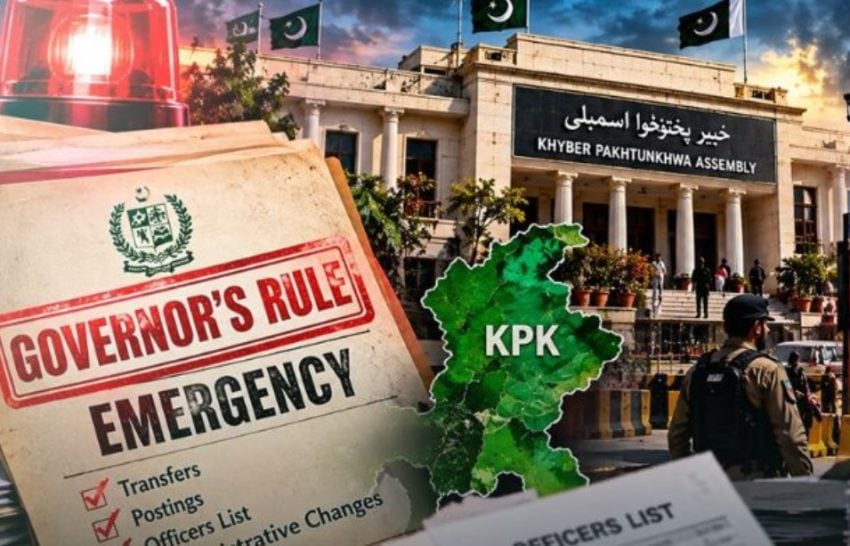
ISLAMABAD – The federal goverment imposed emergency in Khyber Pakhtunkhwa, raising questions over provincial powers, parliamentary approval and the future of the country’s northwestern region.
At the centre of the situation are two constitutional provisions, Article 232, which deals with the proclamation of an emergency, and Article 234, which provides for action when the constitutional machinery in a province fails.
Although both provisions can expand federal authority, they differ substantially in their legal requirements, duration and implications for provincial governance.
Article 232 expands Federal Powers without Dissolving Provincial Assembly
Under Article 232 of the Constitution, the president proclaims emergency when Pakistan, or any part of the country, faces a serious threat to its security because of war, external aggression or internal disturbances beyond the control of a provincial government.
Pakistani Constitution provides different procedures for such a proclamation, including provincial assembly resolution in cases involving internal disturbances or presidential action subject to parliamentary approval.
Where the president issues a proclamation without a provincial assembly resolution, it must be approved separately by the National Assembly and Senate within 10 days. The proclamation must also be presented at a joint sitting of Parliament within 30 days. Failure to secure the required parliamentary approval would bring the proclamation to an end after two months.
Unlike Governor’s Rule, an emergency under Article 232 does not automatically transfer all provincial legislative powers to the federal Parliament. The provincial assembly retains its lawmaking authority, although the federation gains expanded powers under the constitutional framework.
A joint sitting of Parliament can also reject an emergency proclamation through a majority of the total membership of both houses.
Article 234 provides constitutional route when the government of a province can no longer be carried on in accordance with the Constitution. Under this provision, the president may act on a report from the governor. The president can assume the provincial government’s functions or delegate them to the governor, while the provincial assembly’s legislative powers may be exercised by Parliament under the applicable constitutional arrangements.
The provision also allows Parliament to play a decisive role in determining whether the arrangement continues. Governor’s Rule ENDS after two months unless approved by joint sitting of Parliament. Following approval, it can be extended in periods of up to two months, but its total duration cannot exceed six months.
While Article 232 expands federal authority during an emergency, Article 234 provides a mechanism for dealing with a breakdown of constitutional governance in a province.
CM Sohail Afridi, Junaid Akbar reportedly Arrested as KP faces Federal Takeover
One of the key questions surrounding Emergency and Governor’s Rule concerns rights of political leaders and citizens. The imposition of Governor’s Rule under Article 234 does not, by itself, suspend fundamental rights or prevent citizens from approaching courts to enforce them.
An emergency under Article 232, however, can have wider implications for civil liberties. Article 233 deals with the suspension or restriction of certain constitutional protections during an emergency, including those relating to movement, peaceful assembly, association, business, freedom of expression and property.
Emergency does not automatically mean that every fundamental right is suspended or that all restrictions take effect without further legal action. The specific constitutional provisions, applicable laws and presidential orders must be examined to establish the extent of any restrictions.
The president may also issue a separate order affecting the right to approach courts for the enforcement of specified fundamental rights. Such an order can apply nationwide or to a particular area and is subject to separate parliamentary approval requirements.