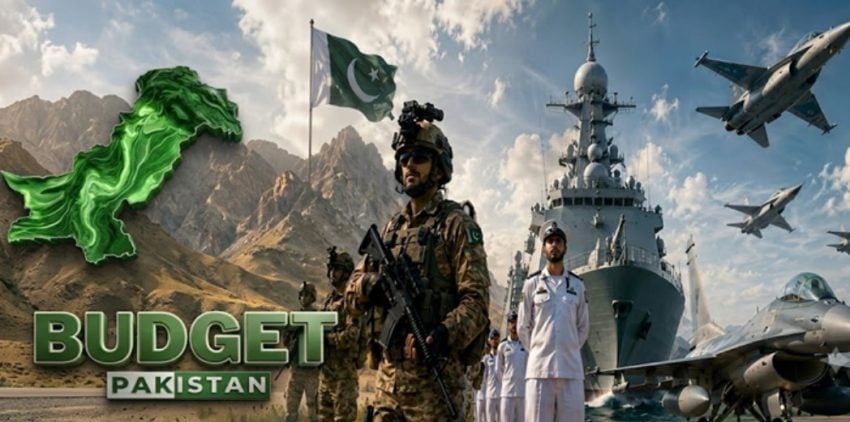
ISLAMABAD – Pakistan’s federal government unveiled sharply increased defence budget of Rs3,000 billion for financial year 2026–27 as compared to staggering 17.6% rise compared to the previous year.
Finance Minister Muhammad Aurangzeb, presenting the budget in the National Assembly, justified surge by pointing to an “uncertain regional security environment” and the need to ensure what he called an “invincible national defence posture.” The latest allocation caps a dramatic three-year upward trajectory in military spending. From Rs 2,122 billion in 2024–25, the defence budget has ballooned by Rs 878 billion, reflecting consistent year-on-year expansion despite persistent concerns over fiscal pressure and debt servicing.
Last year’s revised figure stood at Rs 2,595 billion, already a significant jump, which has now been pushed further upward in the new fiscal plan.
According to official budget documents, the Rs 3 trillion allocation is distributed across multiple heads Rs 967 billion for personnel costs, including salaries and allowances (up 14.36%), Rs 743 billion for operational expenses such as fuel, training, medical, transport and logistic), Rs 925 billion for “physical assets” — the fastest-growing segment, covering weapons, ammunition, and military hardware (a sharp 39% increase) and Rs 336 billion for infrastructure, construction, and maintenance of defence facilities.
The surge shows a shift towards modernisation and technology-driven warfare, including drones, cyber capabilities, and advanced weapons systems.
Critics argue that while defence spending continues to rise, economic constraints and debt pressures are squeezing all other sectors. Analysts note that although defence spending as a share of GDP has technically declined over time, its weight on federal revenues remains substantial.
Budget documents further reveal that while military pensions are not formally part of the defence budget, they represent a massive parallel expenditure. Out of Rs 1,169 billion allocated for pensions, Rs 822 billion is earmarked for retired military personnel alone. Defence analysts defending the increase point to escalating regional instability, citing tensions along borders, cyber warfare trends, drone-based conflicts, and global war dynamics including Ukraine and the Middle East.
In reality, modern warfare demands constant upgrades. “Without advanced technology, defence readiness is impossible in today’s environment,” he said.
Pakistan is a security nation and the geographics and regional tensions remained key reason why defence spending keeps rising in the budget. The South Asian naiton sits in difficult neighbourhood. Tensions with India, military stand-offs, and long-standing disputes mean the state prioritises deterrence and military readiness.
On western side, instability in Taliban led Afghanistan and concerns about cross-border militancy add another layer of pressure. Together, these factors keep security at the top of the agenda.
Government defends budget 2026-27 as growth-oriented plan with relief measures