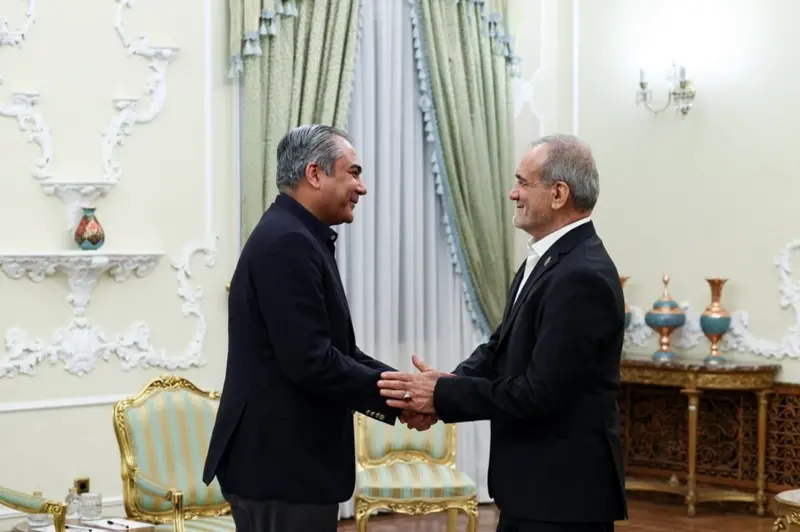
TEHRAN – Pakistan’s Interior Minister Mohsin Naqvi arrived in Tehran for a high-stakes diplomatic mission, holding meetings with Iranian President Masoud Pezeshkian and Foreign Minister Abbas Araghchi as efforts intensify to revive dialogue between Iran and the United States.
Naqvi’s visit comes at a particularly sensitive moment, with the Strait of Hormuz remaining at the centre of a rapidly evolving regional crisis and diplomatic efforts underway to restore commercial movement through the strategically vital waterway.
Iranian state media have so far provided limited details about Naqvi’s meetings with the country’s top leadership.
Naqvi was received in Tehran by Iranian Interior Minister Eskandar Momeni. According to Iran’s official news agency IRNA, Naqvi subsequently met Foreign Minister Abbas Araghchi, while further talks with Momeni were expected to focus on bilateral relations, cooperation between Pakistan and Iran and other matters of mutual interest.
Naqvi’s Tehran visit comes as Iran and Oman continue discussions over arrangements governing movement through the Strait of Hormuz.
The waterway has become one of the most sensitive flashpoints in the regional crisis. Recent diplomatic efforts have raised hopes of an arrangement allowing commercial shipping to resume, but Iranian officials have stressed that an agreement with Oman alone would not necessarily mean the strait will immediately reopen.
Iran linked reopening of the waterway to broader conditions involving the US, including changes in Washington’s policies and an end to military hostilities. At the same time, Washington has indicated that progress is being made in negotiations involving Iran and Oman, with the possibility of an arrangement aimed at facilitating commercial shipping through the strait.
The conflicting positions underline the enormous diplomatic challenge facing mediators.
Islamabad has increasingly positioned itself as a channel between Tehran and Washington as tensions threaten to destabilise the wider region. Naqvi’s mission therefore carries significance beyond Pakistan-Iran relations, with Islamabad seeking to keep diplomatic channels open at a time when direct engagement between Iran and the United States remains extremely difficult.
The latest visit also comes amid renewed international concern over the continued closure or restricted movement through the Strait of Hormuz, a critical route for global energy supplies.
For Pakistan, the stakes are particularly high. Any prolonged disruption in the waterway could have serious consequences for regional trade, energy markets and the economies of countries across South Asia and the Gulf.