
ISLAMABAD – Pakistan’s electricity crisis has striking geographical divide as some districts reportedly lose nearly all the electricity supplied to them, much of Punjab records losses in single digits.
The district-level figures show the scale of the challenge, with Balochistan and parts of Khyber Pakhtunkhwa emerging as major centres of electricity losses and revenue-recovery problems.
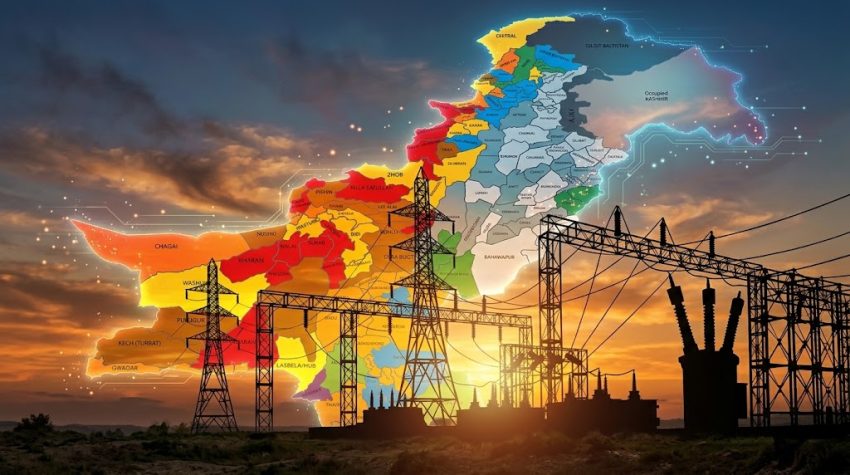
The figures were shared by former Energy Minister Engr. Dastagir Khurram. Based on Power Division and distribution company data, the map classifies districts according to reported electricity losses and assigns financial-loss estimates to eight percentage bands.
The map of electricity theft and/or refusal to pay is the map of Pakistan’s overall governance.
Non-payment for electricity is a symptom, NOt the disease.
Map courtesy @RShahzaddk
— Engr. Khurram Dastgir-Khan (HI) (@kdastgirkhan) October 15, 2026
The findings point to a crisis extending far beyond electricity theft. Technical losses, unauthorized consumption, billing problems and unpaid bills all place pressure on distribution companies, weakening their finances and adding to Pakistan’s persistent circular-debt burden.
Estimates put electricity losses at around 97% in Awaran, 93–94% in Kalat and Qilla Saifullah, 93% in Sherani, 90% in Pishin and 88% in Chaman. Other districts identified in the high-loss belt include Qilla Abdullah, Khuzdar, Kech, Kharan, Chagai, Washuk and Zhob.
Four locations, Sherani, Chaman, Usta Muhammad and Jaffarabad, are specifically marked on the map.
Balochistan is not the only region confronting severe electricity-sector problems. Several districts in Khyber Pakhtunkhwa, particularly in the south and former tribal areas, also feature prominently in the high-loss categories.
Historical estimates put losses at around 82% in Tank, 78% in Karak, 65% in Dera Ismail Khan and 63% in Bannu. Charsadda and some northern areas, including Chitral, have also been associated with elevated losses.
The contrast between districts raises questions about differences in enforcement, network conditions, consumer payment behaviour and the capacity of distribution companies to collect their dues.
While some districts in Balochistan and KP report losses exceeding 80%, most districts across Punjab fall into the map’s lowest-loss categories.
Large parts of the territories served by LESCO, FESCO, GEPCO, MEPCO and IESCO have historically reported losses below 10%. Kasur, Okara, Rajanpur and Rahim Yar Khan are among the exceptions cited in the low-teens range.
Parts of interior Sindh also face substantial electricity losses. Areas served by HESCO and SEPCO, including parts of Hyderabad, Larkana, Sukkur, Jacobabad and Ghotki, appear among the locations associated with moderate-to-high losses.
These districts generally show a more mixed pattern than Balochistan, with some falling into the 21–40% and 41–60% categories.
PESCO and QESCO have repeatedly featured among the major loss-making distribution companies, while HESCO and SEPCO have also faced significant financial challenges. Reports in recent years have cited substantial annual losses at PESCO and rising financial pressure at QESCO, although precise amounts vary by year and methodology.
The pattern also raises broader questions about institutional capacity and the administration of public utilities. In some areas, distribution companies may face difficulties maintaining infrastructure, accessing networks, enforcing disconnections or collecting payments consistently. Political interference, local resistance and weak administrative coordination may further complicate enforcement.