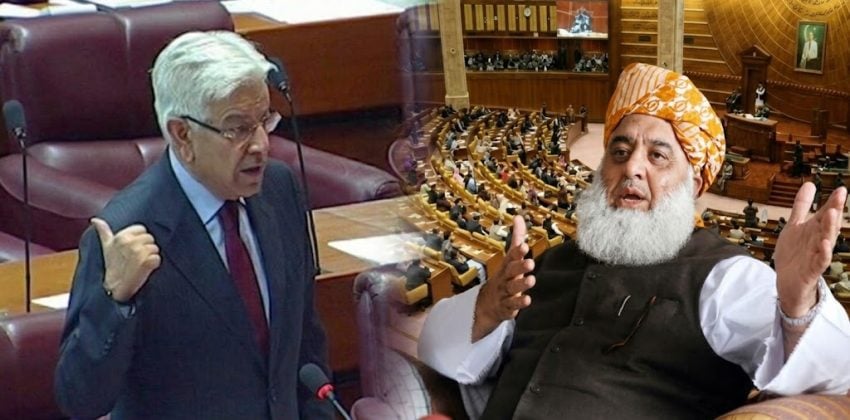
ISLAMABAD – Defence Minister Khawaja Asif strongly responded to JUI-F chief Maulana Fazlur Rehman in heated National Assembly session, clarifying that Field Marshal Asim Munir’s Tehran visit was aimed at promoting regional peace, not negotiating a defence agreement.
A fierce political showdown occured in National Assembly as Defence Minister Khawaja Asif launched counterattack against Jamiat Ulema-e-Islam-Fazl (JUI-F) chief Maulana Fazlur Rehman, questioning his political legacy, challenging his performance on Kashmir and accusing him of exploiting religion for personal and political gains.
Asif defended Chief of Defence Forces (CDF) Field Marshal Asim Munir’s visit to Tehran, rejecting suggestions that the high-level diplomatic engagement involved negotiations over a new defence agreement. The minister insisted that Pakistan’s military leadership is playing key role in reducing regional tensions and bringing rival countries to the negotiating table.
Asif maintained that the Tehran visit was a diplomatic initiative focused on regional peace, not a mission to negotiate or finalise a military pact.
Why Khawaja Asif Did Not Attend the Tehran Meeting?
Addressing questions surrounding his absence from high-level gathering, Asif explained that his participation was unnecessary because the discussions did not concern any agreement falling under the Ministry of Defence.
He said the meeting brought together representatives holding different positions, including Saudi Arabia’s defence minister and Türkiye’s intelligence chief, rather than the defence ministers of all participating countries. The minister argued that describing the gathering as a defence-related negotiation would misrepresent its purpose.
Asif praised Field Marshal Munir’s diplomatic involvement, saying the military leader had consistently encouraged dialogue as a way to resolve regional disputes. Referring to Pakistan’s military victory last year, Asif said the field marshal had subsequently contributed to efforts aimed at promoting negotiations and restoring stability across the region.
He stressed that Pakistan and its military leadership deserved wider international recognition for their contributions to peace-building initiatives.
The defence minister’s response became increasingly confrontational as he shifted from explaining the Tehran visit to challenging Fazlur Rehman’s political credentials. Although Asif acknowledged JUI-F chief’s seniority and influence in national politics, he argued that those questioning others should also be prepared to defend their own records.
He reminded the house that Fazlur Rehman had enjoyed positions of influence in several governments and had served as chairman of the National Assembly’s Kashmir Committee for approximately a decade. Asif questioned what tangible achievements the JUI-F leader could claim for the Kashmir cause during his lengthy tenure.
Asif further claimed that he had been willing to acknowledge his own mistakes publicly, describing himself as the only politician to have apologised for his past positions. He conceded that his earlier speeches frequently returned to haunt him whenever he discussed the country’s hybrid political system, but insisted that political accountability should apply equally to everyone.
The parliamentary clash took a sharper turn when Khawaja Asif accused Fazlur Rehman of using religious influence to advance his political interests and obtain financial benefits. The defence minister alleged that JUI-F leader had made religion a source of political and financial advantage, contrasting his approach with that of other mainstream political parties.
The confrontation followed Fazlur Rehman’s criticism of the government’s representation at the Tehran discussions. JUI-F chief had questioned why Pakistan’s defence minister remained in Islamabad while the country’s senior military leadership participated in important regional security talks.
The diplomatic engagement took place against the backdrop of growing instability in the Middle East and efforts by regional powers to prevent another escalation. October 26 discussions involved Field Marshal Asim Munir, Saudi Defence Minister Prince Khalid bin Salman, Turkish intelligence chief Ibrahim Kalin and senior Iranian officials.
Iranian authorities described the initiative as an effort to develop regional security cooperation and reduce the risks of further conflict. The talks also drew attention because of the existing Makkah Joint Defence Agreement involving Pakistan, Saudi Arabia and Türkiye.
Fazlur Rehman rejects emergency in KP, vows strong political response