
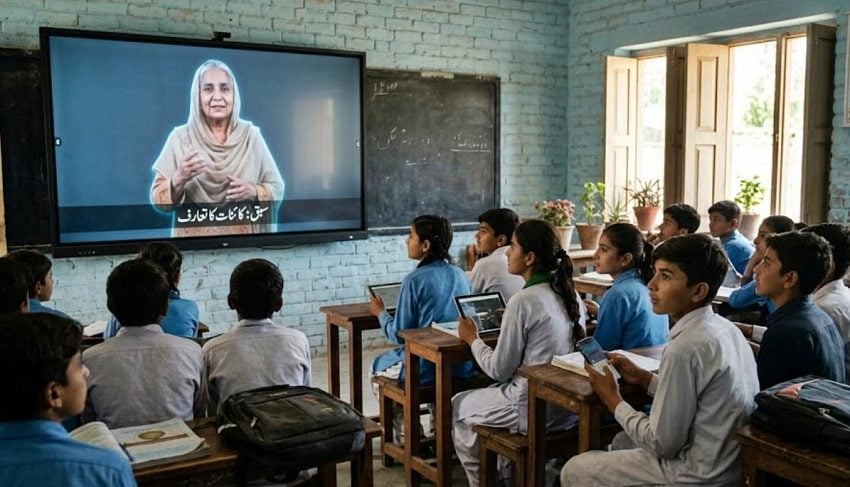
PESHAWAR – Imagine walking into classroom where teacher has a face, a voice and decades of teaching experience, but is not physically there. That’s the future Pakistan’s northwestern region is now testing, with AI-powered “human clones” set to teach students as part of digital education experiment.
Khyber Pakhtunkhwa government announced a sweeping digital education plan under which AI-powered human clones of teachers will deliver lessons to students, bringing virtual teachers to classrooms where conventional teachers are unavailable.
Parho Khyber Pakhtunkhwa project aims to digitize the province’s curriculum, put lessons on mobile phones and introduce virtual classrooms, AI-assisted personalized learning and virtual science laboratories. The government says initiative will require a one-time investment of Rs5 billion but could generate annual savings of more than Rs100 billion.
The plan was approved at a high-level meeting on digital education reforms chaired by Khyber Pakhtunkhwa Chief Minister Muhammad Sohail Afridi, who has set an ambitious target of increasing the province’s literacy rate by 30 to 35 percent within two years.
But while the government is portraying the initiative as a potential digital revolution, teachers’ representatives are questioning whether an AI-driven education system can survive the province’s harshest ground realities, including poor connectivity, vacant teaching posts and schools lacking basic facilities.
The most striking feature of project is the government’s plan to use “human clones”, virtual representations of real teachers created using their faces and voices. A virtual clone of a well-known Peshawar teacher has already been developed. The teacher has reportedly taught at Cambridge and government educational institutions.
These AI-based teacher characters are being used to deliver lessons in physics, Maths, Urdu and other subjects, with the government claiming that the virtual instructors can cover the project’s 2,900 curriculum modules for grades six through twelve. Students will not merely watch prerecorded lectures. Officials say they will be able to ask questions directly to the virtual teachers and receive answers.
That could turn traditional classroom model on its head, instead of waiting for teacher to arrive, students in remote areas could potentially learn from the same virtual instructor used elsewhere in the province.
The technology is being introduced primarily to tackle one of the province’s biggest educational challenges: the shortage of qualified teachers in remote areas. Regions including Bajaur, South Waziristan, North Waziristan and Bannu face particular shortages of teachers, especially science teachers.
Under the pilot system, selected schools have been equipped with screens, cameras, microphones, internet connections and sound systems. Students can then attend live classes transmitted from the virtual school in Gulbahar, Peshawar.
One of the biggest questions surrounding the project is how an AI-based education system will function in areas where internet connectivity itself is unreliable. The government is developing an LMS, learning management system, for both mobile phones and the web, with course material available offline as well. The plan is to ensure students can access lessons even when an internet connection is unavailable.
In schools operating under the virtual model, a technical staff member rather than a conventional physical teacher would reportedly be present to facilitate the system. That claim, however, has already become one of the most controversial aspects of the project.
Meanwhile, Young Teachers Association Khyber Pakhtunkhwa questioned the practical feasibility of the initiative, saying many areas do not even have reliable basic network connectivity, raising serious doubts about the viability of virtual classrooms. They also challenged the government’s claims about offline AI, asking how an AI-based system could function without access to online data.
The teachers’ representative says the government should first address the province’s existing educational crisis rather than focus on futuristic technology. Millions of children are out of school, while as many as 40,000 schools lack basic facilities and up to 60,000 teaching positions remain vacant.
Officials estimate that a Rs5 billion one-time investment could potentially generate more than Rs100 billion in annual savings. The government also plans to exploit one of its biggest potential educational assets: smartphones.
Instead of relying exclusively on physical textbooks and classrooms, students could access curriculum content, lectures and other educational material through their phones.