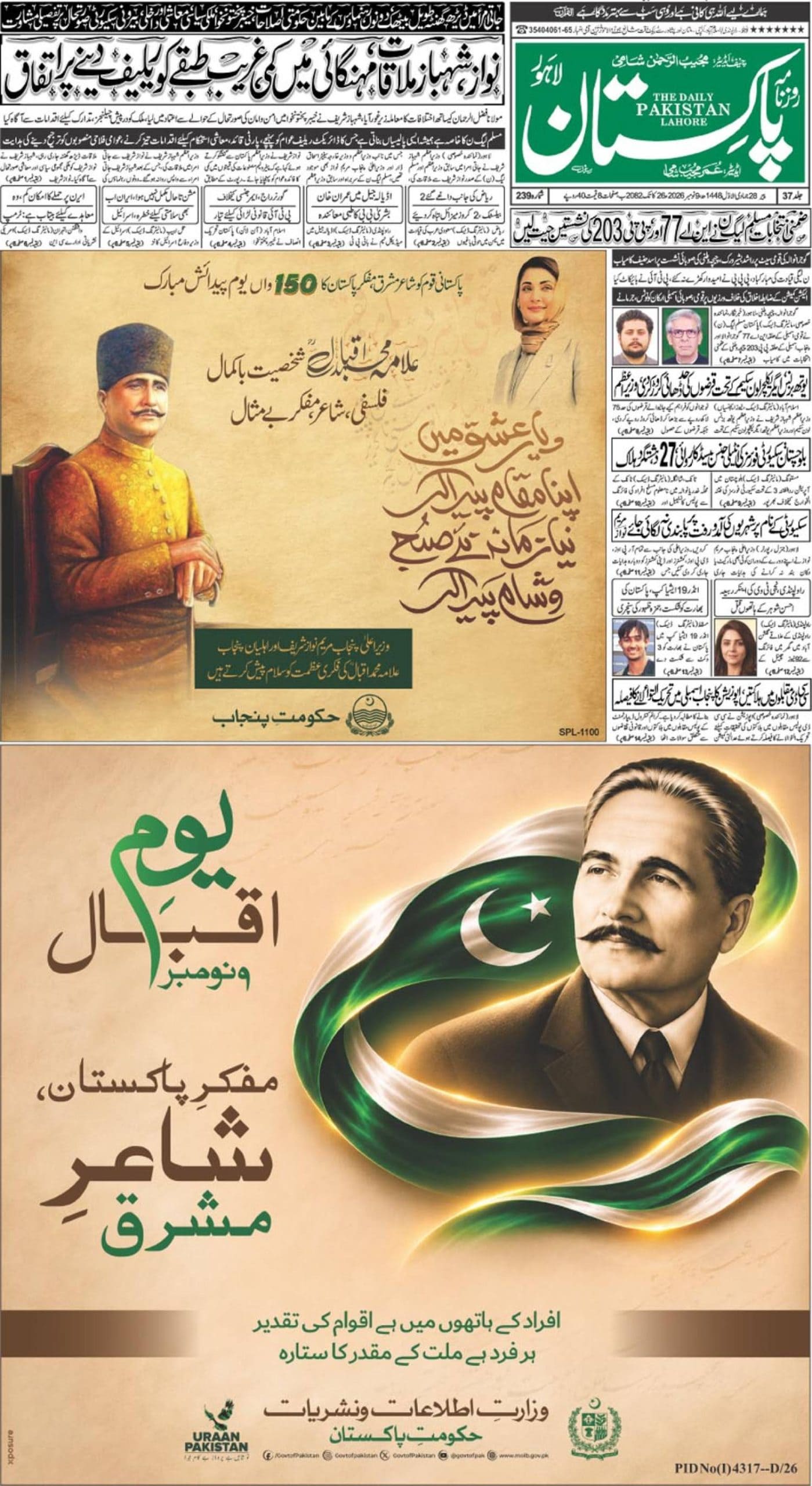
LAHORE – Pakistan is observing 149th birth anniversary of national poet and philosopher Dr Allama Muhammad Iqbal on Monday, with nationwide celebrations, special ceremonies and tributes honouring the visionary whose ideas helped shape the struggle for an independent Muslim homeland.
The occasion, widely celebrated as Iqbal Day on Nov 9, brought together educational institutions, literary organisations and government representatives to commemorate the life, poetry and political philosophy of the man remembered as the Poet of the East.
The federal government has declared November 9 a nationwide public holiday, allowing citizens to participate in commemorative activities and reflect on Iqbal’s contributions to Pakistan’s history and national identity.
Under official holiday notification issued by the Cabinet Division, government offices and educational institutions are closed for the day. Banks are also observing the holiday, with the State Bank of Pakistan suspending its operations on Monday. One of most ceremonies took place at Allama Iqbal’s mausoleum near the historic Badshahi Mosque in Lahore, where a ceremonial change of guard marked the national poet’s birth anniversary.
A smartly dressed contingent of the Pakistan Navy formally assumed honorary guard duties from Pakistan Rangers Punjab during the ceremony. Pakistan Navy Station Commander Lahore, Commodore Misbah-ul-Amin, attended as the chief guest, inspected the participating contingents and paid tribute to the national poet.
A floral wreath was laid at the mausoleum on behalf of Chief of Naval Staff Admiral Naveed Ashraf, followed by Fateha for the departed poet. Federal Minister Ahsan Iqbal also visited the mausoleum to pay his respects.
Special programmes and commemorative activities are being organised across Pakistan to highlight Iqbal’s intellectual legacy, literary achievements and vision for Muslim unity.
Educational, cultural and literary circles are marking the occasion through poetry recitations, discussions and events exploring the relevance of Iqbal’s philosophy to contemporary Pakistan.
Born in Sialkot on November 9, 1877, Allama Muhammad Iqbal emerged as one of the most influential poets, philosophers and political thinkers of the twentieth century. Through his powerful Urdu and Persian poetry, he encouraged Muslims to rediscover their identity, develop self-confidence and pursue intellectual and spiritual independence.
His philosophy of Khudi, or selfhood, remains among his most celebrated contributions, emphasising individual dignity, self-awareness and the power of human potential. Iqbal’s historic presidential address at Allahabad in 1930 became a defining moment in the political history of British India. During the address, he advocated the consolidation of Muslim-majority regions in northwestern India, helping lay the intellectual groundwork for the movement that eventually led to Pakistan’s creation in 1947.
Although Iqbal breathed his last on 1938, nearly nine years before Pakistan gained independence, his ideas continued to influence the political leadership and aspirations of Muslims throughout the independence movement.
Nearly nine decades after his death, Iqbal’s philosophy continues to hold significance as Pakistan confronts challenges involving education, economic development, political stability and national cohesion.
For millions of Pakistanis, Iqbal Day is more than an annual public holiday. It is an occasion to remember a thinker who imagined a better political future for the Muslims of the Subcontinent and inspired generations to work toward that vision.