
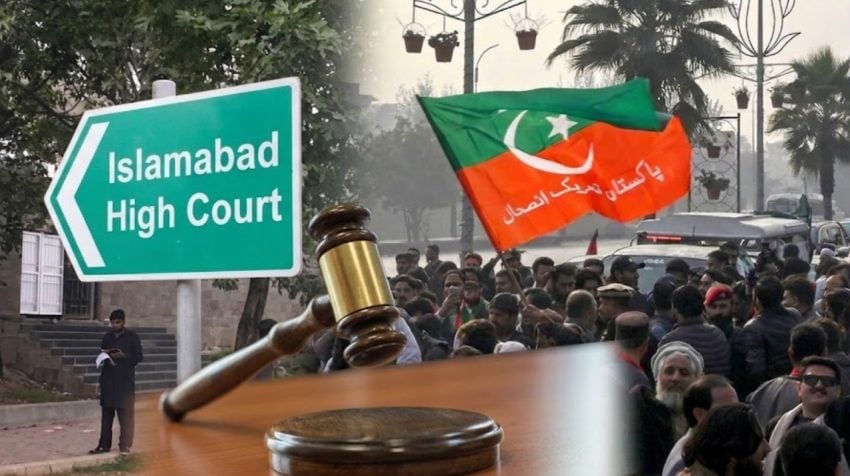
ISLAMABAD – Another blow to Pakistan Tehreek-e-Insaf (PTI) as Islamabad High Court makes it clear that no political party or public office-holder can shut down Islamabad’s roads or public spaces for political activity.
The court’s ruling came on a petition linked to PTI’s planned September 27 protest in the capital and the possibility of a long march. A three-member larger bench, headed by Islamabad High Court Chief Justice Sarfraz Dogar and comprising Justice Azam Khan and Justice Muhammad Asif, disposed of the case after hearing arguments from all sides.
The message from the bench was clear that the right to protest does not give any political party the authority to block public highways, roads or public places. The court said the same principle applies to people holding public office. Political protests must remain within the law and cannot come at the expense of citizens’ fundamental rights or their normal movement.
The ruling also carries a warning for provincial governments, particularly over the use of official machinery during political protests. The court directed that no provincial government should allow its administrative or state machinery to be used for a political party’s protest or political activities.
The chief ministers were told to ensure that government resources, machinery and administrative powers are not deployed for political purposes. The issue came under particular scrutiny during the hearing as the court sought assurances from the Khyber Pakhtunkhwa government over the possible use of state resources.
KP Chief Secretary Shahab Ali Shah assured the court that an affidavit would be submitted confirming that government machinery and resources would not be used for any political gathering. KP Inspector General of Police also assured the court that any illegal action or advance would be stopped.
Court watches PTI protest videos
The hearing also took a dramatic turn when the court allowed videos of PTI protests from 2022 and 2024 to be played in the courtroom with special permission. The government lawyer relied on the footage to argue that previous PTI protests had involved the removal of barriers, damage to public and government property and serious law-and-order concerns.
Islamabad’s Advocate General Naveed Malik argued that any future protest or long march must follow the prescribed legal procedure.
He told the court that permission from the relevant administration would be required for a gathering, stressing that the government was not targeting any political party or leader but wanted any protest to remain within the law.
The bench also directly questioned the KP police chief over what would happen if an unlawful or unconstitutional gathering took place. IGP assured the court that the province had submitted an affidavit in accordance with its directions and that any illegal action or advance would be stopped.
The proceedings were attended by Attorney General Mansoor Usman Awan, Islamabad Advocate General Naveed Malik, the Prosecutor General, KP Chief Secretary Shahab Ali Shah and the KP IGP.
Islamabad High Court’s decision has drawn a clear legal line ahead of PTI’s planned September 27 protest. The court has not banned political protests. Instead, it has stressed that the right to demonstrate must operate within constitutional and legal limits.
The ruling means that PTI can protest, but it cannot claim the right to shut down Islamabad’s public roads or places. At the same time, provincial governments have been put on notice that official machinery, resources and administrative powers cannot be turned into political tools.
Over 100 PTI activists detained under 3-MPO ahead of Sept. 27 March to Islamabad