ISLAMABAD – A fresh wave of controversy erupted after controversial document, circulated by online portal “Dropsite,” resurfaced claims related to already explosive cypher controversy from the final days of former Prime Minister Imran Khan’s government.
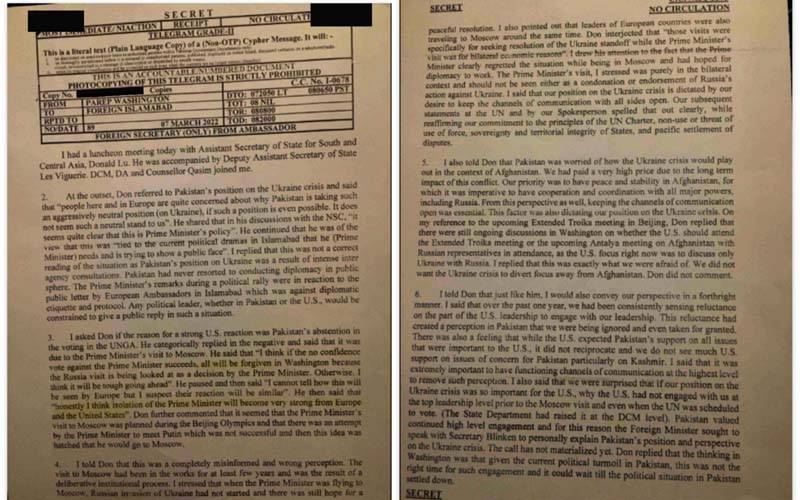
The alleged cable, reportedly written by Pakistan’s then ambassador to US Asad Majeed, shows what is being described as a high-stakes diplomatic conversation with senior US official Donald Lu, now once again at the centre of political debate in Pakistan.
According to the document, Washington reportedly expressed serious concern over Pakistan’s “aggressively neutral” position on the Russia–Ukraine war, suggesting that both US and European partners were uneasy with Islamabad’s stance at the UN. The document claims that US officials viewed Pakistan’s policy not as purely institutional, but closely aligned with the personal foreign policy direction of then Prime Minister Imran Khan, raising questions about intent and messaging on the global stage.
Moscow Visit Becomes the Diplomatic Flashpoint
At the heart of the controversy lies Imran Khan’s visit to Moscow shortly before the outbreak of the Ukraine war, which the leaked text describes as a central point of friction between Washington and Islamabad. The document alleges that Donald Lu directly linked US frustration to the Moscow visit rather than Pakistan’s UN voting behavior, and in one of the most politically charged claims, is quoted as suggesting that if a no-confidence motion against Imran Khan succeeded, “everything would be forgiven” in Washington, as the visit was being interpreted as a personal decision rather than an institutional one.
This alleged remark has reignited intense political debate, with supporters of Imran Khan viewing it as evidence of external pressure, while critics argue it reflects routine diplomatic communication being selectively interpreted in a political context.
In response, ambassador Asad Majeed is said to have firmly rejected the framing presented in the conversation, insisting that Pakistan’s policy on Ukraine was the outcome of detailed inter-institutional consultation rather than the decision of any single individual. He reportedly maintained that the Moscow visit had been under consideration for years and finalized through proper channels, and at the time of planning, Russia had not yet launched its full-scale invasion of Ukraine.
The alleged response also emphasises that several European leaders were engaging with Moscow around the same period, arguing that Pakistan’s visit should not be viewed in isolation or interpreted as endorsement of Russian actions. The ambassador is further quoted as stating that Pakistan’s engagement with Russia was strictly bilateral and driven by economic and diplomatic considerations rather than geopolitical alignment.
Beyond Ukraine and Moscow, the leaked document also reflects broader frustrations in Pakistan–US ties. Pakistani side is said to have raised concerns that while the United States expects support from Pakistan on issues central to Washington’s interests, Pakistan’s own priorities, particularly Kashmir dispute, do not receive comparable attention or backing from the US side.
The ambassador is also reported to have questioned the lack of high-level engagement prior to key developments, including Pakistan’s Moscow visit and the United Nations vote on Ukraine, suggesting that meaningful diplomatic communication could have altered perceptions and prevented misunderstandings.
The document further claims that Pakistan attempted to establish direct high-level contact with Washington, including efforts by the Foreign Minister to reach US Secretary of State Antony Blinken. However, according to the alleged record, these attempts did not result in any conversation, further deepening diplomatic strain during a sensitive geopolitical period.
In response to Pakistan’s concerns, the US side is quoted as stating that political instability in Pakistan made high-level engagement difficult at the time, and that Washington preferred to wait until the situation stabilized before advancing diplomatic dialogue. This position is presented in the document as a cautious but deliberate approach to an already tense bilateral relationship.
The alleged communication concludes with a significant development, as Pakistan’s ambassador reportedly suggested that the matter be taken seriously in Islamabad and that a formal diplomatic protest could be lodged with the US Chargé d’Affaires. This reflects the level of concern expressed in the document and underscores the seriousness with which the issue was being considered at the diplomatic level.
The resurfacing of this alleged cypher has once again placed the controversy surrounding the removal of Imran Khan at the center of national debate. While supporters view it as validation of long-held claims about foreign pressure and interference, critics caution against drawing conclusions from disputed and unverified material, arguing that diplomatic language is often complex and open to interpretation.
Blow to Imran Khan as Azam Khan records statement against PTI Chief over cypher controversy