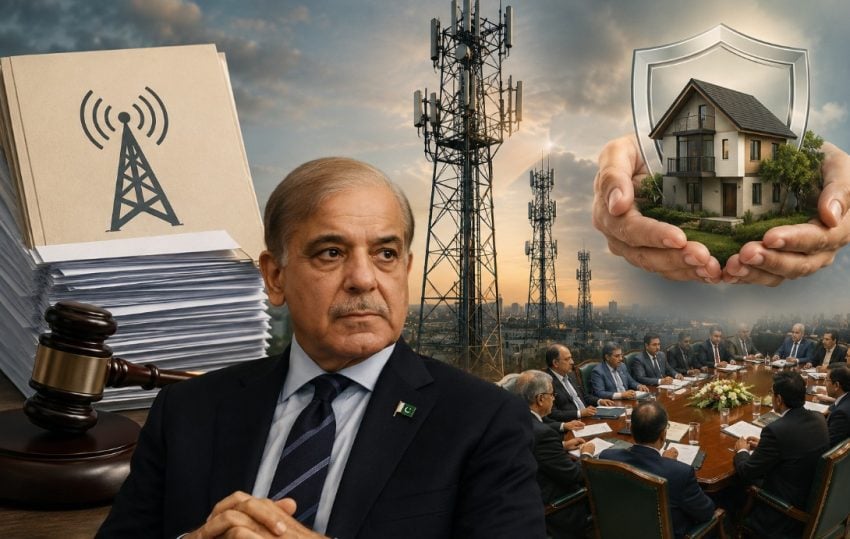
ISLAMABAD – The controversial Pakistan Telecommunication (Re-organization) (Amendment) Bill, 2026 allowing use of private land for public connectivity projects, amassed huge outrage and amid mounting concerns over provisions, Prime Minister Shehbaz Sharif ordered an urgent review of Right of Way (RoW) clauses in Pakistan Telecommunication (Re-organization) (Amendment) Bill, 2026, establishing a 10-member high-level committee to scrutinize the proposed framework.
The move comes after lawmakers and stakeholders raised alarms over provisions that critics fear could expand telecom operators’ ability to access private and collectively owned properties for network infrastructure projects.
The committee, headed by the Federal Minister for Law and Justice, has been tasked with conducting a comprehensive examination of the bill’s RoW provisions and assessing their legal, constitutional, and policy implications. At the heart of debate is question that has resonated across parliamentary circles: how far should the state and telecom operators be allowed to go in the race to expand digital connectivity, and where should the line be drawn to protect private property rights?
The committee will specifically review clauses dealing with access to privately owned land, housing societies, and other shared premises. It will evaluate whether the existing provisions provide sufficient safeguards for property owners or whether stronger legal protections are needed.
Another key focus will be the bill’s proposed deemed approval mechanism, a provision that has attracted particular scrutiny during parliamentary discussions. The panel will also assess rules governing compensation, rent, fees, and other charges related to the installation of telecommunications infrastructure, with instructions to recommend amendments and oversight measures where necessary.
The legislation was passed by the National Assembly of Pakistan on June 11 before being sent to the Senate of Pakistan. However, its progress encountered resistance in the upper house, where the Senate Standing Committee on Information Technology and Telecommunication heard concerns from several senators regarding the scope and potential consequences of the proposed RoW powers.
What is PTA Amendment Bill 2026?
A new law proposed by government, Pakistan Telecommunication (Re-organisation) (Amendment) Bill, 2026, is creating concern because many people believe it could affect the rights of property owners.
The government wants to make it easier for telecom companies to expand internet and mobile networks across Pakistan. To do this, companies may need to install fibre-optic cables, telecom towers, generators, and other equipment in different locations. Under the proposed law, if a telecom company wants to place its equipment on private land, it can formally ask the owner for permission.
The property owner would have 30 days to respond. If both sides cannot reach an agreement, the matter could be sent to a government-appointed official. Instead of the property owner having the final say, that official would decide whether the telecom company can use the land and how much compensation or rent should be paid to the owner.
Critics say this could reduce the control that homeowners and landowners have over their own property. If a telecom company wants to install a tower, fibre-optic cable, or other equipment near your home, you may not be able to permanently reject the proposal if the government authority decides in the company’s favor.
Many people believe that decisions about private property should remain with the owner, not with a government official. One of the most controversial parts of the bill is the penalty clause. According to the proposed law, individuals who refuse to comply with a final decision could face heavy fines. In some cases, penalties could reach up to Rs50 million.
This led critics to argue that property owners may feel pressured to accept installations even if they are uncomfortable with them.
Officials argue that Pakistan needs better internet and telecom infrastructure, and delays in obtaining permissions often slow down network expansion. They say the proposed changes are intended to speed up digital development while ensuring that property owners receive compensation.
Govt takes U-Turn on Telecom Bill carrying Rs5 Crore Penalty amid Property Rights Backlash