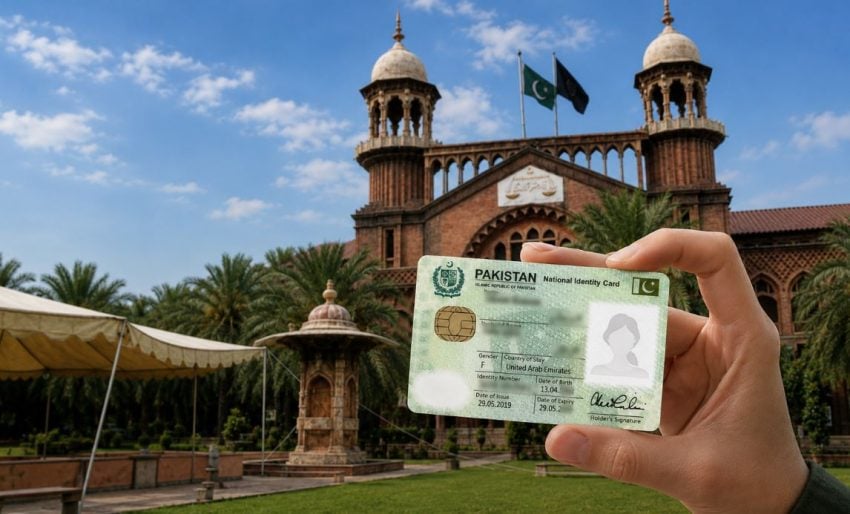
LAHORE – A CNIC card may open doors to all basic services, but according to Lahore High Court, the ID document is not the final word on citizenship. In a recent ruling, the court held that a alone cannot serve as conclusive proof of Pakistani nationality, clarifying that citizenship claims must be assessed under the country’s citizenship laws and relevant NADRA regulations.
Lahore High Court (LHC) has declared that possession of a Computerized National Identity Card (CNIC) alone does not conclusively establish Pakistani citizenship, underscoring that nationality disputes must be decided under the Pakistan Citizenship Act and relevant NADRA laws.
Justice Mohsin Akhtar Kayani of LHC made the ruling while allowing civil revision petition filed by the National Database and Registration Authority (NADRA), which challenged lower court rulings declaring Khalid Khan and another individual as Pakistani citizens.
Setting aside the earlier decisions, the LHC held that questions of nationality cannot be settled solely through civil court proceedings and must instead be examined under the legal framework governing citizenship and national registration.
According to the case record, NADRA had blocked the respondents’ CNICs after classifying them as “aliens” and referred the matter to a Joint Verification Committee comprising officials from the Special Branch, Intelligence Bureau (IB), and Inter-Services Intelligence (ISI). Despite conducting an inquiry, the committee was unable to verify the respondents’ claim to Pakistani nationality.
The court noted that the respondents’ father failed to provide crucial information about his family history and background during the verification process, a factor that raised serious doubts about his assertion of Pakistani origin.
Justice Kayani remarked that many individuals who entered Pakistan as refugees during and after the Afghan conflict had managed to get national identity documents despite not being citizens of the country.
Respondents were required to produce credible public records issued before 1979 to establish their father’s citizenship status, the court said, but no such evidence was presented before the court.
Finding that the lower courts had overlooked important facts and documentary evidence submitted by NADRA, the LHC overturned their judgments and ruled in favour of the national registration authority.