

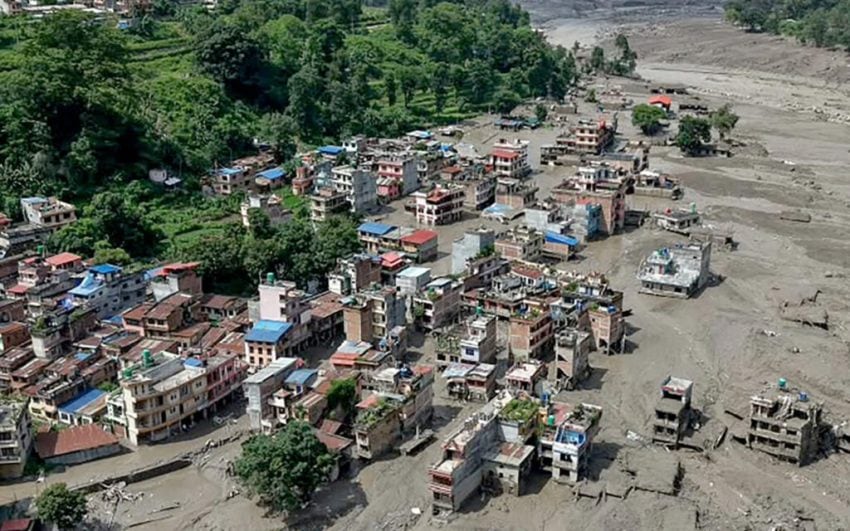
At least 165 people have died and nearly 1,500 remain missing following devastating floods and landslides in the Himalayan border region between Nepal and China, authorities said.
The disaster occurred after a massive mass of mud and rocks collapsed into a river, triggering a powerful surge of water and debris through mountainous communities.
Homes, roads, vehicles and power infrastructure were swept away, while several areas were buried under thick layers of mud.
In Nepal, authorities said 157 bodies had been recovered, with identification efforts still underway. Around 826 people remain missing, including hundreds of foreign nationals. Officials said the missing tourists include citizens of India, the United States, Australia, Britain and Canada, among other countries.
The affected region lies along a route used by tourists, trekkers and pilgrims travelling toward the Kailash Mansarovar area in Tibet. The scale of destruction has made rescue efforts particularly difficult in the remote mountain terrain.
A horrific scene of severe flooding at the Rasuwagadhi border point on the Nepal-Tibet border.
The strong currents wreaked havoc across the area, leaving 400 pilgrims and 105 Indian tourists also missing in the Nepal floods.#NepalFloods #Nepal #Rasuwa #FlashFlood #Floods pic.twitter.com/dwAX12Gj7l— Ravi Pandey🇮🇳 (@ravipandey2643) August 26, 2026
Across the border in Tibet’s Gyirong county, Chinese authorities reported hundreds of people missing, including foreign nationals. At least three deaths were also reported there. South Korea said eight of its citizens working at a hydropower project in the area were missing.
Initial reports suggested that a magnitude 4.4 earthquake may have contributed to the collapse of a glacier-covered slope, sending ice, rocks and other debris into the Lhende River. Preliminary satellite assessments placed the landslide around 20 kilometres northeast of a border crossing.
Rescue operations are continuing, with helicopters being used to locate survivors, deliver emergency supplies and evacuate people from isolated areas. Damaged roads, communications networks and electricity infrastructure have hampered access to several locations.
China has deployed drones to assess the destruction and prepared aircraft, helicopters and other equipment for rescue operations.
Authorities in India’s Uttar Pradesh and Bihar have also issued alerts over the possibility of floodwaters moving downstream. Thousands of people in Bihar have already been relocated, with further evacuations being prepared.