
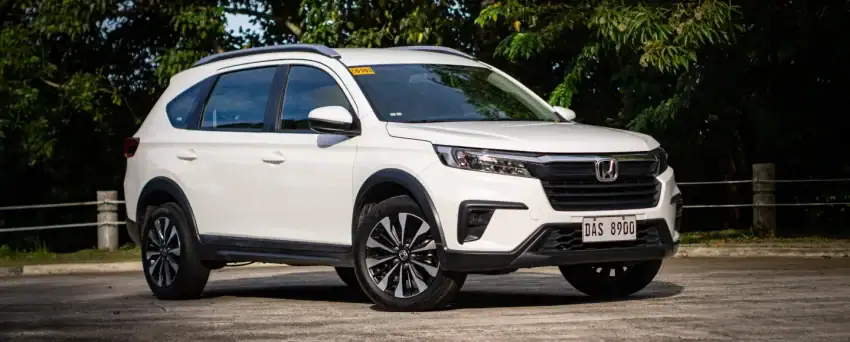
ISLAMABAD – Honda BR-V’s journey is coming to an end in Pakistan. Honda’s first local 7-Seater was rolled out in 2017 as family crossover which is now being phased out as the company shifts its focus toward newer models and hybrids.
The model, which was launched in Pakistan on April 21, 2017, has been removed from Honda Pakistan’s official lineup, while the company has confirmed that local production has come to an end.
The development is end of first-generation BR-V’s production in Pakistan, where it remained in assembly from 2017 until 2026 despite the model reaching the end of its lifecycle in several other international markets earlier.
BR-V occupied unique position in Honda Atlas’s local lineup. It was company’s first seven-seater to be assembled in Pakistan and was marketed as a practical crossover aimed at families seeking additional seating, greater ground clearance and Honda’s brand appeal. Assembled at Honda’s Lahore plant, the BR-V featured a 1.5-litre SOHC i-VTEC petrol engine producing around 118 horsepower and 145 Nm of torque.
The vehicle was initially offered with both manual and automatic transmissions, although the manual version was later phased out. Honda also introduced a facelift in 2019, updating the model’s appearance while retaining its basic first-generation platform. BR-V entered the market with a price of roughly Rs2.23 million to Rs2.33 million. By the time it reached the end of its local run, its price had climbed to around Rs5.7 million to Rs6.4 million.
Honda Atlas has not publicly identified a single reason for discontinuing the BR-V. However, the model had struggled to achieve the sales volumes of Honda’s more successful products, particularly the City and Civic.
The situation became more challenging after Honda introduced the HR-V in Pakistan in 2022. The newer crossover offered a more modern design and positioned itself closer to the growing SUV and crossover segment, where consumer demand was increasingly shifting.
BR-V and HR-V figures reported through industry data have generally remained modest compared with Honda’s core models. While Honda’s overall sales have recovered in recent periods, much of that improvement has been driven by the City and Civic rather than the BR-V.
Another factor behind the BR-V’s exit was the age of its underlying product. The vehicle continued to use the first-generation platform even as newer crossovers entered the Pakistani market with updated styling, technology, safety equipment and powertrain options. The original BR-V had already been phased out in several international markets, making its continued production in Pakistan increasingly difficult to justify as competition evolved.
Pakistani consumers have shown growing interest in modern crossovers and SUVs, while Chinese automakers have entered the market with newer and feature-rich alternatives. Economic pressures have added to the challenge. Currency fluctuations, taxation changes, import restrictions, localization issues and changing production costs have all affected Pakistan’s automotive sector in recent years.
The discontinuation also comes as Honda Atlas increasingly concentrates on its strongest products. The company’s locally assembled lineup now centers on the City, Civic and HR-V, with hybrid technology becoming an increasingly important part of its product strategy.
Honda introduced the HR-V e hybrid in Pakistan in July 2025, reflecting the company’s broader focus on hybrid vehicles as a transition toward electrification. The auto giant indicated that hybrids currently offer a more practical path for Pakistan’s market, where charging infrastructure and wider readiness for fully electric vehicles are still developing.
This strategy leaves little room for an aging, relatively low-volume model such as the BR-V.
Despite the BR-V’s departure, Honda Atlas has not announced a direct replacement. There has been speculation about a future seven-seat crossover or MPV, but the company has not officially confirmed any such model for Pakistan. For now, the HR-V remains Honda’s main locally assembled crossover, while the City and Civic continue to anchor the company’s sedan lineup.
Honda’s recent moves further highlight its focus on the HR-V and hybrid segment. In September 2026, prices of some HR-V variants were reduced following changes related to hybrid taxation. HR-V e reportedly received a price reduction of around Rs1.07 million, bringing it to approximately Rs9.299 million, while the VTi-S variant received a reduction of Rs500,000.
Honda has also sought to maintain the City below the Rs5 million threshold, positioning the model within a more competitive price and taxation range.
BR-V is also not the only established model to disappear from Pakistan’s automotive market in recent years. Suzuki discontinued several longstanding products as it has gradually modernized its lineup. Wagon R ended its local run around March 2025 after roughly 11 years, while the Ravi pickup was also discontinued in 2025. The Bolan had already been phased out as Suzuki moved toward newer commercial vehicles such as the Every.
Kia’s Picanto was another recent departure, with reports of its discontinuation around mid-2026 after several years in Pakistan. These exits reflect a broader industry trend in which manufacturers are reassessing models affected by aging platforms, low sales volumes, changing regulations, higher production costs and shifting consumer preferences.
The competitive landscape has changed significantly since the BR-V arrived in Pakistan in 2017. Chinese manufacturers and local assembly partners have expanded their presence, particularly in the SUV and crossover categories. Brands including Haval and Chery have introduced vehicles offering modern styling, extensive features and newer powertrain technologies, increasing pressure on established Japanese automakers.