
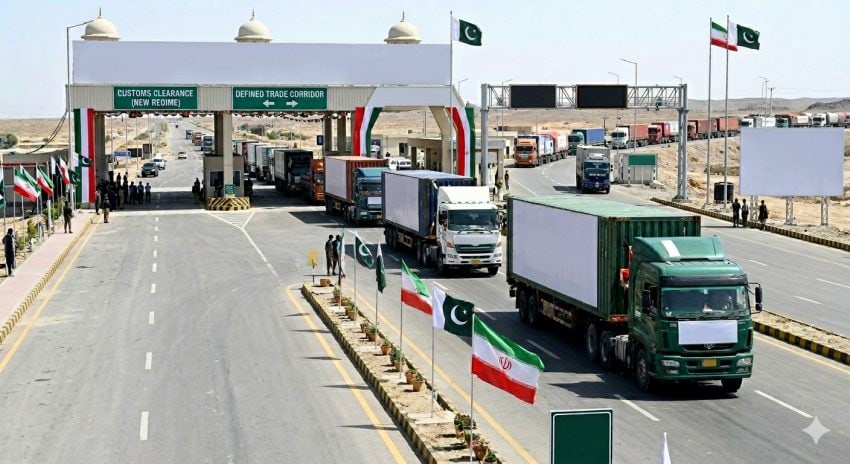
KARACHI – Pakistan has taken major step toward becoming regional trade hub, unveiling a new transit regime to move goods to Iran through well-defined corridors.
The new framework aimed at facilitating the transit of goods through Pakistan to Iran, in a move designed to streamline cross-border trade and strengthen regional connectivity.
“Transit of Goods through Territory of Pakistan Order 2026” has taken immediate effect and operates under the 2008 bilateral agreement between Pakistan and Iran on international road transport of passengers and goods.
The new regime lays down comprehensive rules governing transit operations, including procedures for cross-stuffing, customs guarantees, and the responsibilities of shippers. It clearly defines transit as the movement of goods through Pakistan as part of a journey that begins and ends outside the country.
It applies specifically to goods originating from third countries and destined for Iran via Pakistan, establishing a structured mechanism for their movement through officially designated transit corridors.
A network of key routes has been identified for transit trade, including Gwadar–Gabd; Karachi/Port Qasim–Ormara–Pasni–Gabd; Karachi/Port Qasim–Khuzdar–Dalbandin–Taftan; as well as extended corridors connecting Gwadar, Turbat, Panjgur, Khuzdar, Quetta, and Taftan. These routes are expected to significantly enhance logistical efficiency and facilitate smoother regional trade flows.
Under the new framework, all transit cargo will be regulated in accordance with the Customs Act, 1969, along with relevant rules and procedures issued by the Federal Board of Revenue (FBR). Traders will be required to submit customs security equivalent to applicable import duties to ensure full compliance.
Officials believe the initiative will ease transit procedures, reduce bottlenecks in trade movement, and strengthen economic ties with Iran, while also positioning Pakistan as a key regional transit hub for international trade.