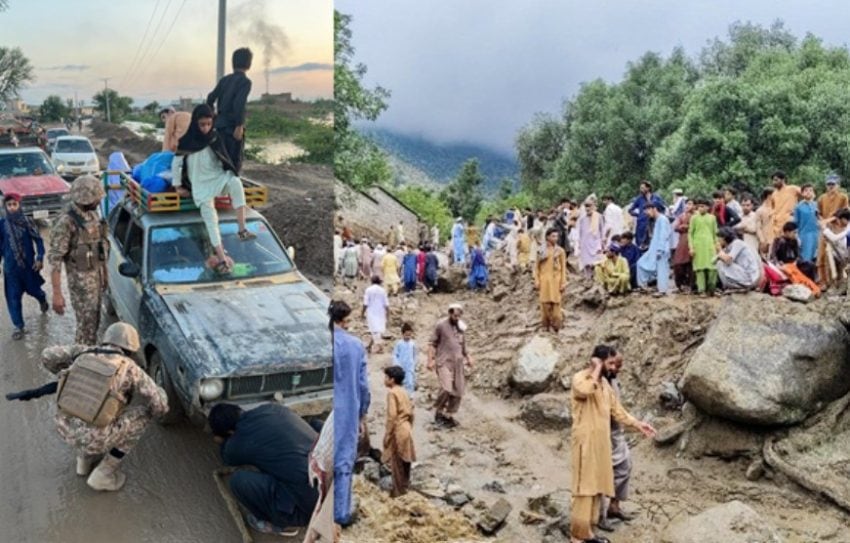
ISLAMABAD – Pakistan’s monsoon season turned deadly, with torrential rains, flash floods, lightning strikes, and collapsing structures claiming at least 14 lives and injuring dozens across multiple provinces, while authorities warn that the worst may still be ahead.
The most heartbreaking tragedy unfolded in Swat, where a tourist boat capsized at Saifullah Lake, killing six members of the same family. Rescue teams recovered all six bodies, while search operations continue for a missing woman feared to have drowned.
In KP, relentless rain, strong winds, and flash floods have wreaked havoc over the past 48 hours, leaving seven people dead and 19 injured, according to officials. In Attock, heavy rains triggered the collapse of walls and rooftops, killing three people, including two brothers, and injuring five others.
Lightning strikes added to the devastation. In Landi Kotal, two children lost their lives while four others were injured after being struck by lightning. In Upper Dir, a lightning strike hit a madrassa, injuring 20 female students.
In Zhob, a woman and a child were killed when rain-weakened roofs caved in. Another fatality was reported from Ganjial, Qaidabad, where a resident died after being struck by lightning. In Abbottabad, three people were injured after their vehicle was swept away by a rain-fed stream. In Mardan, powerful winds brought down a signboard and a wall, injuring three people, including two children.
The downpours also brought major urban disruption. Heavy rainfall in Islamabad and Rawalpindi broke the intense summer heat, while Lahore witnessed widespread showers, cool winds, and prolonged power outages after multiple electricity feeders tripped.
In Punjab, cities including Attock, Pindi Bhattian, Mandi Bahauddin, Sargodha, Bhera, Hafizabad, Kasur, and Muridke received heavy rainfall. In Gujrat, low-lying neighborhoods were inundated, while overflowing streams in Haripur created dangerous conditions. In Abbottabad, roads turned into pools of water as rainwater flooded streets and entered commercial areas.
Monsoon activity extended to Khuzdar, Zhob, Kohlu, Swabi, and Karachi, where rain and hailstorms were reported. Light drizzle fell over New Karachi, Gulshan-e-Memar, and Gadap, signaling the spread of the weather system to the country’s southern coast.
The situation remains particularly alarming in Gilgit-Baltistan, where monsoon rains triggered flooding in Gees Bala, Gees Pain, and Niat Valley in Diamer district. Floodwaters entered homes, damaged vital access roads, and cut off entire communities. Authorities said crops, orchards, and agricultural land have suffered extensive damage, while residents of Niat Valley remain isolated after road links were severed.
As the disaster unfolds, the National Disaster Management Authority (NDMA) has issued a nationwide monsoon alert, warning of heightened risks of glacial lake outburst floods (GLOFs), flash floods, landslides, and mudslides in vulnerable parts of Gilgit-Baltistan and Khyber Pakhtunkhwa.
NDMA has directed district administrations to keep emergency response teams and heavy machinery on standby, while urging residents in low-lying areas and communities along rivers to remain vigilant and follow safety advisories as fresh spells of monsoon rain threaten to intensify in the coming days.
With forecasts indicating continued rainfall across several regions, officials fear the death toll and scale of destruction could rise further unless precautionary measures are strictly observed.
Monson 2026 rains likely to start across Pakistan in first week of July