
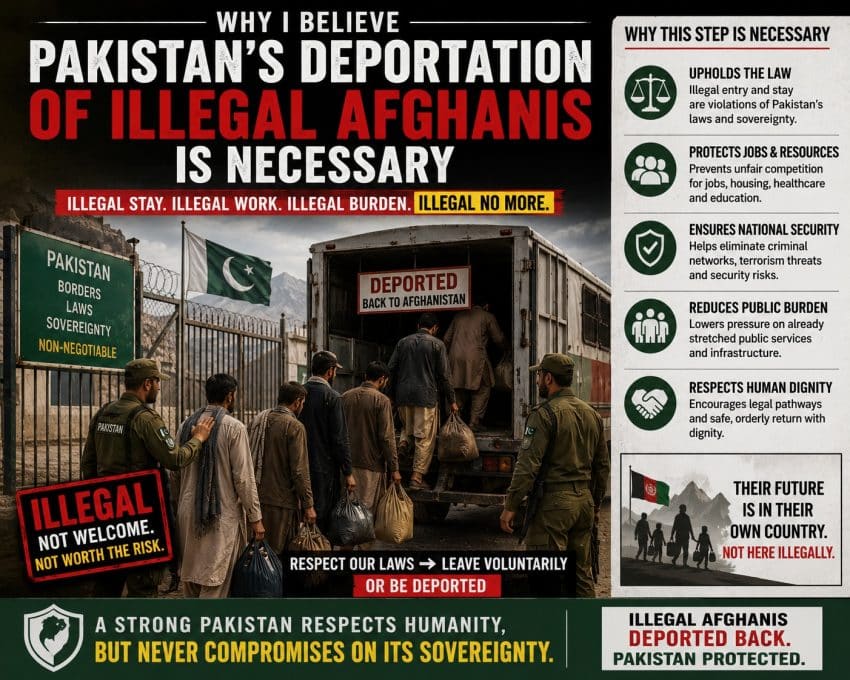
On July 10, 2026, Pakistan’s Interior Ministry began enforcing what it calls the Illegal Foreigners’ Repatriation Plan in full. Any Afghan national found here without a valid visa or UNHCR registration card is now liable to immediate arrest. I understand why some abroad see this as harsh. I do not see it that way, and I want to explain why.
I did not arrive at this position lightly. Pakistan has hosted Afghan refugees since 1979, longer than most of the people reading this have been alive. We built camps, opened schools, and shared what little our own economy could spare. That history matters to me, and it should not be erased. But hospitality is not supposed to be a one way street, and lately it has felt like exactly that.
Pakistani security sources say 265 Afghan nationals were involved in suicide bombings and other terrorist attacks inside Pakistan between 2022 and 2025. In November 2025, our own interior minister stood in parliament and confirmed that both suicide bombers behind that week’s attacks, one at a cadet college in Wana, one outside a courthouse in Islamabad, were Afghan citizens. Twelve people died outside that courthouse. I think about their families often. On the criminal side, police in Islamabad broke up an armed robbery and motorcycle snatching gang earlier this year led by an Afghan national, one case among many that rarely make international headlines but shape how ordinary Pakistanis feel about their own streets.
So I ask a simple question. Why are these networks operating from Pakistani soil instead of Afghan soil, the country whose government now runs Kabul? The honest answer is that Pakistani cities offer anonymity, weak documentation trails, and, for years, comparatively little consequence. That gap is what this policy is meant to close.
Since October 2023, roughly 2.5 million Afghans have returned from Pakistan under this same repatriation program. I try to picture any other country absorbing that many people from one neighbor and I cannot think of one that would. Certainly not India, despite the warmth on display when Afghanistan’s agriculture minister visited New Delhi this month and told his hosts, in his own words, that Afghan and Indian DNA are one. Nice words do not translate into open borders. India has not offered to resettle a fraction of that number, even all of us in Pakistan believe New Delhi has quietly found other uses for elements within Afghanistan’s instability. I will not pretend to know how that relationship ends. I only know Pakistan cannot keep absorbing the cost of hosting while absorbing the cost of attacks at the same time.
None of this means I want Afghan civilians to suffer. Even this week, while the deportation drive continued, Pakistani customs cleared 26 World Food Programme containers of food and relief supplies through Torkham for delivery inside Afghanistan. That gesture tells you something. This was never about punishing a nation. It is about which government is responsible for which people, and for how long one country can carry a burden others have stopped sharing.
I go back to a simple line, one I keep returning to. This is our land, and our resources have to be for our people first. Refugees who are here legally, registered and documented, remain welcome. Everyone else has a country of their own to return to, and after this many years, it is time they did.
Operation Shaban: How Pakistan’s Security Forces Neutralised 75 Terrorists in Balochistan