
NEW YORK – Pakistan stepped up efforts to get US financial support for three critical economic fronts. Pakistan International Airlines (PIA), the Reko Diq mining project and the modernization of the country’s refineries, with financing for new Boeing 787 Dreamliners and the revival of grounded Boeing 777s also emerging as key issues.
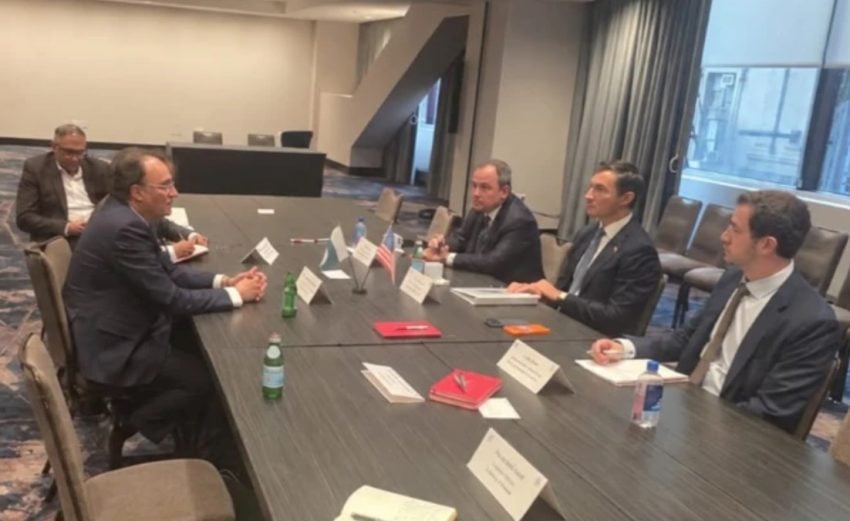
On sidelines of 81st session of United Nations General Assembly in New York, Federal Minister for Finance and Revenue Senator Muhammad Aurangzeb met with John Jovanovic, Chairman of the U.S. Export-Import Bank (EXIM Bank), where the two sides held detailed discussions on potential financial support for Pakistan’s major economic and industrial projects.
The future of PIA’s fleet emerged as a major component of the discussions. Muhammad Aurangzeb informed the U.S. EXIM Bank that PIA is interested in acquiring Boeing aircraft, particularly Boeing 787 Dreamliners, and requested U.S. support for a financing package covering the purchase of the aircraft and their engines.
The two sides also reviewed the possibility of financing pre-delivery payments for the aircraft. But Pakistan’s request extends beyond purchasing new planes.
Finance Minister also highlighted PIA’s need for spare parts to bring grounded Boeing 777 aircraft back into service, signaling that the government is pursuing both fleet expansion and the restoration of existing aircraft.
During the same visit, Aurangzeb also met Boeing Global President Dr. Brendan Nelson, with discussions focusing on PIA’s fleet modernization and broader cooperation in Pakistan’s aviation sector. According to the Pakistani government, Boeing confirmed that it would provide PIA with a revised proposal for the acquisition of new aircraft.
The discussions also covered aircraft delivery slots, interim leasing arrangements, engines, spare parts, maintenance and the rehabilitation of grounded aircraft. The development comes as Pakistan seeks to modernize PIA’s fleet following the airline’s privatization process and strengthen its operational capacity.
Reko Diq project was another major focus of the meeting with the U.S. EXIM Bank. Aurangzeb described Reko Diq as critically important to Pakistan’s future exports and economic growth, emphasizing that delays in the project could carry significant economic costs. He also welcomed the U.S. EXIM Bank’s continued interest in and commitment to supporting Reko Diq.
Pakistan’s ambitious refinery modernization program was also discussed with the U.S. EXIM Bank. Two sides reviewed the possibility of U.S. support for refinery-upgrade projects while agreeing to continue work on a broader framework for cooperation alongside progress on individual projects.
Pakistan is seeking international support for an approximately $5 billion oil refinery upgrade program, with the government engaging U.S. institutions as part of its efforts to mobilize financing. The refinery modernization effort is intended to improve the country’s refining capacity and support the broader transformation of Pakistan’s energy sector.
One of the key aspects of New York meeting was the agreement to work not only on individual projects but also on a broader framework for cooperation between Pakistan and the U.S. EXIM Bank. That potentially places several major Pakistani projects under one wider financing conversation.
On one side is PIA’s planned acquisition of Boeing 787 aircraft and financing for associated engines and advance payments. On another is the effort to return grounded Boeing 777s to service through access to spare parts.
Then there is Reko Diq, a strategically important mining project that Pakistan hopes will contribute significantly to future exports. And alongside it sits the country’s approximately $5 billion refinery modernization program, for which Pakistan is seeking international financing and technical cooperation.
The talks mark another step in Pakistan’s efforts to diversify its sources of external financing and attract support for major infrastructure, aviation, mining and energy projects. However, the discussions should not yet be described as finalized financing agreements.
The final financing amounts, terms, approvals and implementation arrangements for individual projects would still have to go through separate processes.