

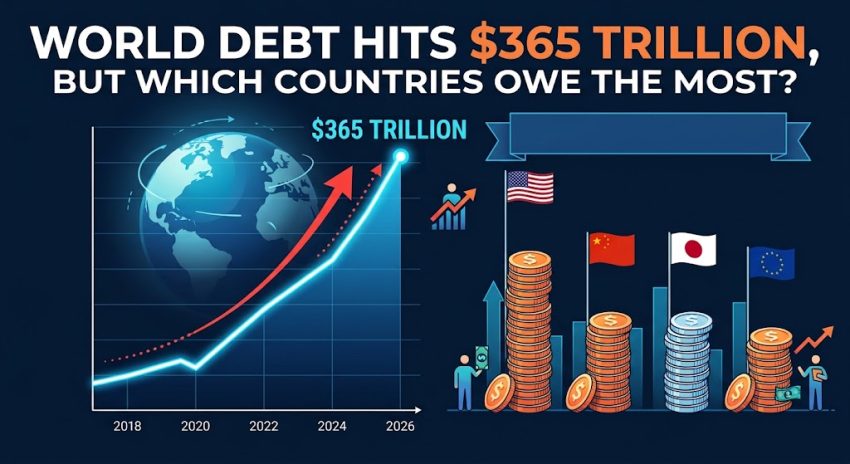
WASHINGTON — The world has crossed another staggering debt milestone as global borrowing surged by more than $10 trillion in the first half of 2026, pushing total debt to roughly $365.5 trillion, a fresh record that underscores the growing financial burden facing governments, companies and households around the world.
The figures, released by the Institute of International Finance (IIF) in its latest Global Debt Monitor, show that the world’s debt pile has continued to expand even as higher interest rates make borrowing increasingly expensive.
The latest increase represents the sixth consecutive quarterly rise in global debt. Yet the pace of accumulation has slowed sharply: the world added about $21 trillion during the first half of 2025, more than twice the increase recorded in the first six months of this year.
Emerging markets are at the center of the latest borrowing wave. Their combined debt jumped by approximately $6.5 trillion in the first half of 2026, reaching about $110.6 trillion. China accounted for the largest share of the increase. Excluding China, debt across emerging and developing economies still climbed by roughly $1.7 trillion, reaching a record $38 trillion.
$365 Trillion
The headline number is enormous, but the relationship between debt and economic output provides another perspective. Global debt now stands at roughly 310% of world GDP, around 25 percentage points below its early-2021 peak. That decline, however, does not mean the world has undergone a massive debt reduction.
The broader $365 trillion figure includes four major sectors, governments, households, financial corporations and non-financial corporations, so it should not be confused with sovereign debt alone. Using government-debt figures cited in the supplied IMF-style 2026 projections, the largest government debt piles are approximately:
| Rank | Country | Government debt |
|---|---|---|
| 1 | United States | $40.7 trillion |
| 2 | China | $22.3 trillion |
| 3 | Japan | $9.0 trillion |
| 4 | United Kingdom | $4.4 trillion |
| 5 | France | $4.3 trillion |
| 6 | Italy | $3.8 trillion |
| 7 | Germany | $3.5 trillion |
| 8 | India | $3.5 trillion |
| 9 | Canada | $2.8 trillion |
| 10 | Brazil | $2.5 trillion |
Debt-to-GDP ratios provide better indication of how large government liabilities are relative to the size of an economy, although they too have important limitations. The supplied 2026 projections put Japan’s government debt at roughly 204% of GDP, while Singapore is around 172%.
US is around 126%, while Italy, Greece, Sudan and Bahrain are also among economies with very high government-debt ratios. France, Canada and China are in the broad range of 100%–110% or above under some estimates.
IMF itself cautions that debt figures can vary according to methodology and coverage. Its 2026 Fiscal Monitor also says global public debt was just below 94% of GDP in 2025 and is projected to reach 100% by 2029 under its baseline projections.
China’s position requires particular scrutiny because its broader debt burden extends beyond conventional central-government borrowing. Debt estimates can include borrowing associated with local-government financing vehicles, as well as substantial corporate liabilities.
Perhaps the most important issue ahead is not simply the size of the debt mountain, but the amount that must continually be rolled over. IIF estimates that more than $30 trillion of debt across mature and emerging markets is approaching maturity, creating a massive refinancing requirement.
a