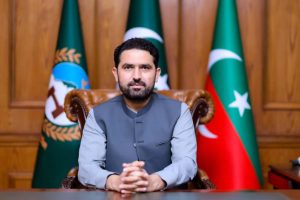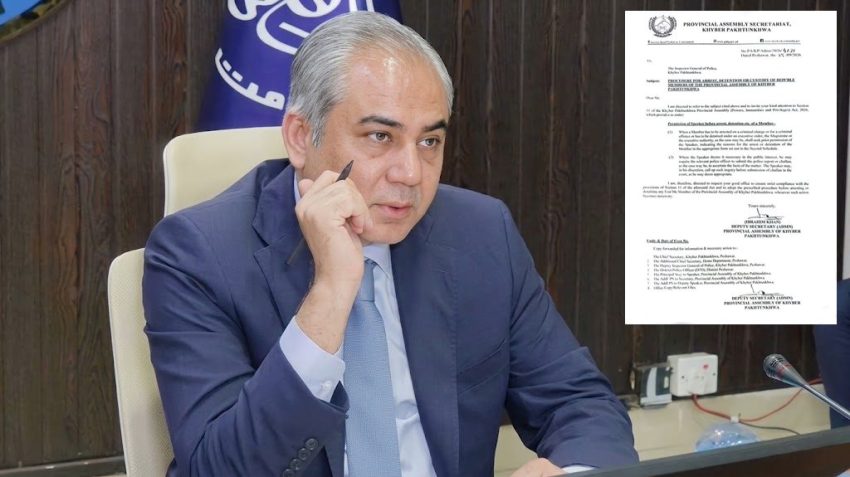
The security czar raised issue after sharing a notification issued by KP Provincial Assembly Secretariat directing Inspector General of Police and other authorities to strictly follow the procedure prescribed under Section 11 of the Khyber Pakhtunkhwa Provincial Assembly (Powers, Immunities and Privileges) Act, 2026.
Naqvi questioned how such a provision could be reconciled with the principle of equality before the law. “Now in Khyber Pakhtunkhwa, even if an MPA is accused of a criminal offence, the police must first seek the Speaker’s permission before arresting him. What next? If an MPA kills someone, will the police first wait for the Speaker’s permission to arrest him?”
Now in Khyber Pakhtunkhwa, even if an MPA is accused of a criminal offence, the police must first seek the Speaker’s permission before arresting him.
What next? If an MPA kills someone, will the police first wait for the Speaker’s permission to arrest him?
What an extraordinary… pic.twitter.com/HaxuBDT3c1
— Mohsin Naqvi (@MohsinnaqviC42) September 26, 2026
He went on to question the broader principle behind the provision, asking: “What an extraordinary version of ‘equality before law.’ Well done. Keep it up! And this is Riyasat-e-Madina?”
The notification, issued by Deputy Secretary (Administration), Provincial Assembly of Khyber Pakhtunkhwa, was addressed to the Inspector General of Police, KP. It specifically refers to Section 11 of the 2026 law, titled “Permission of Speaker before arrest, detention etc. of a Member.”
Under Section 11(1), when an MPA is to be arrested on a criminal charge or for a criminal offence, or is to be detained under an executive order, the magistrate or executive authority is required to seek prior permission from the Speaker, while providing reasons for the proposed arrest or detention.
The notification directs KP police authorities to comply with this procedure whenever action against a provincial assembly member becomes necessary.
The provision goes beyond simply requiring permission. Under Section 11(2), the Speaker may, where he considers it necessary in the public interest, require the relevant police officer to submit the police report or challan to ascertain the facts of the matter.
The law further states that the Speaker may, at his discretion, call for an inquiry before submission of the challan to the court.
This effectively places a procedural step involving the Assembly Speaker between the authorities and the arrest or detention of an MPA under the provision cited in the notification. The notification therefore formally directs the police and concerned authorities to adopt the prescribed procedure before arresting or detaining an MPA.
The issue is not new. KP Provincial Assembly Act, 2026 was passed earlier this year and attracted criticism over expanded privileges for lawmakers.
The original legislation included provisions concerning official passports, arms licences, preventive detention and the requirement for the Speaker’s permission before arresting a member on criminal charges
Amid public and political criticism, KP Assembly later amended the law and withdrew several controversial provisions. Assembly’s official records list the Powers, Immunities and Privileges (Amendment) Act, 2026, passed on August 7 and enforced on August 19.