
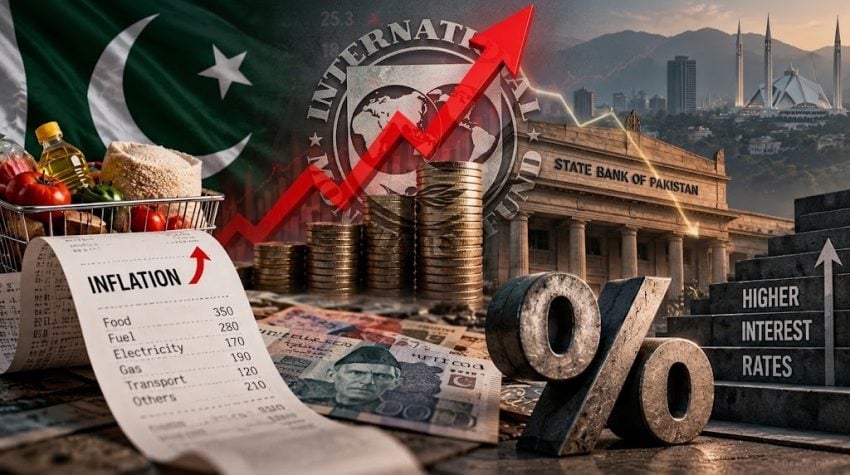
ISLAMABAD – Pakistan could face another wave of inflationary pressure in 2027, with International Monetary Fund (IMF) projecting fifth most populous country’s inflation rate to surge to 9.9% while economic growth slows slightly, raising fresh concerns about the economic outlook.
In World Economic Outlook (WEO) report, the IMF said inflation is expected to climb from 7.1% in 2026 to 9.9% in 2027, marking an increase of 2.8 percentage points in just one year. The forecast shows sharp reversal from last year, when Pakistan’s inflation rate stood at 4.5%. If the projections materialise, inflation will have increased by 5.4 percentage points over two years.
Amid soaring fuel and food prices, the outlook shows challenging picture for Pakistan, as rising inflation coincides with a slight moderation in economic growth and an anticipated deterioration in the country’s current account position.
IMF’s projections point to a steady acceleration in inflation over the forecast period, with the rate expected to rise from 4.5% in 2025 to 7.1% in 2026 before approaching double digits next year.
The projected increase could intensify pressure on household budgets and business costs, although the forecast does not establish precisely which factors will drive the anticipated rise.
IMF’s Pakistan Economic Forecasts
| Economic Indicator | 2025 | 2026 Forecast | 2027 Forecast |
|---|---|---|---|
| Inflation | 4.5% | 7.1% | 9.9% |
| GDP growth | 3.2% | 3.6% | 3.5% |
| Unemployment | 7.1% | 6.9% | 6.5% |
| Current account balance (% of GDP) | +0.5% | — | -1.0% |
Source: IMF’s October 2026 WEO
Alongside the inflation outlook, Pakistan’s economic growth is projected to ease to 3.5% in 2027 after reaching an estimated 3.6% in 2026. The growth rate is expected to improve from 3.2% in 2025 to 3.6% this year before losing some momentum next year.
Although the projected slowdown is marginal, the combination of higher inflation and softer growth could complicate the economic outlook. The figures nevertheless indicate continued economic expansion rather than a contraction.
IMF calls for immediate end to broad fuel subsidy scheme in Pakistan
IMF’s projections offer a comparatively positive signal for Pakistan’s labour market, with unemployment expected to fall from 7.1% in 2025 to 6.9% in 2026 and 6.5% in 2027. However, these are projected figures, not confirmation that unemployment has already declined or that the anticipated improvement is guaranteed.
Pakistan’s external position could also weaken over the coming years, according to the figures. The current account balance is projected to shift from a surplus equivalent to 0.5% of GDP in 2025 to approximately zero in 2026 before moving into a deficit of 1% of GDP in 2027.
If the forecast materialises, the deterioration could increase attention on the country’s external financing requirements and its ability to manage external economic pressures.
The IMF’s latest global outlook highlights a world economy that continues to demonstrate resilience but remains exposed to geopolitical tensions, trade disruptions and financial vulnerabilities. Global economic growth is projected to rise from 3.1% in 2026 to 3.4% in 2027, while headline inflation is expected to decline from 4.7% to 4.1%.
It also mentioned that the expected improvement in global growth, the Fund warns that the benefits of economic resilience are unevenly distributed, leaving some countries more vulnerable to future shocks.
Continued conflict in the Middle East poses a risk to energy supplies and international markets. Any disruption that drives oil prices higher could increase transportation, food and production costs, adding to inflationary pressures in energy-importing economies.