
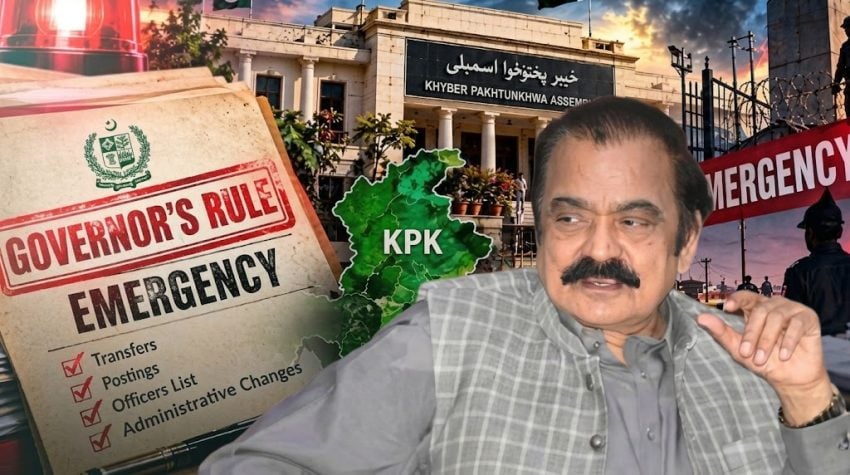
ISLAMABAD – The emergency imposed in Khyber Pakhtunkhwa could remain in force until next general elections in 2029, Prime Minister’s Adviser on Political Affairs Senator Rana Sanaullah Khan said, saying the federal government may pursue extended emergency arrangement if the province’s security situation fails to improve.
Speaking on programme G For Gharidah, Sanaullah said an emergency imposed under Article 232 of the Constitution could continue until the next elections. His statements brought the duration of the extraordinary measures in KP into sharp focus amid growing political tensions, security concerns and legal challenges amid debate that such setup could hardly last 6 months with extensions.
Later, TV show host Gharidah Farooqi shared post online, saying the emergency in Khyber Pakhtunkhwa could remain in place until the next elections.
Rana Sanaullah’s remarks raised questions about the distinction between an emergency under Article 232 and governor’s rule under Article 234, two constitutional provisions associated with the federal government’s extraordinary measures in the province.
Article 232 deals with the proclamation of an emergency in circumstances involving threats to national security, including war, external aggression or internal disturbances beyond the capacity of a provincial government to control, subject to constitutional requirements. Unlike governor’s rule under Article 234, an emergency under Article 232 does not carry the same fixed six-month ceiling. Its continuation remains subject to the Constitution’s applicable requirements and parliamentary procedures.
KP Emergency Rule Explained: Why Many Are Calling It Youm-e-Nijat
Rana Sanaullah said the move aims is to restore peace and enable residents to live and conduct business without fear. He said the government would seek to improve the situation within three to six months. However, if conditions failed to improve, he warned that emergency measures could be imposed repeatedly.
His remarks suggest that the government is linking the duration of its extraordinary measures to progress on security rather than committing to a short, fixed timetable for returning to normal provincial administration.
The federal government cited rising terrorist attacks, deteriorating law and order, and allegations that the Pakistan Tehreek-e-Insaf-led provincial administration had failed to cooperate adequately in addressing the security situation.
Under the announced arrangement, provincial administrative authority was placed under Governor Faisal Karim Kundi, while the offices of Chief Minister Sohail Afridi and other provincial officeholders were reported to have been terminated or suspended under the measures. The move has intensified the confrontation between the federal government and the PTI, which has opposed the intervention.
Pakistan’s next general elections are due by February 28, 2029, based on the five-year term following February 2024 polls, unless the National Assembly is dissolved earlier or other constitutional developments alter the timetable.