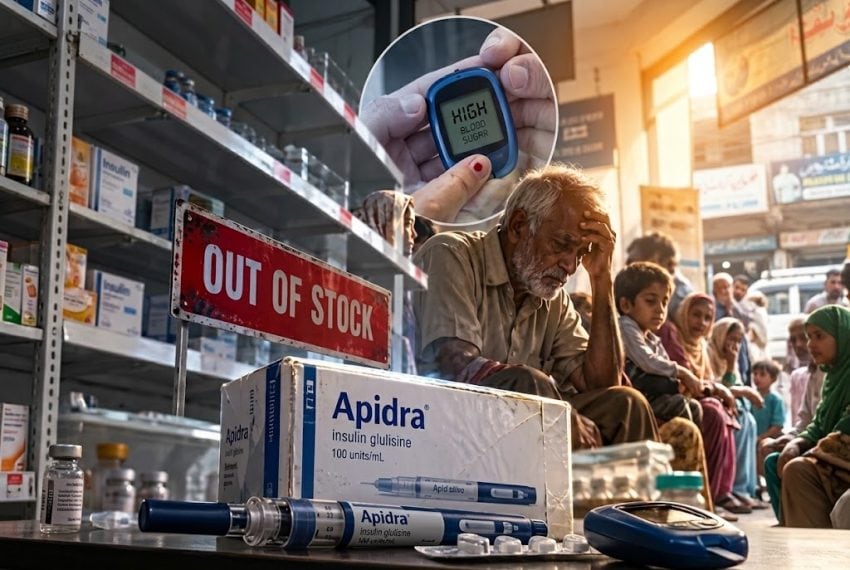
LAHORE – Pakistan’s insulin supply comes under renewed scrutiny amid reports of unavailability of Apidra, which raised concerns among diabetic patients, prompting health authorities to clarify that the disruption is limited to one brand rather than a nationwide shortage.
The clarification comes at critical time for Pakistan, where estimated 3-3.5 Crore adults are living with diabetes, making the country one of the most affected nations worldwide. Officials insist that alternative insulin products remain available, patients’ concerns have reignited questions about the reliability, affordability and long-term sustainability of essential medicine supplies.
Health ministry spokesperson Sajid Shah said Apidra, a rapid-acting insulin manufactured by Sanofi, is currently unavailable because of international supply constraints. He maintained that other insulin products continue to be accessible across Pakistan.
NovoRapid, manufactured by Novo Nordisk, and Humalog, produced by Eli Lilly, are available as alternative rapid-acting insulin analogues. Human insulin formulations and other insulin analogues are also reportedly available.
However, the distinction between a brand-specific disruption and a nationwide shortage offers little immediate reassurance to patients who depend on a particular prescription. Social media discussions and media reports, including coverage highlighting difficulties in Lahore, have drawn attention to the challenges some patients face when trying to obtain Apidra.
Doctors caution that patients should not switch insulin products independently. Different formulations can have varying effects on blood glucose levels, making medical guidance, appropriate dose adjustments and regular monitoring essential when changing treatment.
Recent estimates associated with the International Diabetes Federation’s Diabetes Atlas put the number of adults aged 20 to 79 living with diabetes in Pakistan at approximately 34 million to 34.5 million. By absolute patient numbers, Pakistan ranks behind China and India, while its age-standardised prevalence has been estimated at around 31.4%, among the highest worldwide.
Access to treatment can be even more difficult for families outside major cities, where specialised diabetes services and paediatric endocrinologists may be limited. The cost of ongoing medication adds another burden for low-income households.
Provincial initiatives, including diabetes screening and free-insulin programmes in Khyber Pakhtunkhwa, are among the efforts aimed at improving access. Nevertheless, the latest concerns underline the importance of ensuring that essential treatments remain consistently available.
The insulin issue has also revived concerns over Pakistan’s wider medicine supply chain. Last year, Pakistan Medical Association warned that at least 80 essential medicines were facing shortages, including treatments for diabetes, cancer and heart disease. PMA also warned of potential black-market activity, where shortages can make essential medicines more difficult to obtain and potentially more expensive.
Diabetic children in Punjab to get Insulin delivered to their doorstep under CM’s Initiative