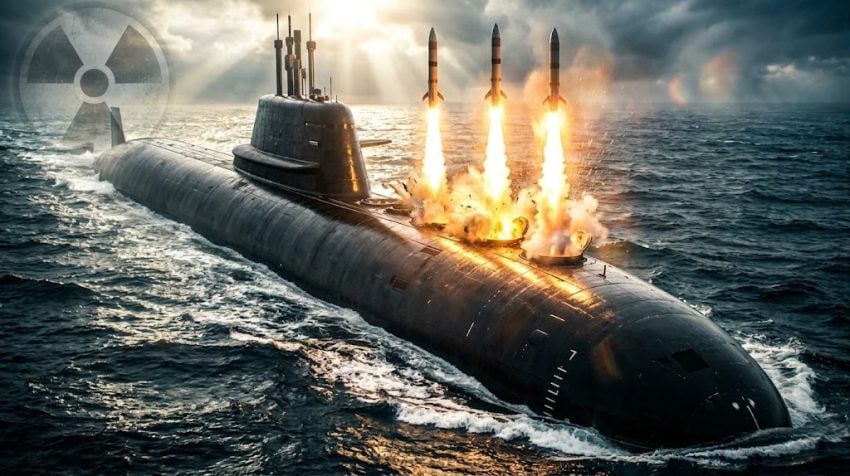
ISLAMABAD – Pakistan raised the alarm over what it describes as India’s increasingly aggressive nuclear posture, warning that the expansion of sea-based nuclear capabilities could push South Asia towards a potentially catastrophic conflict.
Lieutenant General (retd) Mazhar Jamil, an adviser to Pakistan’s National Command Authority (NCA) and former D.G of the Strategic Plans Division, questioned the credibility of India’s declared No First Use (NFU) nuclear policy, arguing that its evolving military capabilities warrant serious international scrutiny.
Addressing the 11th Track 1.5 workshop organised by the International Institute for Strategic Studies (IISS) and the Centre for International Strategic Studies in London, Jamil warned that developments involving India’s submarine-launched ballistic missiles could increase the risk of miscalculation during a military crisis.
Jamil argued that New Delhi’s continued efforts to strengthen its sea-based nuclear deterrent were inconsistent with the assurances conveyed by its NFU policy. He characterised the policy as a diplomatic façade, alleging that New Delhi’s actions pointed towards a more aggressive nuclear posture. His remarks have renewed attention on the nuclear rivalry between Pakistan and India, particularly following their intense military confrontation in May 2025.
Jamil cited assessments attributed to the Stockholm International Peace Research Institute (SIPRI) and other research sources, saying reports indicated that India had begun pairing nuclear warheads with submarine-launched ballistic missiles and conducting maritime patrols.
He warned that the combination of submarine-based nuclear weapons and limited advance notification of missile tests could complicate crisis management, increasing the possibility of misinterpretation and dangerous decisions during periods of heightened tension.
Submarine-launched nuclear weapons are particularly significant because they can operate away from established land-based installations, making it more difficult for rival states to assess their movements and intentions. Jamil argued that India’s development of longer-range missiles and acquisition of dual-use technologies were also affecting the strategic balance in South Asia.
Pakistan has repeatedly advocated a “No War Pact” with India, but continuing military competition between the two nuclear-armed neighbours has complicated efforts to establish lasting confidence-building measures.
While Jamil’s allegations reflect Pakistan’s security concerns, India’s nuclear doctrine and the operational role of its sea-based capabilities remain subjects of wider strategic debate.
Jamil urged the international community to reconsider the Nuclear Suppliers Group’s (NSG) 2008 exemption for India, which opened the way for international civilian nuclear trade despite India not being a signatory to the Nuclear Non-Proliferation Treaty (NPT). He argued that the exemption, coupled with assistance from international technology partners, had helped India expand its nuclear and missile programmes, raising questions about transparency, non-proliferation standards and regional security.
Jamil called for the waiver to be withdrawn, maintaining that India’s evolving strategic capabilities required a reassessment of the international arrangements governing nuclear cooperation.
The warning comes months after the most serious military confrontation between Pakistan and India in more than two decades, which brought the nuclear-armed neighbours into a dangerous cycle of strikes and retaliation.
India watches closely as China’s Hangor-class submarine set to join Pakistan’s fleet