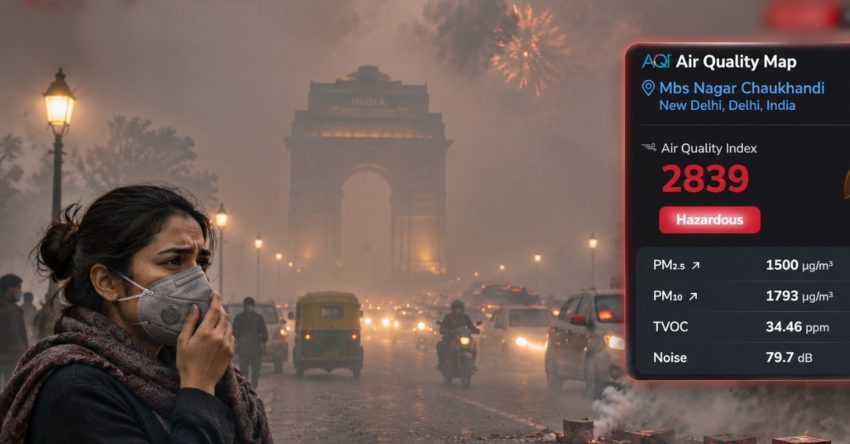
NEW DELHI – Indian capital plunged into alarming pollution crisis as relentless Diwali fireworks blanketed Delhi in thick, toxic smog, triggering people to check air quality readings which shows 3,000 after Diwali firecrackers.
The environmental emergency sparked fresh political confrontation, with opposition Aam Aadmi Party (AAP) accusing BJP-led Delhi government of manipulating pollution figures to conceal the true severity of the situation.
The crisis also coincided with startling real-time rankings suggesting that 99 of the world’s 100 most polluted cities were located in India, highlighting the scale of the pollution emergency gripping the country.
Delhi AQI at 3,000
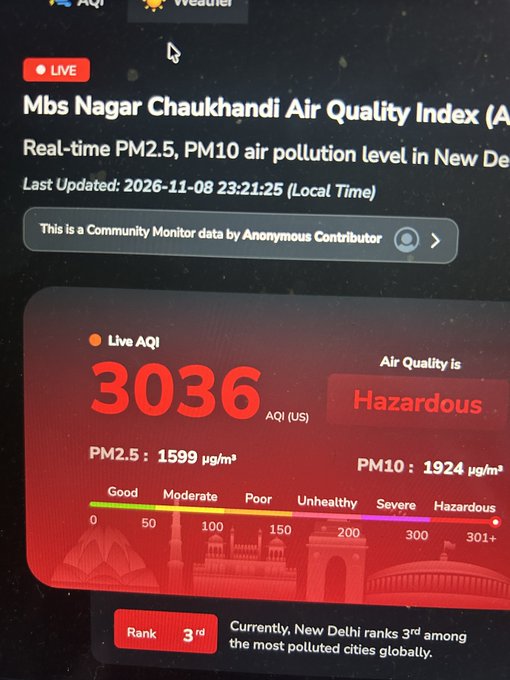
AAP leader Saurabh Bhardwaj claimed that independent air quality monitoring platforms recorded pollution levels exceeding 3,000 during Diwali celebrations, sharply contradicting official government figures.
He questioned the credibility of Delhi’s pollution monitoring system and accused authorities of deliberately presenting misleading information to millions of residents. Bahrdwaj alleged that 20 additional air quality monitoring stations had been installed in greener, relatively cleaner areas of Delhi to influence reported pollution levels.
In an even more serious allegation, Bhardwaj claimed that water was being sprayed around monitoring stations in heavily polluted locations to artificially reduce particulate readings. The opposition leader accused the government of concentrating on improving pollution statistics rather than addressing the hazardous air threatening public health.
Even without the disputed readings, Delhi’s officially recorded pollution levels remained dangerously high. Central Pollution Control Board reported a citywide AQI of 376 on November 8, placing Delhi in the very poor category.
By Sunday evening, 19 monitoring stations had recorded severe pollution, while 33 registered very poor air quality and seven remained in the poor category. Jahangirpuri emerged among the worst-affected neighbourhoods, with an AQI reading of 460.
Independent monitoring platforms reported considerably higher figures, including a reading of 1,331 during the early hours of November 9. India’s official AQI scale ranges from 0 to 500, meaning higher figures reported by independent platforms cannot be directly compared with government measurements.
According to a real-time ranking from independent platform AQI.in on November 9, Indian cities occupied 99 of the world’s 100 most polluted positions at the time of measurement. Bathinda reportedly topped the list with an AQI of 816, followed by Faridkot at 804, Rewari at 696 and Sri Ganganagar at 689.
New Delhi stood fifth with a reading of 635, while Pakistan’s Lahore was reportedly the only non-Indian city among the top 100, ranking 15th with an AQI of 466. These figures represented a specific monitoring snapshot rather than a permanent global ranking.
Toxic Smog
Despite restrictions on firecrackers, celebrations continued late into Sunday evening across Pitampura, Burari, Mayur Vihar and Lutyens’ Delhi. Authorities had permitted only approved green firecrackers. However, reports of fireworks continuing outside authorised hours raised serious questions about enforcement.
Firecracker emissions added to existing pollution from traffic, industrial activity, construction dust and agricultural burning, while stagnant weather conditions restricted the dispersal of hazardous particles.
The worsening air quality poses particular risks to children, elderly residents and people suffering from respiratory or cardiovascular diseases.
Lahore chokes on Toxic Smog as Breathing Air equals ‘Smoking 10 Cigarettes a Day’