Ask a Sindhi nationalist why a new province cannot happen, and the answer is always unity, culture, the river, the ancestors. What never comes up is the seat count, and it exposes the whole argument.
Start with the nationalist parties themselves. In the general election held on 8 February 2024, the Grand Democratic Alliance, the coalition carrying what remains of Sindh’s dedicated nationalist bloc, Sindh Taraqi Pasand Party, Qaumi Awami Tehreek and Sindh United Party, won two general seats out of 130 in the entire Sindh Assembly, and most of even that belongs to a non nationalist partner in the coalition. Qaumi Awami Tehreek’s own president, Ayaz Latif Palijo, the most recognisable Sindhi nationalist still willing to contest, lost his own seat in Hyderabad that night, polling 7,369 votes against the winning PPP candidate’s 38,693.
The harder-line factions, Jeay Sindh Qaumi Mahaz and Jeay Sindh Muttahida Mahaz, barely appear on the ballot at all, since both reject Pakistan’s parliamentary system and campaign for independence instead. Honestly counted, dedicated nationalist seats in the 168-member assembly round to zero, yet that objection gets treated as the voice of Sindh.
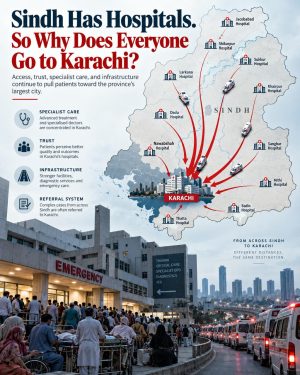
The party that actually holds power is something else entirely. Karachi’s economy carries the province, an estimated ninety per cent of Sindh’s output, and FBR data put the city’s share of national income tax at roughly 41 per cent, more than Lahore and Islamabad combined. Yet Karachi division holds only 47 of the assembly’s 130 general seats, about 36 per cent, up from 44 before the 2023 delimitation. A city generating nine tenths of the province’s economy controls barely a third of the votes deciding how it gets spent.
The ruling party’s mandate makes this sharper still. It won 84 general seats overall in 2024, but only 10 from Karachi, seventy-four from interior districts contributing a fraction of the city’s tax revenue. With reserved seats added, its strength reached 116 in the 168-seat house, past the 112 needed for the two-thirds majority the constitution requires to create a new province. It has enough votes to make this happen tomorrow. The threshold nationalists call proof of fairness sits in the hands of the one party with every incentive never to use it, while the parties actually speaking in nationalism’s name hold no comparable leverage.
Follow the money and the incentive is plain. Karachi’s revenue funds a rural-urban quota system reserving jobs and university seats for the interior, and cross-subsidises districts still trailing the country on literacy and maternal health after eighteen straight years of the same government. Break the province apart, and that transfer breaks with it. When the numbers run out, nationalists reach for 1955, when Sindh lost its provincial government for fifteen years before it was restored in 1970, a real wound doing work it was never meant to do, standing in for an argument about tax shares that has nothing to do with what happened seventy years ago.
There is also a case for the province on its own terms, separate from who is blocking it. An elected urban government would answer directly to the people living with Karachi’s water shortages, garbage backlogs and collapsing public transport, rather than to a legislature elected mostly outside the city, and it would keep more of the revenue Karachi already generates to spend on those problems instead of routing it through a provincial budget shaped by rural priorities. Smaller, more responsive administrations tend to move faster on local infrastructure precisely because the people deciding the budget live with the results of neglecting it. The same argument extends to Hyderabad, Sukkur and Larkana, Sindh’s other major urban centres, which compete with hundreds of rural constituencies for a provincial government’s attention despite generating tax revenue far out of proportion to the services they receive back.
None of this means Karachi’s civic failures are imaginary, or that poverty in interior Sindh is a myth. They are precisely the reasons why the province needs a serious debate about administrative reform. Sindh’s shared irrigation system and the fact that Sindhi speakers remain close to sixty per cent of the population are important realities, but neither automatically means that Sindh must remain a single administrative unit. A new province would not erase Sindh’s cultural identity or divide its people; it could instead bring government closer to citizens, improve accountability, and allow Karachi and the interior to address their very different economic and administrative challenges. The real question, therefore, is not whether Sindh should remain politically indivisible, but whether its current structure is actually delivering effective governance to all of its people.