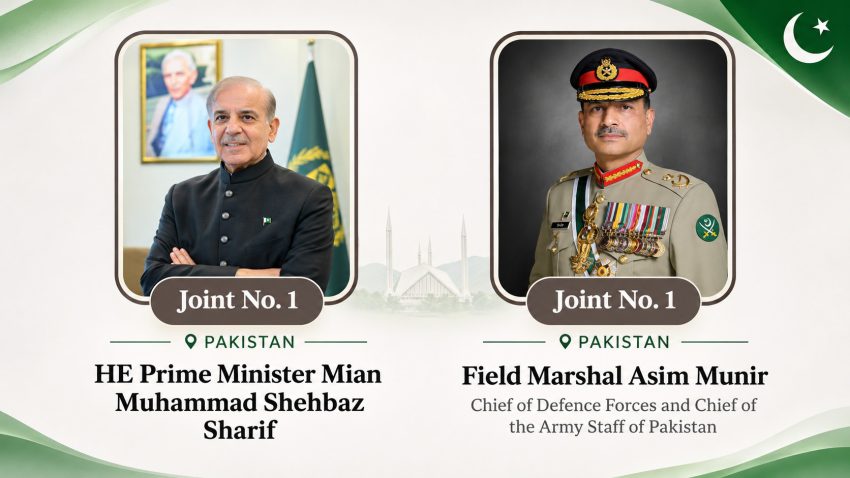
ISLAMABAD – Pakistan emerged at the forefront of global Muslim leadership as Prime Minister Shehbaz Sharif and Chief of Defence Forces Field Marshal Asim Munir jointly secured the number one position in the 2027 edition of The Muslim 500.
The annual publication picked five leaders from three countries at the top of its influential Muslim personalities ranking, marking the first such arrangement in its 18-year history. This recognition puts Shehbaz Sharif and Field Marshal Asim Munir on equal footing with Saudi Arabia’s King Salman bin Abdulaziz, Crown Prince Mohammed bin Salman and Turkish President Recep Tayyip Erdoğan.
The fresh 18th edition shows growing influence of Pakistan’s political and military leadership in shaping regional security, international diplomacy and cooperation among Muslim-majority nations. At the heart of the historic ranking is the strengthening strategic alliance between Pakistan, Saudi Arabia and Türkiye, which the publication identifies as a major turning point in regional defence cooperation.
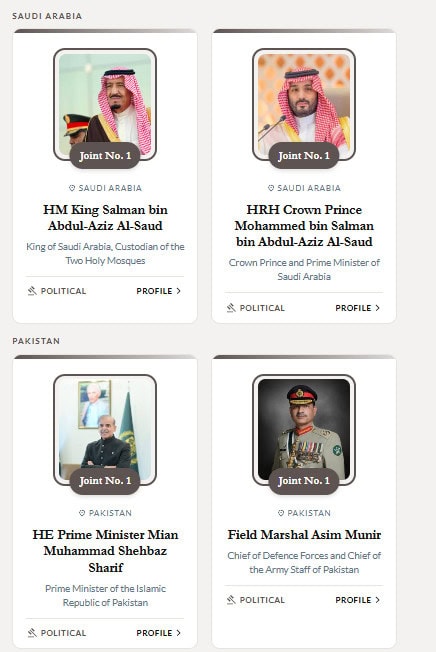
The report particularly highlights the Makkah Joint Defence Agreement, signed on August 7, 2026, and subsequently activated during an emergency summit in Riyadh. The agreement brings together three major strengths, Saudi Arabia’s financial resources, Türkiye’s technological and industrial capabilities, and Pakistan’s military might.
For Pakistan, the development places both its civilian government and military leadership at the centre of an emerging international security partnership.
Six Pakistani Personalities Secure Places Among Global Muslim Elite
Pakistan’s prominence in the 2027 edition extends beyond Prime Minister Shehbaz Sharif and Field Marshal Asim Munir.
Four leading Pakistani religious personalities have also earned positions among the world’s 50 most influential Muslims, bringing the country’s representation in the top-ranking group to six individuals.
Mufti Muhammad Taqi Usmani has
Renowned Islamic scholar Mufti Muhammad Taqi Usmani has secured seventh position, making him one of the highest-ranked religious scholars in the publication.
Maulana Tariq Jamil
Prominent preacher Maulana Tariq Jamil occupies 32nd place, reflecting his influence in religious preaching and public engagement.
Meanwhile, Tablighi Jamaat leader Maulana Nazar ur-Rehman has been ranked 41st, while Dawat-e-Islami founder Sheikh Muhammad Ilyas Attar Qadiri has secured 44th position.
Together, these figures demonstrate Pakistan’s influence not only in international politics and defence but also in Islamic scholarship, spiritual guidance and religious outreach.
| Rank | Personality | Country |
|---|---|---|
| Joint No. 1 | Prime Minister Shehbaz Sharif | Pakistan |
| Joint No. 1 | Field Marshal Asim Munir | Pakistan |
| Joint No. 1 | King Salman bin Abdulaziz Al Saud | Saudi Arabia |
| Joint No. 1 | Crown Prince Mohammed bin Salman | Saudi Arabia |
| Joint No. 1 | President Recep Tayyip Erdoğan | Türkiye |
| 4 | Ayatollah Sayyid Mojtaba Khamenei | Iran |
| 5 | King Abdullah II | Jordan |
| 6 | Sheikh Tamim bin Hamad Al Thani | Qatar |
| 7 | Mufti Muhammad Taqi Usmani | Pakistan |
| 8 | Sheikh Al-Habib Umar bin Hafiz | Yemen |
| 9 | Sheikh Ahmad Muhammad Al-Tayyeb | Egypt |
| 10 | Sheikh Abdullah bin Bayyah | Mauritania |
| 11 | Grand Ayatollah Ali Al-Sistani | Iraq |
| 12 | President Mohamed bin Zayed Al Nahyan | UAE |
| 13 | Prime Minister Anwar Ibrahim | Malaysia |
| 14 | King Mohammed VI | Morocco |
| 15 | Sheikh Salman Al-Ouda | Saudi Arabia |
| 16 | President Prabowo Subianto | Indonesia |
| 17 | Sheikh Abdul-Malik Al-Houthi | Yemen |
| 18 | Maulana Mahmood Madani | India |
| 19 | Sultan Muhammadu Sa’adu Abubakar III | Nigeria |
| 20 | Professor Ibrahim Kalin | Türkiye |
| 21 | Yahya Cholil Staquf | Indonesia |
| 22 | President Abdel Fattah El-Sisi | Egypt |
| 23 | Sheikh Ali Gomaa | Egypt |
| 24 | Sheikh Habib Ali Al-Jifri | Yemen |
| 25 | Sheikh Hamza Yusuf | United States |
| 26 | Sheikh Ahmad Tijani Cisse | Senegal |
| 27 | Sheikh Usama Al-Sayyid Al-Azhari | Egypt |
| 28 | Sheikh Muhammad Al-Yaqoubi | Syria |
| 29 | Captain Ibrahim Traoré | Burkina Faso |
| 30 | Sheikh Mustafa Hosny | Egypt |
| 31 | Al-Habib Muhammad Luthfi bin Yahya | Indonesia |
| 32 | Maulana Tariq Jamil | Pakistan |
| 33 | Professor Seyyed Hossein Nasr | United States |
| 34 | Dr Timothy Winter (Abdal Hakim Murad) | United Kingdom |
| 35 | President Samia Suluhu Hassan | Tanzania |
| 36 | Sheikh Muqtada Al-Sadr | Iraq |
| 37 | Sheikh Uthman Taha | Syria |
| 38 | Sheikh Rached Ghannouchi | Tunisia |
| 39 | Mohamed Salah | Egypt |
| 40 | President Shavkat Mirziyoyev | Uzbekistan |
| 41 | Maulana Nazar ur-Rehman | Pakistan |
| 42 | Ibrahim Saleh Al-Hussaini | Nigeria |
| 43 | Mullah Haibatullah Akhundzada | Afghanistan |
| 44 | Sheikh Muhammad Ilyas Attar Qadiri | Pakistan |
| 45 | President Mahmoud Abbas | Palestine |
| 46 | President Ahmed Al-Sharaa | Syria |
| 47 | Professor Mustafa Abu Sway | Palestine |
| 48 | Sheikh Hatim Al-Awni | Saudi Arabia |
| 49 | Zohran Mamdani | United States |
| 50 | Dr Hussam Abu Safiya | Palestine |
Other Muslim World Leaders Feature in Global Rankings
Beyond the five personalities sharing first place, Iran’s Supreme Leader Ayatollah Sayyid Mojtaba Khamenei occupies fourth position, followed by Jordan’s King Abdullah II in fifth and Qatar’s Emir Sheikh Tamim bin Hamad Al Thani in sixth.
Yemeni spiritual leader Al-Habib Umar bin Hafiz is ranked eighth, while Egypt’s Grand Imam of Al-Azhar, Sheikh Ahmad Al-Tayyeb, appears ninth.
Mauritanian scholar Sheikh Abdullah bin Bayyah completes the top 10. Other influential political personalities include Malaysian Prime Minister Anwar Ibrahim at number 13, Indonesian President Prabowo Subianto at number 16, Egyptian President Abdel Fattah El-Sisi at number 22 and Uzbekistan’s President Shavkat Mirziyoyev at number 40.
Liverpool football star Mohamed Salah has also secured a place at number 39, while New York City Mayor Zohran Mamdani appears at number 49.
The publication has also recognised individuals whose contributions extend beyond political power and religious leadership. Palestinian paediatrician Dr Hussam Abu Safiya, the former director of Kamal Adwan Hospital in northern Gaza, has been named Man of the Year 2027.
His recognition acknowledges his medical services during Israel’s military campaign in Gaza and his continued detention by Israeli forces. He is also ranked 50th among the world’s most influential Muslims.
Iranian schoolgirl Fatemeh Zahra Sheikhabadi, who survived the February 2026 attack on Shajareh Tayyebeh Elementary School in Minab, has been selected as Woman of the Year.
The Muslim 500 ranks individuals according to their influence on Muslim communities through politics, religious scholarship, economic activity, education, culture, philanthropy and social engagement. The publication covers approximately 2.2 billion Muslims worldwide and identifies 500 personalities whose leadership, decisions or public activities carry significant influence.