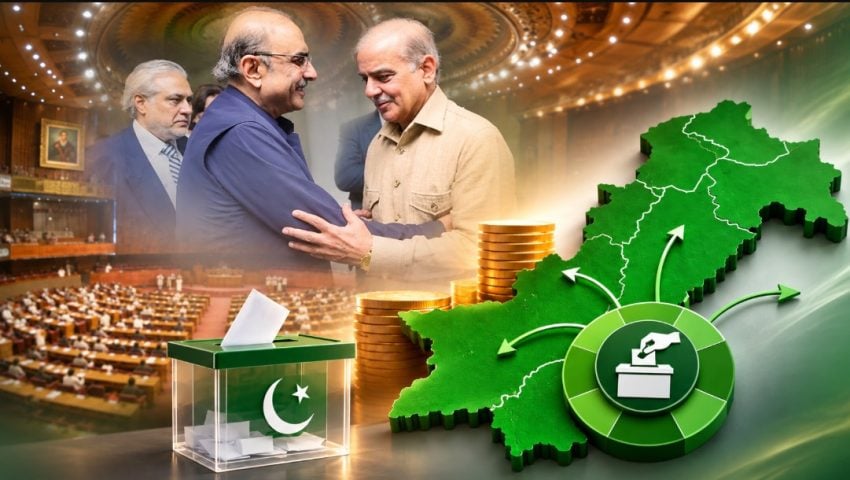
LAHORE – Pakistan’s heated debate over creation of new provinces reached highest levels of political leadership, with President Asif Ali Zardari and Prime Minister Shehbaz Sharif discussed nationwide referendum and proposals to redraw country’s provincial boundaries.
The high-profile meeting came just two days after Interior Minister Mohsin Naqvi publicly floated the possibility of a referendum to settle the controversial issue of establishing new provinces. While official statements focused on political stability, economic challenges and coalition coordination, sources familiar with the discussions revealed that the constitutional procedure for creating additional provinces emerged as a major subject of deliberations.
President Zardari and Prime Minister Shehbaz Sharif agreed that any attempt to establish new provinces or restructure existing administrative boundaries must strictly comply with Pakistan’s Constitution.
The leaders reportedly discussed that neither the federal Parliament nor the provincial assemblies could be bypassed in a decision carrying such far-reaching constitutional and political consequences. Any proposal to seek public opinion through a referendum would have to pass through the parliamentary process, including approval of the decision to hold a vote and the questions to be presented to citizens.
The reported understanding effectively places constitutional safeguards and political consensus at the centre of the debate, even as calls for administrative restructuring gain momentum. However, neither Presidency nor the Prime Minister’s Office officially confirmed that new provinces or referendum arrangements were discussed during the meeting.
One of key sensitive aspects of reported discussions involved the territorial integrity of Sindh, where the Pakistan Peoples Party has repeatedly rejected demands for dividing the province.
President Zardari reportedly reaffirmed the PPP’s position that Sindh’s existing boundaries should remain intact, referring to the resolution adopted by the Sindh Assembly on September 3, 2026. The resolution rejected any attempt to divide Sindh, alter its geographical boundaries or establish separate provinces and administrative units from its territory.
PPP Chairman Bilawal Bhutto-Zardari and Sindh Chief Minister Murad Ali Shah have consistently maintained that dividing Sindh would encounter both constitutional barriers and strong political resistance.
Prime Minister Shehbaz Sharif supported the principle that any changes to provincial boundaries must follow constitutional requirements. The controversy intensified on November 12 when Interior Minister Mohsin Naqvi suggested that a public referendum could offer a way out of the longstanding disagreement over new provinces.
Naqvi argued that the issue could be resolved by directly consulting citizens, while promising that political parties would be taken into confidence before any decision. He also referred to surveys indicating public support for administrative restructuring and stressed that no such initiative should move forward against the people’s wishes.
More than Three-Fourths of Pakistanis back New Provinces amid ‘System Collapse’
Presidency however rejected that interpretation, stating that Naqvi’s meeting with Zardari concerned national security and regional developments, with no discussion about new provinces. Sources nevertheless claimed that Zardari and Shehbaz held a brief private conversation on Saturday about a message reportedly delivered by Naqvi during his Nawabshah visit.
Adding another layer to the controversy, Defence Minister Khawaja Asif recently suggested that Pakistan could have as many as 12 provinces to improve administrative efficiency and public service delivery. Asif argued that the country’s expanding population and growing governance challenges had increased the need for smaller administrative units.
PML-N keader also avoided announcing clear party-wide position, indicating that any policy decision would be presented through Parliament.
Behind political controversy lies a constitutional framework that makes provincial restructuring considerably more complicated than holding a public vote.
Article 239(4) requires a two-thirds majority of the total membership of the provincial assembly concerned whenever a constitutional amendment seeks to alter that province’s boundaries. Article 48(6), meanwhile, allows a referendum on a matter of national importance through the constitutionally prescribed process.
The government seeks to change provincial boundaries would still need to secure the required parliamentary majorities and approval from the assembly of the affected province. The constitutional restriction is especially significant in Sindh, where the PPP’s opposition could prove a major obstacle to any territorial restructuring proposal.
Some reports have also suggested that political circles are examining referendum procedures and possible legal options involving the Federal Constitutional Court if parliamentary difficulties arise.
Imran Khan backs New Provinces push amid 28th Amendment Debate