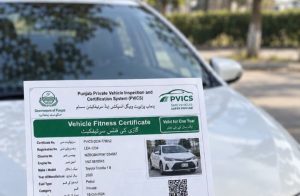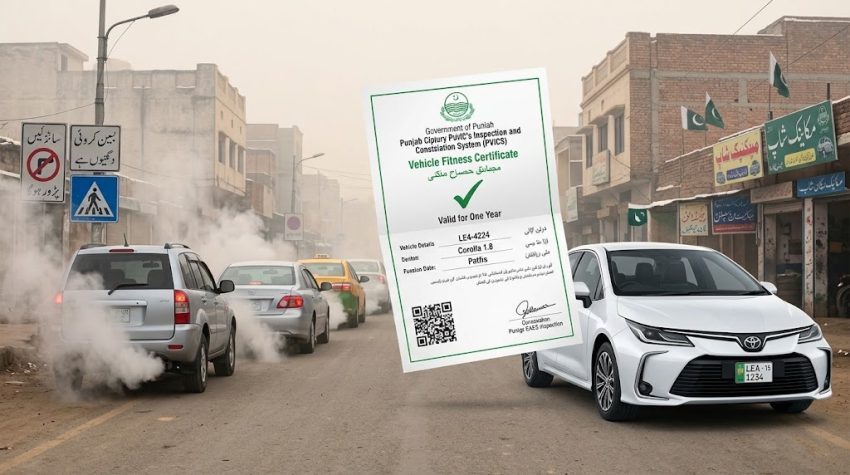
LAHORE – Punjab made fitness and emissions testing mandatory for all private cars under anti-smog campaign. Enforcement is expected to begin on October 15, 2026, potentially affecting around 2.3 million private vehicles.
The move could affect around 2.3 million private vehicles, marking a major expansion of Punjab’s vehicle inspection system, which has historically focused more heavily on commercial transport and visibly smoke-emitting vehicles.
For motorists, October 15 is emerging as the key deadline. Vehicles that have reached the legally prescribed age for testing and are operating without the required fitness and emissions certification could face enforcement action after that date. But there is an important catch: not every private car has to undergo testing immediately. The first mandatory test depends on the vehicle’s engine capacity and age.
Cars with engines of up to 1,000cc become due for their first mandatory test after five years. Vehicles between 1,001cc and 2,000cc enter the testing regime after six years, while cars above 2,000cc become due after seven years. Once a vehicle enters the mandatory cycle, testing is required annually.
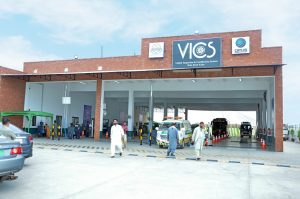
Punjab is moving away from relying solely on visual roadside inspections. The new system is built around dedicated testing centres, measured emissions, annual certification and QR-based verification. Punjab Transport Department has licensed 13 Private Vehicle Inspection and Certification System (PVICS) centres, including eight in Lahore. The government plans to expand Lahore’s testing network to 25 locations to increase capacity before enforcement begins.
While the inspection is primarily an emissions test, vehicle condition could make the difference between a pass and a fail. Owners are advised to make sure their token tax is paid, number plate is properly displayed and engine is functioning normally. They should also check for excessive exhaust smoke and ensure basic maintenance, including spark plugs, air filters and engine tuning—is up to date.
For ageing vehicles, neglected maintenance could become a serious problem. A car may continue to drive normally while still producing emissions above the permitted limit.
The testing procedure is designed to be relatively quick. At Auto Aeon-operated facilities, motorists can drive their vehicles into the testing area, with the operator saying that documents are not required for the test itself. When there is no queue, the actual test can take less than five minutes.
A failed test does not mean the vehicle is permanently off the road. Instead, the owner will generally need to identify and repair the emissions-related fault before returning for another inspection. Potential causes include poor engine tuning, a dirty air filter, worn spark plugs, an incorrect fuel-air mixture, faulty oxygen sensors, catalytic converter problems, excessive oil burning and general engine wear.
For older cars that have gone years without proper maintenance, the inspection could expose problems that have previously gone unnoticed.
13 Centres Already Licensed Across Punjab
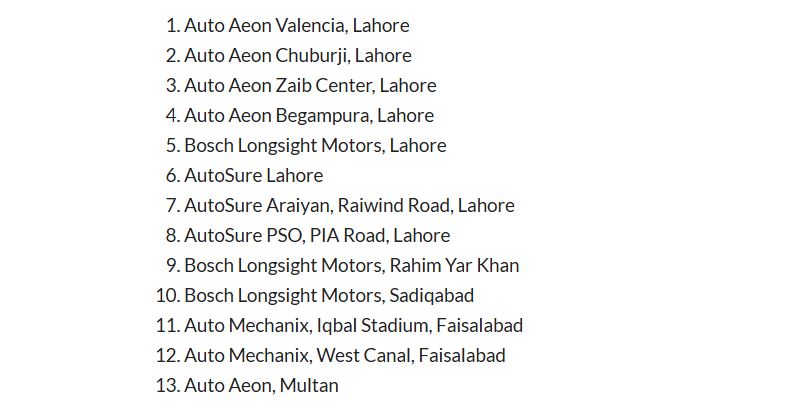
The government intends to increase Lahore’s network to 25 PVICS locations.
Auto Aeon’s live network has also expanded to 17 stations across Punjab, with facilities listed in Lahore, Multan, Faisalabad, Bahawalpur, Lodhran and Sargodha. Motorists have therefore been advised to check the latest station information before travelling.
The policy comes as Punjab prepares for the annual winter smog season, when transport emissions come under heightened scrutiny. The province has traditionally concentrated enforcement on buses, trucks, commercial vehicles and visibly smoke-emitting vehicles. The inclusion of private cars represents a significant shift toward a structured emissions-monitoring system.
Which Cars will be Scrapped in Punjab under New ‘End-of-Life’ Vehicle Law?