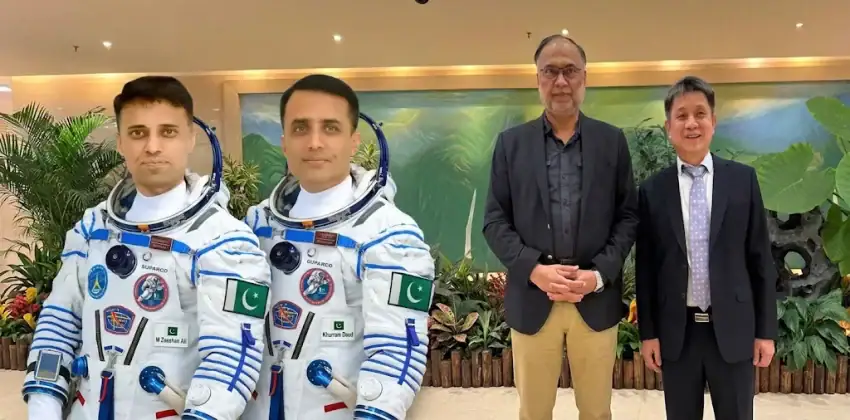
BEIJING – The historic moment for Pakistan’s space ambitions is here as the country’s first astronaut is planning to enter space, and with final preparations underway, Planning Minister Ahsan Iqbal heads to Beijing for send-off ceremony.
Pakistan’s First astronaut prepares to travel aboard China’s Tiangong space station. The minister was received by Yang Yunli, Vice President of China Great Wall Industry Corporation, and officials from the Pakistani embassy. He was scheduled to visit the Jiuquan Satellite Launch Centre in northwestern China today to meet the two Pakistani astronaut candidates who have completed their intensive training.
Iqbal said Pakistan was taking major step towards space exploration, carrying the hopes and ambitions of its younger generation beyond Earth’s atmosphere. He highlighted the historic significance of Pakistan becoming the first foreign country to send an astronaut to China’s Tiangong space station, saying the achievement would add a new dimension to the longstanding partnership between Islamabad and Beijing.
China Manned Space Agency (CMSA) announced that a Pakistani astronaut would participate in the Shenzhou-24 crewed mission as a payload specialist. The development will make Pakistan first foreign country to have astronaut aboard China’s Tiangong space station and mark the first joint Chinese-foreign crewed flight under Beijing’s human spaceflight programme.
Pakistani astronaut will undertake a short-duration mission, expected to last around one week, before returning to Earth aboard the Shenzhou-23 spacecraft, which is already docked with the orbital station.
Unlike Chinese crew members responsible for spacecraft and station operations, Pakistan’s representative will primarily participate in scientific research and experiments conducted in the microgravity environment. Zeeshan Ali and Khurram Daud were picked in April 2026 after undergoing rigorous selection process. The two candidates emerged from wider pool of 20 shortlisted pilots and scientists who were assessed through medical examinations, psychological evaluations and technical aptitude tests. Both subsequently travelled to China for specialised astronaut training at the country’s astronaut research and training facilities.
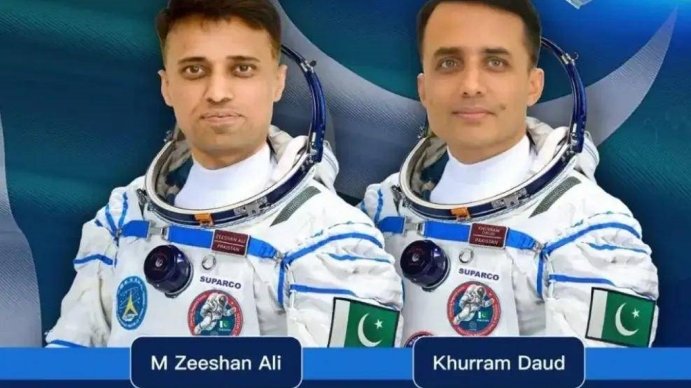
Their preparation covered spacecraft systems, microgravity operations, physical endurance, high-G centrifuge exercises, emergency response procedures and Mandarin language training. With both candidates completing the programme, one is expected to undertake the historic flight as the primary payload specialist, while the other will remain on standby as the backup astronaut.
Pakistani astronaut will participate in scientific activities aboard Tiangong, with planned research covering material science, biotechnology and other experiments requiring a microgravity environment. The mission is expected to provide Pakistani researchers with an opportunity to advance scientific understanding and gain practical experience in space-based experimentation.
Pakistan’s First Astronaut set to Enter into Space on November 25
The historic flight follows cooperation agreement signed in Islamabad in February 2025 between China’s Manned Space Agency and Pakistan’s Space and Upper Atmosphere Research Commission (SUPARCO). The agreement established a framework for selecting and training Pakistani astronauts and enabling their participation in short-duration missions aboard China’s Tiangong space station.
The partnership builds on years of collaboration between the two countries in satellite technology, scientific research and broader space development initiatives. The latest breakthrough also reflects China’s growing efforts to expand international participation in its human spaceflight programme.