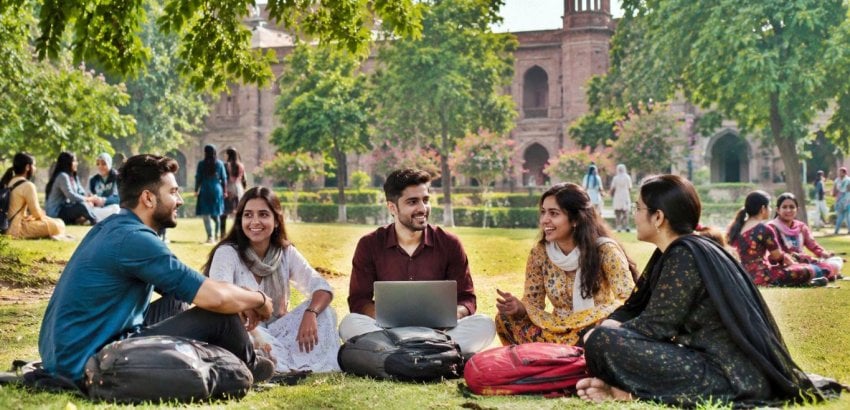
ISLAMABAD – As AI threatens jobs, rising inflation clouds economic prospects and global uncertainty fuels anxiety among younger generations, a new international survey revealed a surprising trend, saying Pakistani students are more hopeful about the future than their peers in India, US and UK.
Pakistani students turn out to be among most hopeful young people, securing seventh place globally in environmental optimism and outperforming first world countries. The findings offer encouraging picture of Pakistan’s younger generation, revealing that students remain confident about the future even as countries across the world grapple with inflation, conflict, environmental threats and the rapid rise of AI.
The survey conducted by Oxford Scholastica Academy finds how students from different countries view their personal futures, economic opportunities, environmental challenges, political developments and the overall direction of society. The research collected 1,433 responses from students across 100 countries. However, only 41 countries received sufficient responses to qualify for the final international rankings.
Global Optimism Rankings 2026
Pakistan clinched 14th position among 41 countries, achieving overall optimism score of 3.94, narrowly surpassing its South Asian neighbours India and Bangladesh, which recorded scores of 3.93 and 3.92, respectively.
The country’s strongest performance came in environmental optimism, where Pakistani students achieved a score of 3.73, placing them seventh globally.
Pakistan ranked 13th in optimism about the future of society, ahead of US, while students also shows confidence in their personal prospects. Politics, however, remained a major source of uncertainty.
With a political optimism score of 3.27, the category emerged as Pakistan’s weakest area. Nevertheless, Pakistani students still expressed greater political optimism than those surveyed in Germany, Britain and France.
The findings suggest that while Pakistan’s younger generation remains concerned about political developments, such uncertainties have not completely overshadowed its expectations for the future.
Asian Students Lead Optimism Rankings
Perhaps one of the survey’s most surprising revelations came from Sri Lanka, which emerged as the world’s most optimistic country despite having faced severe economic difficulties in recent years. Sri Lankan students achieved the highest environmental optimism score of 4.62, alongside an impressive 4.75 in confidence about their personal futures.
Their optimism about society’s future also remained strong at 4.25, highlighting a notably positive outlook despite the country’s economic challenges. Kenya secured second place overall with a score of 4.31.
Students in Kenya recorded the highest political optimism score of 3.96 and shared the top position with Cyprus for confidence in society’s future, both scoring 4.43. Nepal followed in third place, standing out with a perfect personal optimism score of 5.00 and the highest economic optimism score of 4.80.
Kazakhstan took fourth position, with students recording 4.56 in economic confidence and 3.76 in political optimism. Nigeria and Indonesia were also among the stronger performers. Nigeria recorded an overall optimism score of 4.08, supported by an environmental optimism score of 3.92, while Indonesia achieved an overall score of 4.07 and registered particularly strong economic confidence at 4.41.
One of striking patterns was the contrast between students in developing economies and those in some of the world’s wealthiest nations. Canada emerged as one of the stronger Western performers, ranking sixth overall with an optimism score of 4.08. However, Us, Germany, Britain and France appeared further down the rankings.
France recorded the lowest environmental optimism score in the entire survey at 2.25, indicating particularly weak confidence among French respondents about the planet’s future. Poland also struggled in political optimism, recording a score of just 2.30.
At the opposite end of the rankings, Kuwait emerged as the least optimistic country, recording an overall score of just 2.92. Political confidence among Kuwaiti students was especially low at 1.80, while optimism about society’s future stood at 2.40. Rwanda finished second from the bottom with an overall score of 3.20, followed by Türkiye at 3.22.