
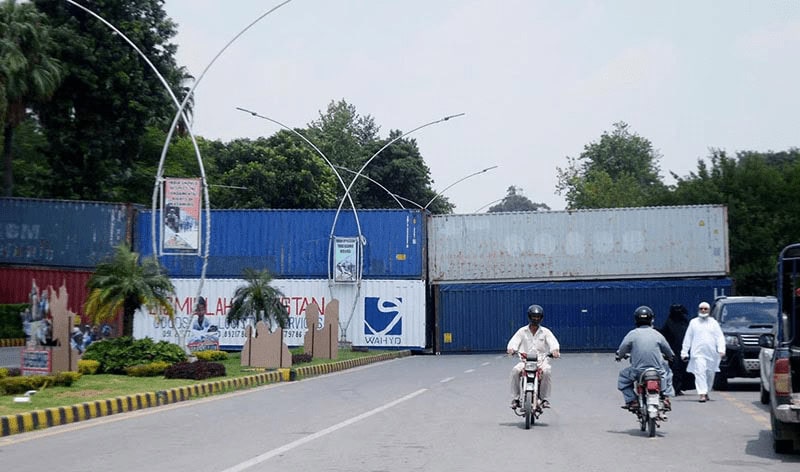
ISLAMABAD — Pakistani capital is rapidly turning into fortified city ahead of planned September 27 long march of Pakistan Tehreek-e-Insaf, with authorities shutting major highways, sealing strategic entry points and deploying thousands of security personnel across the capital and surrounding districts.
The restrictions are already choking some of the country’s most important road links. M-1 Islamabad-Peshawar Motorway, M-14 CPEC Motorway and sections of the N-5 GT Road have been closed until further notice, while additional routes connecting Punjab, Khyber Pakhtunkhwa and the twin cities have also been blocked.
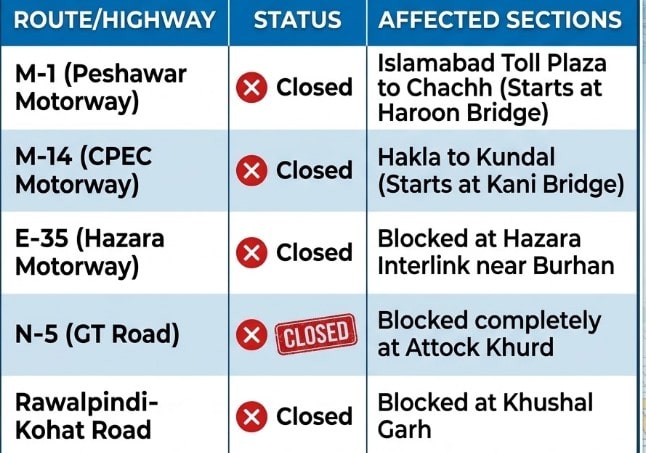
Traffic Update
- M-1: Closed between Islamabad Toll Plaza and Chachh Interchange.
- M-14: Closed between Hakla and Kundal.
- N-5/GT Road: Closed at Attock Khurd.
- Hazara Motorway: Restricted near the Hazara Interchange.
- Rawalpindi-Kohat Road: Blocked at Khushal Garh.
- Abbottabad-Hassan Abdal route: Restricted at Jhari Kas.
- Red Zone: Heavily secured, with access restrictions.
- Metrobus: Reported operational in the latest local update.
National Highways and Motorway Police says the M-1 is closed in both directions between the Islamabad Toll Plaza and Chachh Interchange. M-14 has been shut between Hakla and Kundal, while the GT Road (N-5) is blocked at Attock Khurd.
Hazara Motorway has been blocked near its Hazara Interchange, the Rawalpindi-Kohat Road has been closed at Khushal Garh, and the Abbottabad-Hassan Abdal route has been restricted at the Jhari Kas checkpoint, according to current traffic reports.
The security operation is particularly intense in Attock, which sits on key road corridors connecting Khyber Pakhtunkhwa with Punjab and the Islamabad-Rawalpindi region.
Containers and sandbags have been positioned around Attock Bridge and Haroon Bridge, while security has been reinforced around the Chachh and Ghazi interchanges. Reports indicate that roughly 30,000 personnel are being deployed across the district. Thousands of personnel are also being assigned to sealing points along the M-1, N-5, N-80 and M-14 corridors.
Inside the capital, the preparations are just as extensive. Large numbers of shipping containers have been positioned around major roads and entry points, with reported locations including Faizabad, Srinagar Highway, Ninth Avenue, Islamabad Expressway, Murree Road, Tarnol, Sangjani, 26 Number Chungi, T-Chowk Rawat and the Red Zone.
Red Zone has already been subjected to heightened restrictions, with routes leading into the area sealed using containers.
Reports indicate that authorities have also arranged cranes, soil-filled trolleys and other equipment to strengthen the barricades and facilitate rapid changes to road closures.
More than 22,000 security personnel are reportedly deployed in the capital, while police from other areas have also been brought in as part of the wider security operation. Surveillance is being conducted through the Safe City system, while additional monitoring resources are being used to track developments.
More than 10,000 police personnel are reportedly being assigned across Rawalpindi, including personnel at entry points, blocking positions, police pickets and roads linking the twin cities.
With only days remaining before the planned September 27 march, the capital is entering a period of heightened uncertainty.
Motorways have been shut. Entry points are being fortified. Containers are being positioned. Security deployments are expanding across Islamabad, Rawalpindi and surrounding districts.