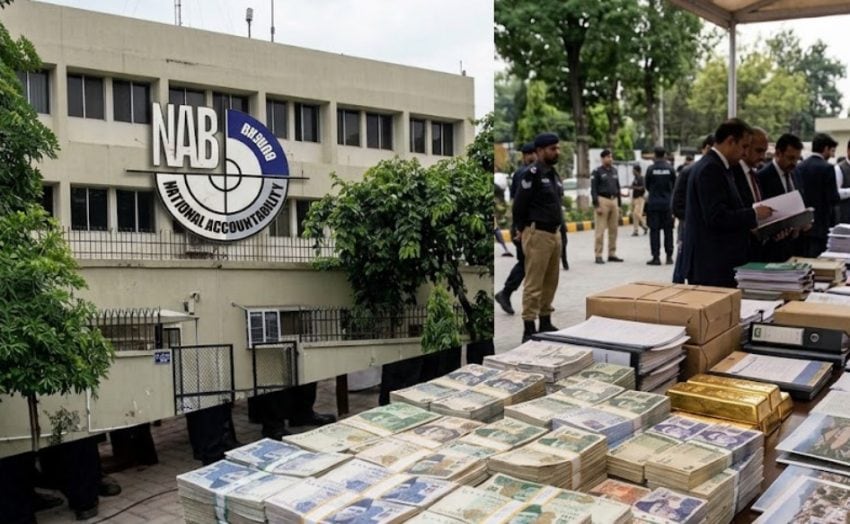
ISLAMABAD – National Accountability Bureau (NAB) revealed details of major corruption investigations involving government officials, private developers and politically influential individuals across Pakistan.
Amjad Majeed Aulakh, Director General (Operations) of National Accountability Bureau (NAB) shared update on politicians from ruling and previous governments, while the anti-corruption watchdog is investigating massive financial irregularities, suspicious payments, fraudulent withdrawals and alleged misuse of state-owned land.
The disclosures came as the official faced tough questions about NAB’s willingness to investigate powerful politicians, the fate of Panama Papers cases. The official insisted that no government or political figure enjoys immunity from accountability, maintaining that NAB pursues cases based on evidence rather than political affiliations.
One of alarming revelations concerned KP Cities Improvement Project, a major development initiative launched in 2017 with financial support from the Asian Development Bank. Initially designed to improve civic infrastructure in Peshawar, Abbottabad and Mardan, the project included public parks, green areas, water supply systems and treatment facilities.
According to the NAB official, the project’s scope was expanded to include Kohat and Mingora without proper feasibility studies. The project, initially backed by approximately Rs32 billion in financing, eventually reached a reported financial size of Rs74 billion. Despite payments of approximately Rs57 billion, investigators discovered disturbing discrepancies between official records and physical progress.
While documentation suggested that 50 percent of the work had been completed, NAB’s field inspections reportedly found progress ranging from just 20 to 25 percent at several locations.
Even more troubling, the official alleged that some developments existed only in official documents, with no corresponding work visible on the ground. Investigators also identified approximately Rs17 billion in questionable payments. When contacted, some companies listed as recipients allegedly denied issuing invoices or carrying out the work for which payments had been recorded.
Upper Kohistan Scam
DG NAB disclosed details of alleged Rs37 billion fraud involving the Upper Kohistan district administration. He said the scandal involved fraudulent withdrawals from the provincial treasury through alleged collusion between officials of the Communication and Works Department and the District Accounts Office.
The official said NAB conducted extensive forensic examinations of approximately 1,200 bank accounts and traced assets worth around Rs26 billion linked to the scandal. He termed the findings as a major breakthrough against an organised network allegedly responsible for diverting public funds. A total of 142 individuals were identified as accused, including government officers and departmental officials, according to the interview.
NAB official avoided publicly identifying politicians allegedly connected to the matter, saying premature disclosures could affect legal proceedings.
Separately, official government records confirm that NAB had frozen assets worth more than Rs27 billion and recovered more than Rs10 billion through plea bargains and other mechanisms by June 2026. These categories should not be confused with cash already returned to the treasury.
The interview also brought renewed attention to a major land controversy in Sindh involving approximately 18,000 acres of state-owned property. According to the NAB representative, government land was allegedly handed over to a private housing developer under an arrangement requiring the developer to provide alternative land in exchange.
However, the official alleged that the government never received the agreed replacement land. He said the property involved in the accountability reference was valued at approximately Rs783 billion. NAB has reportedly submitted a challan before an accountability court, naming 33 accused individuals.
NAB official responded that Malik Riaz and his son had been declared proclaimed offenders in the relevant proceedings. He said they must return to Pakistan and appear before the courts if they wish to contest the allegations. The official stressed that NAB’s responsibility was to present evidence, while determining guilt or innocence remained the judiciary’s exclusive responsibility. He rejected the suggestion that powerful developers should receive preferential treatment simply because their projects involved substantial investments or had already sold plots to members of the public.
Panama Case against Nawaz Sharif
The interview took a political turn when the official was questioned about the Panama Papers controversy and the accountability proceedings involving former prime minister Nawaz Sharif.
The interviewer asked why the disclosures, which implicated hundreds of Pakistanis, had generated such intense scrutiny of one political family while comparatively little public attention was given to many other individuals named in the leaked documents. NAB official explained that references filed by the bureau were subsequently challenged before superior courts.
He cited amendments to accountability legislation in 2023 and subsequent judicial proceedings as factors affecting the handling and outcomes of relevant cases. Asked specifically about the Avenfield Apartments case and the earlier political demand for Nawaz Sharif to produce money trails and property documents, he maintained that NAB was bound by the law and the courts’ decisions.
He stressed that the bureau could not continue pursuing a case contrary to a final judicial determination. The interviewer also challenged NAB over controversial economic decisions, including costly wheat imports, sugar exports and government subsidies benefiting sugar mills.
He questioned why businesses receiving substantial financial benefits from state policies were not automatically subjected to corruption investigations. NAB official responded that granting subsidies was ordinarily a government policy decision and did not, by itself, amount to corruption. However, he clarified that NAB could intervene where credible evidence showed that subsidies had been distributed illegally, granted to ineligible beneficiaries or used to provide unlawful financial advantages.
NAB launches probe into alleged irregularities in KP’s Sehat card programme