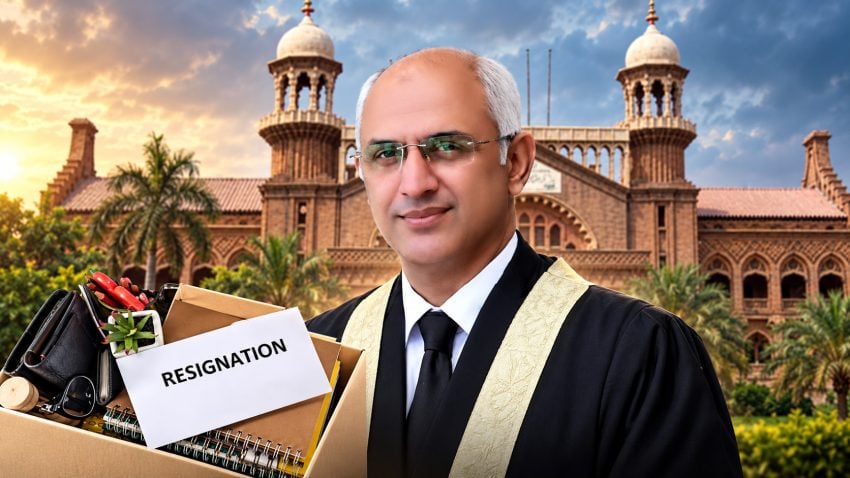
LAHORE – Pakistan’s judiciary has been rocked by another resignation as Lahore High Court (LHC) Justice Mohsin Akhtar Kayani stepped down, accusing the executive of tightening its grip over judicial institutions and warning that controversial constitutional amendments seriously damaged the independence of the country’s superior courts.
The resignation, submitted to President Asif Ali Zardari, comes after months of judicial controversy involving the transfer of senior judges, disputes over seniority and allegations of excessive administrative control within the Islamabad High Court.
Kayani, who served as the senior puisne judge of the Islamabad High Court before his transfer to Lahore earlier this year, cited health concerns following surgery and personal circumstances. However, the most striking part of his resignation was his declaration that his conscience no longer allowed him to remain on the bench.
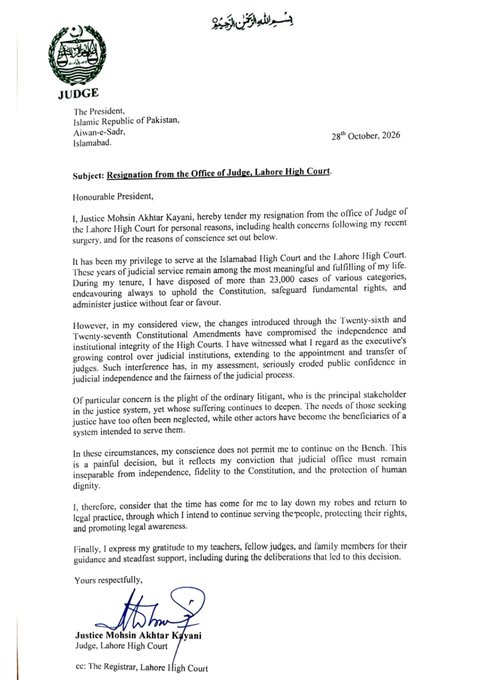
In his letter, the judge challenged the direction of judicial reforms and questioned whether the existing institutional framework could adequately protect judges from outside influence. He singled out the 26th and 27th Constitutional Amendments, arguing that they had undermined the autonomy and institutional integrity of Pakistan’s high courts.
He expressed concerns over the executive’s expanding role in judicial matters, including decisions concerning the appointment and transfer of judges. According to the outgoing judge, these developments had weakened public confidence in the independence of courts and the fairness of judicial proceedings.
His criticism also extended to the broader justice system, where he said ordinary citizens were increasingly bearing the consequences of institutional weaknesses.
Justice Kayani argued that litigants, who should remain at the centre of the justice system, were too often overlooked while other influential stakeholders benefited from arrangements ostensibly designed to serve the public. For him, the issue had reached a point where continuing to hold judicial office would mean compromising the principles he believed the judiciary must uphold.
The resignation brings an end to a judicial career during which Justice Kayani says he disposed of more than 23,000 cases involving various legal matters.
Despite his attachment to judicial service, he concluded that independence, constitutional responsibility and human dignity were inseparable from the office of a judge. Kayani announced that he would return to legal practice, where he intends to continue working for the protection of citizens’ rights and greater legal awareness.
His departure follows turbulent period that saw him lose his senior judicial standing after becoming embroiled in a dispute over transfers between high courts. The controversy started when Justice Sardar Muhammad Sarfraz Dogar was moved from the Lahore High Court to the Islamabad High Court, alongside two judges from the Sindh and Balochistan high courts.
At the time, Justice Kayani was among the most senior judges of the Islamabad High Court and had been seen as a potential candidate for chief justice. The transfers changed the court’s seniority arrangements and triggered legal challenges from Justice Kayani and other judges.
Although the Supreme Court’s constitutional bench upheld the transfers, the ruling did little to settle the institutional dispute. Justice Dogar subsequently became chief justice of the Islamabad High Court, while Justice Kayani and other judges challenged the administrative powers exercised under his leadership.
They alleged that judicial administration had become excessively centralised, leaving judges vulnerable to exclusion from hearing cases through changes in bench rosters. The controversy intensified in April 2026 when Justice Kayani was transferred to the Lahore High Court. The move pushed him down to 12th position on the LHC seniority list, a major change from his previous standing at the Islamabad High Court. Despite his experience, he was not assigned to a division bench at Lahore.
The timing of Justice Kayani’s resignation has added another striking element to the story. Just a day earlier, Lahore High Court administrative reshuffle occured under which he was scheduled to return to the twin cities and hear cases at the Rawalpindi registry. The revised duty roster, covering November 2 to December 24, assigned him to a single bench.
Five other judges Justice Sadaqat Ali Khan, Justice Mirza Viqas Rauf, Justice Muhammad Raza Qureshi, Justice Malik Javid Iqbal Wains and Justice Syed Farhad Ali Shah, were also designated to preside over single benches.
Justice Mohsin Akhtar Kayani, Saman Rafat among several judges Transferred