LAHORE – Punjab Chief Minister Maryam Nawaz Sharif unveiled an ambitious roadmap to deal with the region’s growing water challenges, directing all relevant departments to work under a unified strategy to protect water resources, restore groundwater reserves and modernise irrigation systems.
Chairing meeting on Transformation of Agriculture and Water Management, Punjab CM said safeguarding every drop of water is among the government’s highest priorities, stressing that sustainable agricultural growth and long-term food security cannot be achieved without efficient water management.
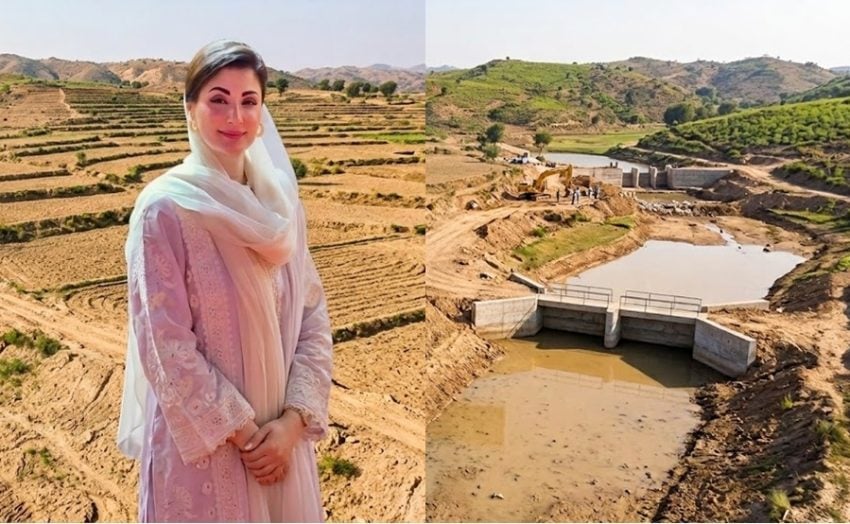
Officials informed the meeting that 110 mini dams have already been completed across Punjab, while an additional 800 mini dams will be constructed over the next three years in the rain-fed Potohar region. The new infrastructure is expected to create a storage capacity of nearly 32,000 acre-feet of water, strengthening agriculture in barani areas and helping replenish underground water reserves.
CM sought plan for the development of modern and secure on-ground water bodies to capture rainwater, saying that advanced nations prioritise the protection of water resources and Punjab must rapidly move towards smarter and more sustainable water management.
To improve coordination, CM instructed Agriculture, Irrigation, Housing and Local Government departments to abandon fragmented approaches and instead implement a single-window Water Security Framework. She also ordered the preparation of a practical strategy to curb water losses, noting that nearly 30 percent of water is wasted during distribution, while another 25 percent is lost during consumption.
The meeting was told that the government has already completed the lining of 2,600 watercourses spanning around 7,000 kilometres, a measure expected to reduce water losses by approximately 20 percent. Over the next three years, another 4,500 watercourses covering 11,500 kilometres will be rehabilitated and lined to further improve water efficiency.
Officials further revealed that high-efficiency irrigation systems have already saved around 18,000 acre-feet of water while increasing agricultural productivity by as much as 50 percent. Building on these gains, the government plans to bring an additional 30,000 acres under modern drip and sprinkler irrigation systems during the next three years.
On groundwater management, the meeting was informed that 100 recharge wells are now operational across the Gujranwala, Gujrat and Lahore divisions, while another 300 recharge wells are nearing completion. The government also decided to strengthen the existing legal framework for groundwater conservation and deploy dedicated personnel to monitor water conservation efforts across the province.