ISLAMABAD – Three years on, the events of May 9, 2023 remain one of the most darkest episodes in Pakistan’s recent history, a day that reshaped politics, deepened institutional tensions, and permanently changed the trajectory of mainstream opposition politics led by Imran Khan and his party, Pakistan Tehreek-e-Insaf (PTI).
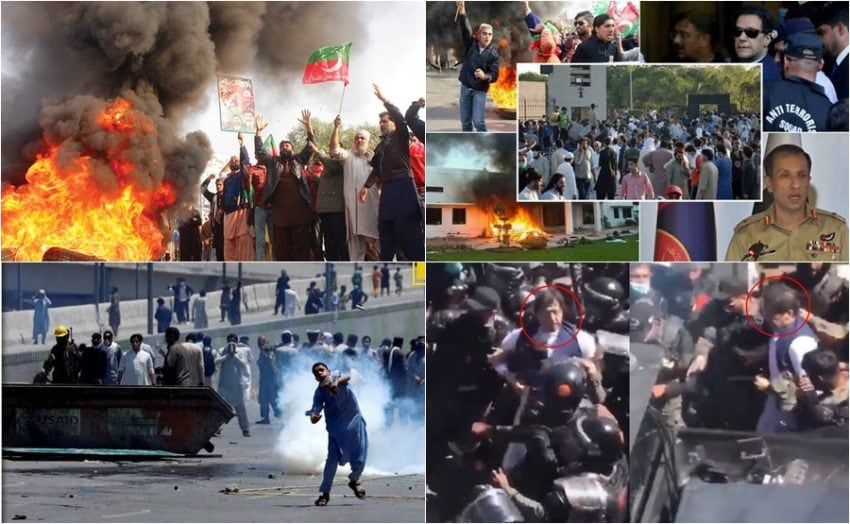
On this day in 2023, former PM Imran Khan was taken into custody by Rangers inside Islamabad High Court in a corruption case linked to the Al-Qadir Trust matter. The arrest, carried out while he was attending a court appearance, triggered immediate nationwide unrest as supporters of his party, Pakistan Tehreek-e-Insaf (PTI), began protesting across multiple cities.
It started as demonstrations rapidly escalated into violent riots, with state and military facilities coming under attack in several urban centres. The government later declared the day a “Black Day” due to the scale and nature of the violence.
Casualty figures differ, but official reports place death toll at around 8 to 14 people, while PTI claimed higher numbers of approximately 50 fatalities. Hundreds of civilians were reported injured, along with 232 police personnel across Pakistan.
Mass arrests followed the unrest. Authorities detained over 1,000 individuals in Lahore alone, while around 3,200 suspected participants were arrested across Punjab. Overall nationwide detention figures reached into the thousands, with some estimates suggesting more than 5,000 arrests. Several senior PTI leaders were also taken into custody during the crackdown.
The damage to public and state property was extensive. Protesters targeted key military and government installations, including the burning of the Corps Commander’s House (Jinnah House) in Lahore and attacks on the GHQ in Rawalpindi, the ISI office in Faisalabad, and Radio Pakistan in Peshawar.
In total, around 40 public and military buildings were damaged or vandalised, and more than 72 vehicles were set on fire. Economic losses were estimated at roughly Rs2.5 billion, with military accounting for approximately Rs1.98 billion of that amount.
The unrest spread across major cities including Islamabad, Lahore, Karachi, Peshawar, Quetta, and Faisalabad. In response, internet services were suspended in several areas, and the armed forces were deployed to help restore order in coordination with civil authorities.
Although Khan was released on 11 May after the Supreme Court ruled his arrest unlawful, he was later detained again in other cases and continues to face multiple legal proceedings. The aftermath of May 9 has included long-term political consequences, expanded legal actions, and, in some instances, military trials for civilians.
What began as a wave of protests following Khan’s arrest quickly escalated into nationwide unrest, with state installations coming under unprecedented attack. Military-linked sites and symbols of authority were targeted in multiple cities, prompting the state to label the incidents as a coordinated assault rather than spontaneous demonstrations. The crackdown that followed was swift, extensive, and enabled through surveillance systems, digital tracking, and mass arrests.
At same time, PTI’s narrative evolved into broader populist movement, with Khan positioning himself as symbol of resistance against both political rivals and the military establishment. His supporters framed the events as part of a larger struggle over democratic legitimacy, while critics described them as a dangerous breakdown of political discipline and state authority.
The aftermath saw sweeping legal cases, convictions, and disqualifications that removed Khan from electoral competition, yet PTI’s political base proved resilient. In the 2024 elections, the party’s candidates still secured significant support, reflecting deep public polarisation rather than organisational collapse.
Historians said May 9 events not only tested strength of Pakistan’s institutions but also redefined the limits of political agitation in an era increasingly governed by surveillance, legal containment, and economic constraint.
May 9 cases: Military courts gets SC’s conditional nod to pronounce verdict of 85 civilians