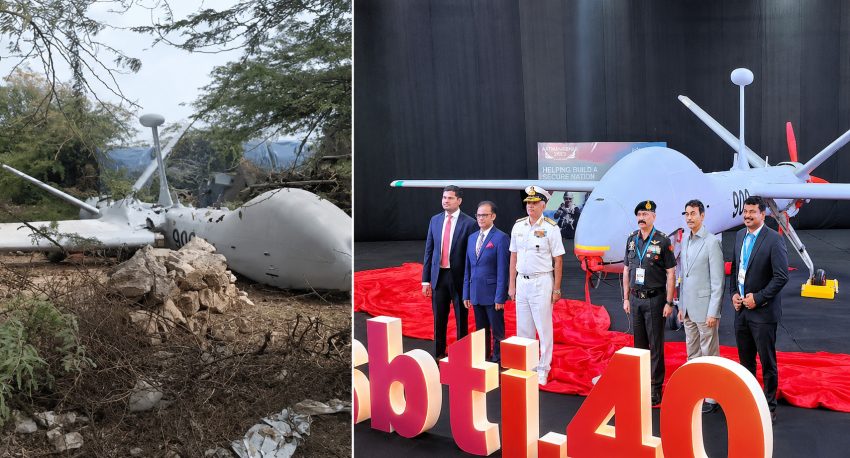
NEW DELHI – India’s ambitious military modernization drive suffered another major setback after Navy’s advanced Drishti-10 unmanned aerial vehicle (UAV) crashed during a routine training mission near the strategic coastal city of Porbandar in Gujarat.
Indian Navy officials confirmed that the drone went down in an open area during a routine training flight. While no casualties or damage to civilian property were reported, the sophisticated surveillance platform was completely destroyed, prompting the Navy to launch a high-level Board of Inquiry to determine the cause of the accident.
The crash is another embarrassment for India’s high-profile indigenous defense manufacturing campaign, with Drishti-10 being promoted as one of the country’s next-gen intelligence, surveillance, and reconnaissance (ISR) Aerial Vehicle.
India Markets Drishti-10 as it's First Indigenous MALE UCAV, but In reality, it's just a locally Assemble Version of Israeli Hermes UCAV. 🇮🇳🤝🇮🇱
So far, only 5x Drone have been Delivered to the Indian Navy, but IN has already Crashed Two of them. 👏 https://t.co/EOfMl5wFgW pic.twitter.com/NDtaIWNBkw
— Armed Forces Update (@ArmedUpdat1947) July 8, 2026
Drishti-10 is based on Israel’s renowned Hermes 900 UAV and is manufactured by Adani Defence in collaboration with Israeli defense giant Elbit Systems. The platform was introduced as a critical asset for maritime surveillance, intelligence gathering, and reconnaissance operations over the Indian Ocean and sensitive coastal regions.
The loss of such strategic surveillance asset raises questions about operational reliability, maintenance standards, technology integration, and the effectiveness of locally assembled high-end defense systems. The drone crashed near Porbandar, one of India’s most strategically significant naval locations due to its proximity to Pakistan’s maritime boundary and its role in monitoring shipping lanes across the Arabian Sea and northern Indian Ocean.
The latest accident adds to long list of military aviation incidents that challenged India’s defense establishment over the years. Previous crashes involving MiG-21 fighters and other military aircraft have repeatedly sparked debate over fleet reliability, maintenance practices, pilot training, and procurement policies.
The incident also places renewed attention on the Modi government’s flagship “Make in India” defense initiative, which aims to reduce dependence on foreign suppliers through domestic manufacturing and strategic partnerships. Drishti-10 represents one of the program’s marquee projects, with Adani Defence announcing in February 2024 that it would deliver Hermes 900-based drones to the Indian Navy under its collaboration with Elbit Systems.
Observers are expected to closely watch the findings of the Board of Inquiry to determine whether the crash resulted from mechanical failure, maintenance shortcomings, operational error, or another technical issue.
Here’s how Pakistan outsmarted Indian Rafale Pilots from 200km Distance in May showdown