
ISLAMABAD – Pakistan International Airlines (PIA) entered a new phase after privitisation in wake of shrinking operations and fading public confidence, and mounting financial losses. Once regarded as Asia’s leading airlines, the national carrier found itself burdened with more than US$2.8 billion in accumulated losses, and now the airline enters a new phase, with a veteran aviation expert being roped in for its revival.
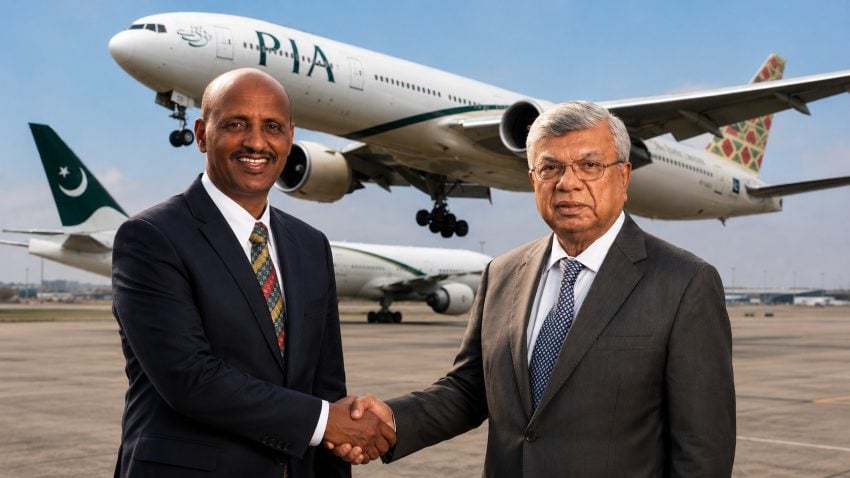
Former Ethiopian Airlines chief Tewolde GebreMariam has been appointed as PIA’s new Chief Executive Officer. Although the airline has yet to make a formal announcement, a senior PIA official confirmed that the decision has been finalized. The official, speaking on condition of anonymity, said the appointment will only be announced publicly after all required security clearances are completed.
GebreMariam, a less familiar name in Pakistan, is poised to make wide range of changes amid a grand transformation. Under his leadership, the Ethiopian airline expanded, modernized its fleet and turned Addis Ababa into one of Africa’s busiest aviation hubs. The African Airlines went on to become the continent’s largest and one of the world’s most respected carriers, connecting dozens of African cities with destinations across Europe, Asia, the Middle East and the Americas.
He can be better than Pakistanis as Ethiopian airline is better than PIA https://t.co/WvR7h681Xb
— Aurangzeb Khan (@zaibkh77) July 11, 2026
It is precisely that experience that PIA’s new owners hope can be replicated in Pakistan. The appointment comes just days after Pakistan completed the first phase of the privatization of Pakistan International Airlines Corporation Limited (PIACL), transferring management control to a consortium led by Arif Habib Corporation.
The consortium has already begun putting money behind its promise. As part of the first phase, it paid Rs10 billion (US$36 million) to the Government of Pakistan as the purchase consideration while injecting Rs80 billion (US$288 million) in fresh capital into the airline.
The funding is intended to stabilize PIA’s finances, expand and modernize its fleet, strengthen domestic and international route networks, improve operational efficiency and raise customer service standards. But the investment does not stop there.
According to the Privatization Commission, Rs55 billion (US$197 million) will go to the government as payment for the airline, while Rs125 billion (US$449 million) will be invested directly into PIA to support its long-term restructuring and growth. The privatization agreement also lays out the next chapter. Within the next 12 months, the consortium is expected to inject another Rs45 billion (US$161 million) into the airline as part of the second phase of the deal.
It has also expressed its intention to exercise a contractual call option to purchase the remaining 25 percent stake in PIA by paying the government an additional Rs45 billion (US$161 million). A major shareholder in the airline believes the new chief executive is well suited for the challenge. “He has been hired. He is an exceptionally capable individual and has played a key role in the successful turnaround of several organizations,” the shareholder said. Yet the scale of the task ahead remains enormous.
Turning an airline like PIA is about far more than repairing balance sheets. It means rebuilding passenger trust, improving reliability, modernizing aircraft, opening profitable routes and restoring confidence among employees, investors and international partners.