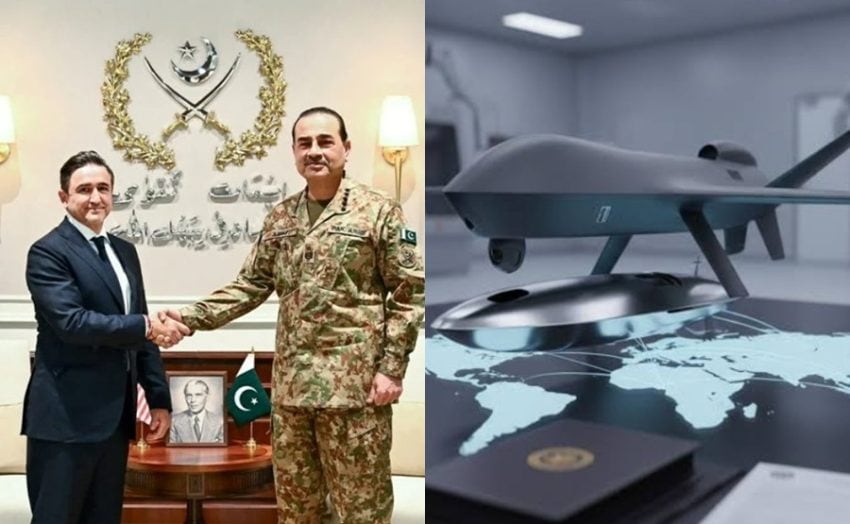
ISLAMABAD — Big boost for Pakistan’s drone warfare as Pakistan Army inked memorandum of understanding with American autonomous systems company Powerus for unmanned aerial systems.
The exact size of the order has not been made public. Neither the number of drones nor their specific models or financial value have been disclosed. It would be premature to assume that Islamabad is buying Powerus’s entire drone portfolio. What is clear, however, is that the agreement opens the door to cooperation with a company whose technology covers everything from small tactical drones and counter-drone interceptors to autonomous heavy-lift aircraft and maritime systems.
A Powerus delegation led by company president and former US Army Special Operations veteran Brett Velicovich met Field Marshal Syed Asim Munir at General Headquarters in Rawalpindi. The discussions reportedly included defense procurement, manufacturing and longer-term capacity building.
Pakistan could potentially gain access not only to American-built unmanned aircraft, but also to autonomy software, training, production know-how and technologies designed to allow different types of drones to operate within a common system.
Powerus is relatively young company, but it has built an unusually broad portfolio in a short period of time. The company was founded by people with backgrounds that include US Army Special Operations. Andrew Fox serves as founder and CEO, while Brett Velicovich is widely identified as a co-founder and president.
Instead of focusing on just one type of aircraft, Powerus is building several interconnected product lines. Its subsidiaries include Kaizen Aerospace, which develops heavy-lift unmanned aircraft; Tandem Defense, which focuses on tactical and FPV-style drones; and Agile Autonomy, which works on converting conventional boats into remotely operated or autonomous vessels.
Powerus’s xNav technology is designed to provide navigation, guidance and autonomous-control capabilities across different platforms. The company also promotes shared ground stations and operator training, meaning the same underlying technology and training ecosystem can potentially be used across multiple types of drones.
One of the company’s most interesting technologies is the Guardian counter-drone interceptor. Instead of carrying a traditional missile or relying solely on electronic warfare, Guardian is designed to physically intercept and destroy hostile drones.
The system is aimed at threats such as Shahed-136/Geran-type one-way attack drones, loitering munitions and other reconnaissance or attack UAVs.
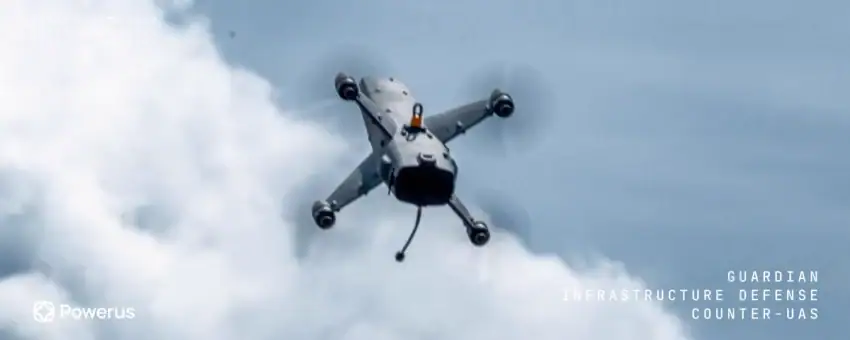
Guardian-1 is a small, fast rotary-wing interceptor. Powerus has described it with a top speed of roughly 210 mph, a range of around nine miles, an endurance of approximately 28 minutes, and an operating ceiling of about 16,400 feet. But the more interesting part is where the system is going.
The first Guardian generation relies heavily on a human operator. Later versions introduce increasing levels of automation. Guardian-2 can receive targeting information from radar and can be automatically launched when a threat is detected, while the operator retains control over the engagement decision.
Guardian-3 is being developed with even greater autonomy, potentially allowing the interceptor to search for and engage targets using combinations of radar, cameras and other sensors. Powerus has also talked about coordinating multiple interceptors, potentially allowing groups of drones to work together.
Powerus claimed interception success rate of around 89 percent across different operating modes. It has also said that its production capability can exceed 500 Guardian units a month.
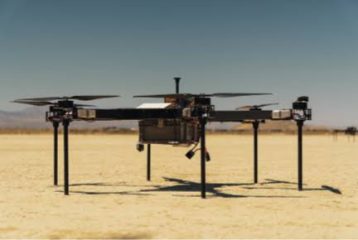
While Guardian is designed to destroy drones, Powerus’s xFold Dragon family is designed to carry things. Developed through Kaizen Aerospace, these are large hybrid VTOL aircraft that combine electric and fuel-powered propulsion. The biggest versions have been described as capable of carrying payloads of up to around 1,000 pounds. Some technical descriptions put the maximum takeoff weight at approximately 1,488 pounds, or 675 kgs.
The aircraft can reportedly remain airborne for roughly six to seven and a half hours in certain hybrid configurations. That makes the Dragon a very different type of military asset.
Instead of sending a helicopter and crew to deliver supplies to a remote position, an autonomous aircraft could potentially carry equipment, ammunition, food or other supplies without putting an aircrew directly into the mission.
For a country with difficult mountainous terrain and remote military positions, that kind of capability could be particularly useful. And the technology is not limited to warfare. Powerus also markets the aircraft for industrial transportation, agriculture, wildfire response and other heavy-lift applications.
At the other end of Powerus’s portfolio is the Matrix family developed by Tandem Defense. These are modular tactical drones built around FPV and quadcopter designs. The company says the architecture can be configured for a huge range of missions, including reconnaissance, attack and logistics.
Instead of building an entirely new unmanned ship, the concept involves adding technology that allows an existing boat to operate without people physically aboard. Potential applications include surveillance, maritime security and other missions where an autonomous vessel could perform tasks without exposing a crew.
Pakistan already has considerable experience with drones and operates systems from both domestic and foreign sources. The Powerus relationship could therefore complement, rather than replace, the country’s existing unmanned capabilities.
As drones become more common in modern conflicts, militaries need affordable ways to detect and defeat them. Guardian-style interceptors could potentially add another layer alongside radar, electronic warfare and other air-defense systems.
Heavy-lift autonomous aircraft could potentially help move supplies to remote locations without requiring conventional aircraft or road convoys for every mission. There is also the possibility of expanding Pakistan’s inventory of small tactical drones. Matrix-type platforms could be adapted for different battlefield roles while using a common underlying architecture. And then there is GPS-denied operation.
US defence company delegation meets Field Marshal Asim Munir at GHQ