
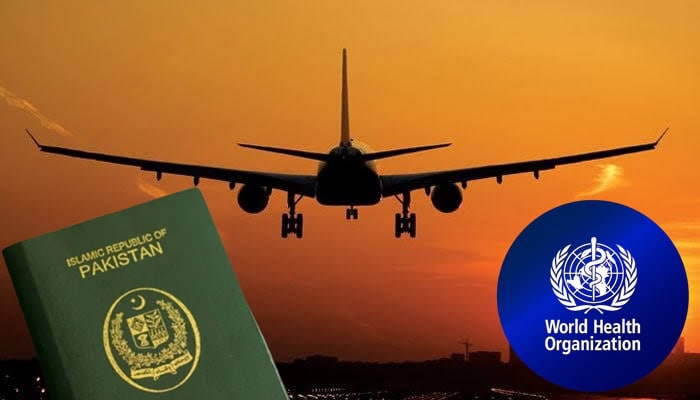
ISLAMABAD – Pakistan is facing another three months of international travel restrictions as World Health Organization (WHO) continues to classify the spread of poliovirus as a global public health emergency.
WHO’s Emergency Committee on International Spread of Poliovirus recommended extending temporary measures after reviewing the latest situation in Pakistan and Afghanistan. The WHO Director-General subsequently endorsed the recommendation, extending the measures from August 21, 2026.
The latest assessment shows continued transmission of wild poliovirus type 1 (WPV1) in Pakistan and Afghanistan, with the two countries effectively forming a single epidemiological bloc because of ongoing cross-border transmission. WHO said 57 environmental samples in Pakistan have tested positive for WPV1 so far in 2026, while four WPV1 cases have been reported across Afghanistan and Pakistan this year — three in Afghanistan and one in Pakistan.
The global health body said sustained transmission remains concentrated in several high-risk areas, particularly Karachi and southern Khyber Pakhtunkhwa in Pakistan, as well as Afghanistan’s southern region.
Karachi has been identified as a significant reservoir of poliovirus, with widespread positive environmental surveillance indicating that local transmission is still continuing. Although WHO noted some encouraging signs following measures introduced after a Karachi programme audit, it warned that the improvements remain at an early stage and do not yet demonstrate the level of programme quality required to eliminate transmission.
The specialized agency of the United Nations (UN) said evidence of shared cross-border transmission between Pakistan and Afghanistan was documented as recently as the first quarter of 2026.
The main transmission corridors include South Afghanistan–Quetta Block and the Northwest Pakistan–South Khyber Pakhtunkhwa–Southeast Afghanistan corridor.
The continued movement of people across Pakistan-Afghanistan border is adding to the challenge, prompting the WHO to call for stronger coordination between the two countries to ensure that people crossing the border are vaccinated. Security and access problems are creating another major hurdle for Pakistan’s eradication campaign.
WHO estimates that around 250,000 children in southern Khyber Pakhtunkhwa remain unreached, primarily because insecurity has restricted access to communities. The area is currently experiencing the most intense WPV1 transmission in Pakistan, while campaign quality remains inconsistent in several high-risk areas, including South KP, the Quetta Block and the Central Pakistan Block.
WHO also flagged vaccine refusals and persistently low immunisation coverage in some communities as continuing obstacles to eradication efforts. WHO Emergency Committee unanimously concluded that the international spread of poliovirus continues to constitute a Public Health Emergency of International Concern (PHEIC) and recommended extending the temporary recommendations for another three months.
The committee also stressed that the decline in cases and positive environmental samples should not be interpreted as proof that eradication-level programme quality has been achieved.
Pakistan and Afghanistan remain world’s two countries with endemic wild poliovirus transmission, making coordinated vaccination, surveillance and cross-border efforts critical to stopping further spread.
28 percent raise approved frontline polio workers in Pakistan