

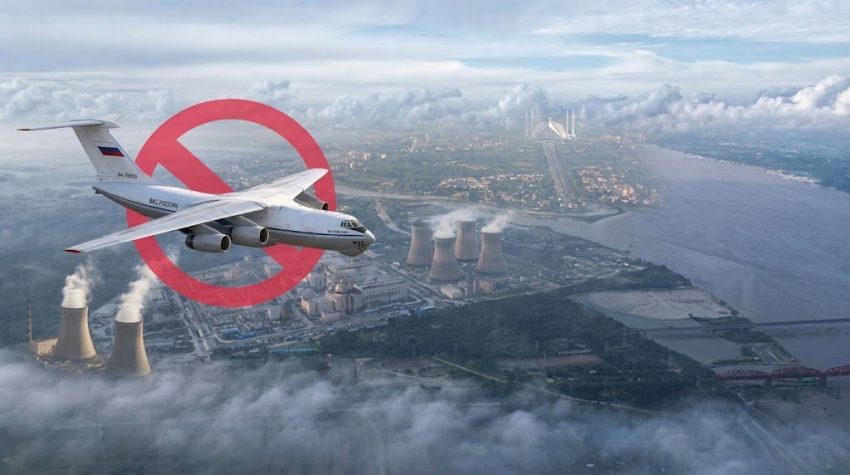
ISLAMABAD/DHAKA – A Russian cargo flight carrying nuclear fuel was ready to head toward Bangladesh when crucial clearance failed to come through, and the shipment was delayed after the aircraft could not secure the required permission to cross Pakistani airspace, forcing Russia to rethink the route and push the delivery into October.
Reports in Bangladeshi media said a Russian cargo flight carrying nuclear fuel for Bangladesh’s Rooppur Nuclear Power Plant has been delayed after it failed to secure the required clearance to pass through Pakistani airspace. The aircraft was due to reach Bangladesh on September 24, but the planned operation was called off after the necessary overflight permissions were not available for the route.
Bangladeshi authorities had already completed preparations at the airport to get highly sensitive cargo when Rosatom liaison officer informed officials that the aircraft could not proceed because the airspace along its route had not been fully cleared.
Bangladeshi Technology Minister Faqir Mahbub Anam said the aircraft had not received permission to use Pakistani airspace, although Bangladesh had not initially been told the precise reason behind the missing clearance.
The shipment requires carefully coordinated international route before reaching Bangladesh. Reports have identified Kazakhstan, Turkmenistan, Pakistan and India among the countries involved in the planned route, while some accounts have mentioned variations depending on the flight plan.
With nuclear fuel on board, the aircraft cannot simply enter another country’s airspace without the necessary authorization. The missing clearance therefore forced the Russian side to postpone the flight and work on a revised transportation plan. Bangladeshi officials have indicated that the issue has since been resolved and that the shipment is expected to move under a new schedule.
Technical Issue behind Clearance Issue?
Pakistan termed the matter as technical and procedural issue involving flight routing and airspace permissions. Officials said overflight requests are processed according to established regulatory requirements and civil aviation procedures, with coordination sometimes required between different authorities.
Islamabad reiterated its relations with Bangladesh and said the matter should be viewed in its technical context. There is no publicly confirmed evidence establishing that the clearance issue was deliberately driven by political considerations or some security issues.
Bangladesh’s science minister also suggested that the problem could have resulted from a gap or oversight, particularly because similar clearances had previously been granted.
The delay has pushed the fuel operation into October, but the wider delivery programme is continuing. Rosatom has said fuel deliveries for Rooppur Unit 2 are scheduled to begin in October and continue through December. The shipments will be carried out through several cargo flights, with the complete Unit 2 fuel delivery expected to be finished by the end of December.
Reports indicate that seven flights are planned for the remaining fuel batches, while an alternative route is being used following the airspace problem. Bangladeshi officials have said the revised operation is expected to begin around October 1.
There is some variation in reports over the exact purpose of the flight that was postponed in September. Rooppur project director Kabir Hossain indicated that the September shipment was connected to the planned reload requirement for Unit 1. Under that arrangement, 48 fuel assemblies were expected to arrive through two flights, with one scheduled for September 24 and another for October 1.
The initial fuel load for Unit 2, meanwhile, involves 163 fuel assemblies and was originally expected to arrive through seven weekly flights beginning in October. This explains why some reports have described the delayed shipment as a Unit 1 reload operation while others have linked it directly to Unit 2.
Direct Flights between Pakistan and Bangladesh to start This January After a Decade
Rooppur Nuclear Power Plant is Bangladesh’s first nuclear power facility and is being developed on the banks of the Padma River in Pabna with Russian technical assistance. The project consists of two VVER-1200 reactors, giving the plant a combined planned capacity of 2,400 megawatts.
Rosatom is responsible for implementing the Russian-supported project, while the Bangladesh Atomic Energy Commission oversees the nuclear programme. The first major fuel delivery for Unit 1 was completed in 2023, when Russia supplied 164 fresh fuel assemblies.
The latest fuel transportation issue is separate from technical and regulatory hurdles surrounding Unit 1. Fuel loading for the first reactor began in April 2026, marking a major step toward Bangladesh generating nuclear electricity for the national grid.
However, technical issues, including matters involving safety and relief valves, along with regulatory requirements such as the B2 licence, have affected the timeline for grid connection and commercial generation.
The latest disruption concerns the transportation route and airspace clearance, not the condition or safety of the nuclear fuel. There has been no reported indication that the shipment was halted because of a problem with the fuel itself. Nuclear material shipments require extensive coordination between the exporting country, transit states and the receiving country, making airspace permissions a critical part of the operation.