

TOKYO – Despite arrival of many Chinese and Western EVs, Toyota Corolla still hold one of top places in sedan category, especially in Pakistani market, where buyers prefer durability and robustness over new plethora of cool features.
The upcoming 2028 Corolla is reportedly being prepared with hybrid, plug-in hybrid and fully electric powertrains, alongside a gasoline option, while its design could become far more futuristic. If Toyota delivers on these plans, the Corolla may soon go from the world’s dependable everyday car to one of its most versatile.
Toyota appears ready to turn one of the world’s most familiar cars into something entirely different. The next-generation Corolla is reportedly being engineered around gasoline, hybrid, plug-in hybrid and fully electric powertrains, while a radical new design and a potentially near-400-hp GR model could push the nameplate into unfamiliar territory.
For decades, the Toyota Corolla has built its reputation on being the sensible choice: affordable, efficient, dependable and easy to live with.
The next-generation Corolla, expected to arrive around 2027 as a 2028 model-year vehicle, is shaping up to be one of the most ambitious redesigns in the history of Toyota’s best-known nameplate. Reports citing Toyota engineers, combined with the dramatic Corolla Concept unveiled at the 2025 Japan Mobility Show, point toward a compact car that could simultaneously offer gasoline, hybrid, plug-in hybrid and battery-electric propulsion.
Toyota has not yet released final production specifications, pricing or market-by-market availability. But if the reported plans materialize, the next Corolla could look—and drive, very different from the car currently sitting in Toyota showrooms.
The biggest story isn’t necessarily the styling. It is what’s underneath as Toyota is reportedly developing next Corolla around a heavily reworked version of its TNGA-C architecture, with the platform designed to accommodate multiple propulsion systems. That could mean customers choosing between a conventional gasoline engine, a standard hybrid, a plug-in hybrid or a fully electric model without the basic vehicle architecture being completely redesigned for each version.
Rather than betting everything on battery-electric vehicles, Toyota is continuing to develop several technologies simultaneously. For a globally sold car like the Corolla, that strategy could allow the company to adapt the vehicle to markets with very different charging infrastructure, regulations, fuel costs and consumer preferences.
In an industry increasingly moving toward electrification, Toyota could make an unusual decision with its next Corolla, keeping gasoline engine alive. The new model could retain an internal-combustion option, potentially using a new 1.5-liter four-cylinder engine. Turbocharging has also been discussed in connection with the new engine family, while an updated 2.0-liter four-cylinder could potentially continue in some applications.
Nothing has been officially finalized, but the message is clear: Toyota does not appear ready to make the Corolla a hybrid- or EV-only nameplate.
The conventional hybrid is expected to remain a major part of the Corolla lineup. A new 1.5-liter four-cylinder engine could work with an electric motor to produce approximately 134 horsepower, based on reported figures. The preliminary breakdown is around 94 hp from the gasoline engine and approximately 40 hp from the electric motor.
Corolla Hybrid is reportedly being engineered for a potential 10–20% improvement in efficiency compared with the current Corolla Hybrid. Toyota could also offer all-wheel drive, potentially using an additional electric motor to drive the rear wheels. That would give the Corolla a combination of low fuel consumption and additional traction without necessarily requiring a traditional mechanical AWD system.
Corolla PHEV vs Electric Corolla
A plug-in hybrid Corolla could be one of the most significant additions to the lineup. The technology would sit between the conventional hybrid and full EV. A substantially larger battery would allow the car to travel farther on electricity alone, while a gasoline engine would remain available for longer journeys.
For drivers with access to home charging, that could mean completing many everyday trips primarily on electric power without giving up the convenience of a gasoline engine on road trips. Toyota has not disclosed the battery capacity or electric-only range, however.
And then there is the BEV. Reports claim a fully electric Corolla is part of the next-generation strategy, potentially with both single- and dual-motor configurations. One reported target is a range of at least 250 miles, or approximately 402 kilometers. That number is not an official EPA or WLTP rating. Final range will depend on the production battery, vehicle weight, aerodynamics, motor configuration and testing procedure.
Perhaps more importantly for American buyers, Toyota has not confirmed that every electrified Corolla configuration will be offered in the United States.
Just when the next Corolla starts sounding sensible again, Toyota’s performance division could change the conversation. A future GR Corolla is reportedly being considered with a turbocharged 2.0-liter four-cylinder engine. And the number attached to it is eye-catching: up to roughly 395 horsepower.
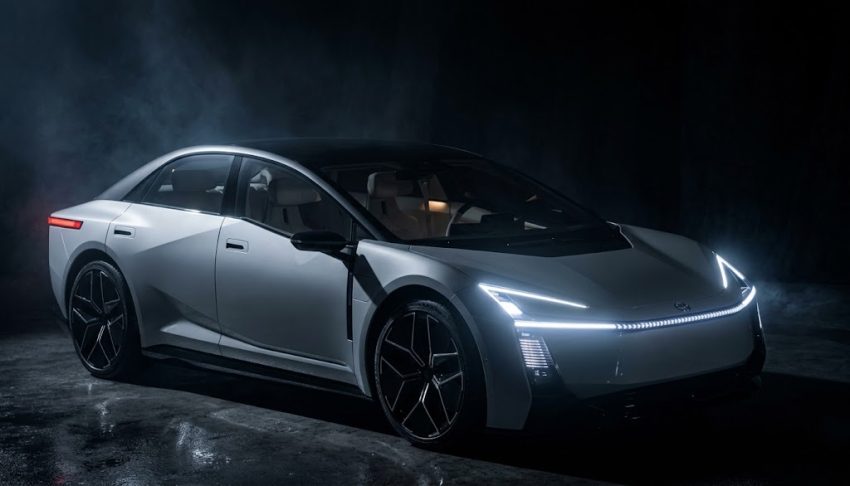
The next Corolla may also be almost unrecognizable from the outside. Toyota’s Corolla Concept at the 2025 Japan Mobility Show gave the clearest indication yet of the design direction being explored. The concept looked lower, sharper and considerably more futuristic than today’s Corolla.
Possible design elements include an aggressively sloped windshield, narrow lighting units, sharper bodywork, a more aerodynamic silhouette and a front end with less emphasis on the traditional grille. A full-width lighting treatment could also feature prominently. There has even been speculation about frameless-style windows and a liftback-like profile.
The production model is unlikely to copy every detail of the concept, but Toyota’s message was difficult to miss: the next Corolla could be far more visually dramatic than its predecessor.
The exterior isn’t expected to be the only major transformation. Inside, the next Corolla is reportedly heading toward a much more modern cabin, with larger screens, updated digital interfaces and fewer traditional controls. Corolla Concept featured unusual controls and a distinctive shifter arrangement, although concept-car features should never be assumed to carry directly into production.
Toyota is nevertheless expected to focus heavily on technology while preserving the practical cabin and cargo space that have traditionally defined the Corolla.
Corolla EV Cost
Despite all the new technology, Toyota is reportedly not expected to push the Corolla dramatically upmarket. Current models begin around $25,000, while hybrid versions start somewhat higher.
Early projections for the next generation have suggested approximate pricing around:
| Version | Estimated U.S. Price |
|---|---|
| Gasoline | ~$25,000 |
| Hybrid | ~$27,000 |
| PHEV | ~$30,000+ |
| BEV | ~$30,000+ |
Honda HR-V e:HEV, Toyota Corolla Cross New Prices in Pakistan after GST Cut