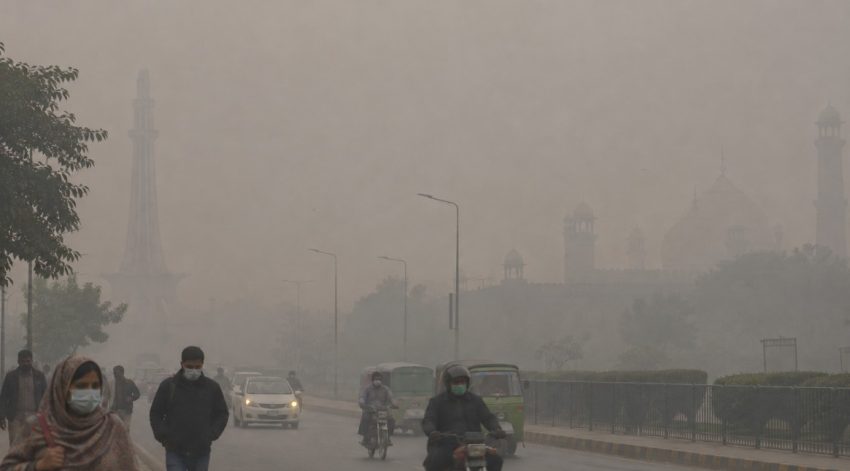
LAHORE – A thick blanket of toxic smog tightened its grip on Punjab capital Lahore, pushing the metropolis to top of the world’s most polluted major cities as air quality deteriorated to hazardous levels on November 1, raising serious health concerns for millions of residents.
The country’s second most populated city recorded alarming Air Quality Index (AQI) of 420 in the global rankings issued by IQAir, making it the most polluted major city in the world. The situation appeared even more alarming in Punjab government’s monitoring data, which showed the city’s AQI soaring to 478 at 7 am.
Lahore Tops Global Pollution Rankings
According to IQAir’s fresh data, Lahore holds first position among the world’s most polluted major cities, leaving other major urban centres far behind. Uzbekistan’s capital, Tashkent, ranked second with an AQI of 196, while Pakistan’s largest city, Karachi, secured third position with a reading of 170. Bangladesh’s capital, Dhaka, stood fourth with an AQI of 166, followed by India’s New Delhi in fifth place at 156.
World’s Most Polluted Major Cities today
| Rank | City | AQI |
|---|---|---|
| 1 | Lahore | 420 |
| 2 | Tashkent | 196 |
| 3 | Karachi | 170 |
| 4 | Dhaka | 166 |
| 5 | New Delhi | 156 |
While Lahore dominated the global ranking of major cities, Gujranwala emerged as Punjab’s worst-affected city in provincial monitoring data. According to the Punjab government’s Air Quality Index report, Gujranwala recorded an AQI of 500 on Sunday morning, followed by Lahore at 478 and Sheikhupura at 336.
Nankana Sahib registered 326, Dera Ghazi Khan 317, Hafizabad 312, Jhang 297 and Khushab 273.
Punjab’s Most Polluted Cities
| Rank | City | AQI |
|---|---|---|
| 1 | Gujranwala | 500 |
| 2 | Lahore | 478 |
| 3 | Sheikhupura | 336 |
| 4 | Nankana Sahib | 326 |
| 5 | Dera Ghazi Khan | 317 |
| 6 | Hafizabad | 312 |
| 7 | Jhang | 297 |
| 8 | Khushab | 273 |
Smog Emergency
The situation turned particularly dangerous in several parts of Lahore, where monitoring stations recorded AQI readings of 500. Barki Road, Shahdara, Kahna Nau, Multan Road, Punjab University, GT Road, Gulberg III, Wagah Border and Egerton Road were among the worst-affected locations.
At such extreme levels, air pollution poses serious health risks even to healthy individuals, while children, elderly people, pregnant women and patients with asthma or heart diseases face greater vulnerability.
An AQI above 300 falls within the hazardous category, meaning exposure can affect the entire population. Health experts generally recommend avoiding outdoor exercise, limiting unnecessary exposure and using well-fitting protective masks when going outside.
Weather observations from November 1 revealed conditions that may have contributed to the accumulation of pollutants across Lahore.
At 7 am, the city’s temperature was recorded at 19 degrees Celsius, while relative humidity remained high at 84 percent.
Wind speed was measured at just 0.3 metres per second, with winds blowing from the south. Solar radiation stood at 13 watts per square metre.
The near-stagnant wind conditions can make it difficult for pollutants to disperse, allowing harmful particles to remain concentrated near ground level. High humidity can also contribute to haze and reduced visibility, although the severity of pollution depends on several additional factors, including vehicle emissions, industrial activity, dust, burning practices and atmospheric conditions.
Exposure to such polluted air can trigger coughing, throat irritation, breathing difficulties and worsening respiratory illnesses. Prolonged exposure to fine particulate matter is also associated with cardiovascular and lung diseases.