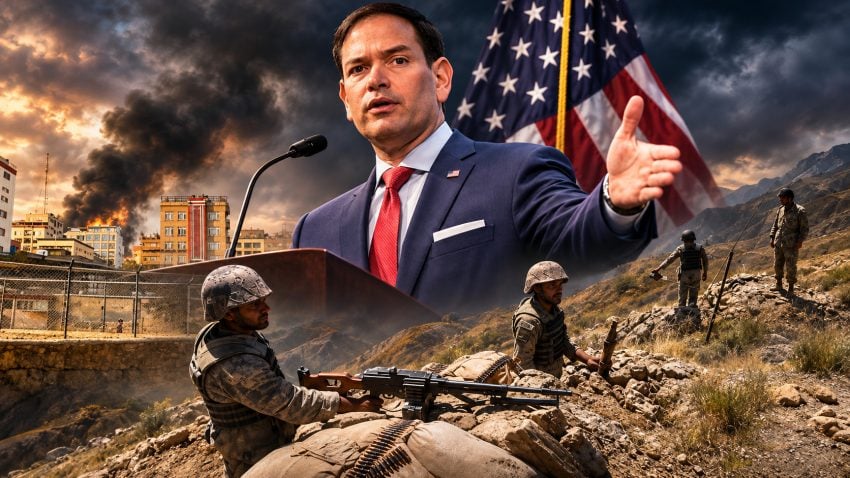
WASHINGTON – Pakistan’s longstanding warnings about terrorism originating from Afghanistan get international attention, as US Secretary of State Marco Rubio openly acknowledged Islamabad’s security concerns, questioned the Afghan Taliban’s efforts to curb militant attacks,
Rubio signalled Washington’s willingness to help ease escalating tensions between Islamabad and Kabul. Amid growing Pakistan-Afghanistan hostilities, Rubio said US was aware of terrorist attacks linked to Afghan territory and understood Pakistan’s concerns about the Taliban administration’s failure to effectively contain the threat.
In his recent presser on the sidelines of G20 meetings, United States Secretary of State made it clear that Washington did not want Pakistan to remain a target of terrorism and was prepared to play a constructive role if an opportunity emerged.
His remarks are important for Islamabad, which repeatedly demanded that Kabul dismantle militant networks allegedly operating from Afghan soil and prevent its territory from being used to launch attacks against Pakistani civilians and security forces.
Addressing increasingly volatile situation along Pakistan-Afghanistan border, Rubio acknowledged that Islamabad had raised serious concerns over terrorist activities originating across the frontier. He said Pakistan believed Taliban failed to take adequate steps to prevent these attacks and had consequently undertaken military action.
US secretary of state further acknowledged that Washington had witnessed some of the terrorist incidents highlighted by Pakistani authorities. He stessed that US opposed terrorism regardless of its source or intended target, reinforcing Washington’s broader commitment to counterterrorism.
With relations between Islamabad and Kabul deteriorating, Rubio indicated that the United States could become involved in efforts to reduce tensions if it could make a meaningful contribution. He also acknowledged the limitations of Washington’s relationship with Afghanistan’s Taliban rulers, noting that the United States does not maintain particularly close ties with the administration in Kabul.
United States has not formally recognised the Taliban government since the group’s return to power in August 2021. Nevertheless, Rubio’s willingness to consider a productive role has introduced a possible diplomatic opening as Pakistan continues to demand concrete action against terrorist organisations operating from Afghanistan.
Pakistan repeatedly warned the international community about the devastating human cost of militancy linked to Afghanistan. More than 4,700 Pakistanis lost their lives in couple of years in terrorist violence that originated from Afghan territory.
Pakistani authorities consistently identified banned Tehreek-e-Taliban Pakistan (TTP) and affiliated militant outfits as major threats to national security. Islamabad maintains that these organisations exploit alleged sanctuaries across the border to plan attacks, recruit militants and carry out deadly operations against Pakistan.
Lately, Islamabad delivered another forceful response to Kabul over its handling of cross-border militancy. Afghan Taliban spokesperson Zabihullah Mujahid accused Pakistan of being unwilling to resolve the dispute through negotiations and claimed that Kabul’s diplomatic efforts had not succeeded.
Pakistan’s Ministry of Information and Broadcasting strongly rejected those allegations, accusing the Taliban leadership of attempting to shift responsibility away from the central issue of terrorism. The ministry stressed that protecting Pakistani citizens remained an absolute national priority and that Islamabad would not tolerate militant sanctuaries threatening its security.
The diplomatic confrontation follows a series of dangerous security incidents along the Pakistan-Afghanistan frontier throughout October 2026. Border areas including Angoor Adda in South Waziristan and parts of Kurram witnessed exchanges of gunfire and retaliatory military actions.
Pakistan again pounds Afghan Taliban Posts after Civilians come under fire in Angoor Adda sector